

Specifying a decorative element like a disco ball for a commercial project isn’t just about aesthetics—it’s a technical procurement challenge. A missing detail in the submittal package, like the core material or a load-rated rigging point, can trigger costly RFIs, delay approvals, and stall your entire construction schedule.

This guide details the exact specifications architects and spec writers need to include in a tender to ensure a compliant, safe, and timely installation. We’ll cover the critical technical data—from core material choices that affect a 1000mm ball’s weight by 5+ kilograms to the engineering drawings that must meet ASME Y14.5 standards—and explain how to integrate these elements with lighting, HVAC, and sustainability requirements like LEED’s LRV thresholds.
What Architects Need for a Successful Submittal
A successful submittal package confirms that proposed products and methods comply with contract documents. It includes shop drawings, product data, samples, test reports, and certifications. Architects review this package for design alignment, system coordination, and code compliance before issuing a formal approval.

| Document Type | Purpose | Key Details |
|---|---|---|
| Shop Drawings | Authorize fabrication and installation | Detailed dimensions, connections, materials, assembly sequences |
| Product Data Sheets | Verify product specifications | Model numbers, dimensions, materials, finishes, performance characteristics |
| Test Reports | Confirm material performance | Laboratory results verifying properties against standards (e.g., concrete mix designs) |
| Samples | Aesthetic and quality verification | Physical specimens (brick, paint, flooring) labeled with project references |
| Transmittal Form | Administrative tracking and routing | Project ID, unique submittal number, spec section, responsible parties |
Core Components of a Submittal Package
A complete submittal package is a collection of technical documents and physical items that prove the contractor’s proposed materials and methods meet the project’s requirements. The core components provide the architect with everything needed to verify compliance.
Shop drawings are detailed fabrication and installation diagrams. They show exact dimensions, connection details, material specifications, and the sequence of assembly. Approval of these drawings authorizes the contractor to begin manufacturing and installing the components.
Product data sheets from the manufacturer provide the technical specifications for each item. These sheets list model numbers, dimensions, material composition, available finishes, and performance data like load capacities or thermal ratings.
Physical samples, such as bricks, paint swatches, or flooring tiles, allow for visual and tactile verification of color, texture, and quality. Each sample must be clearly labeled with the project name and specification section.
Test reports from independent laboratories confirm that materials perform as required. For example, a report might verify the compressive strength of concrete or the fire rating of an assembly. Manufacturer certificates attest that the products meet specific building codes and have necessary third-party approvals.
Warranty documents guarantee materials and workmanship for a specified period. The package is formally submitted using a transmittal form, which acts as a cover sheet. It includes the project identification, a unique submittal number, the relevant specification section, and a list of all responsible parties for tracking.
The Architect’s Review and Approval Process
The architect’s review is a systematic evaluation to ensure the proposed work aligns with the project’s design and technical requirements. The process begins with the contractor performing a pre-submission audit, marking exact matches between the submittal items and the specification requirements to check for completeness and accuracy.
The architect first checks for alignment with the design intent. This includes verifying that aesthetic finishes like paint colors or stone textures match the samples originally selected, and that functional capacities meet the project’s needs.
Next is coordination review. The architect ensures the proposed item will fit and function correctly with adjacent building systems, such as structural supports, mechanical ducts, electrical conduits, and plumbing lines. Clashes or interferences must be resolved before approval.
A critical step is verifying compliance with all applicable building codes, zoning regulations, and referenced standards like those from ASTM or ISO. The product data, test reports, and certificates are scrutinized for this compliance.
If the project specifications are unclear or ambiguous, the contractor must submit a formal Request for Information (RFI) to get clarification before a compliant submittal can be prepared. This prevents submissions based on incorrect assumptions.
Upon completion of the review, the architect issues a formal response. Common responses are “Approved,” “Approved as Noted” (with minor comments), “Revise and Resubmit” (for significant changes), or “Rejected.” The approval of shop drawings is the official authorization for the contractor to proceed with fabrication and installation.
Technical Specs: Weight, Diameter, and Core Material
For architectural-grade mirrored components, key specifications include the overall diameter and weight for structural and aesthetic planning, and the core material—typically a high-density substrate like MDF or acrylic—which dictates durability, mounting compatibility, and finish quality. These specs are foundational for load calculations, system integration, and achieving the desired visual impact.

| Specification | Typical Range / Example | Primary Influence |
|---|---|---|
| Diameter | 100 mm (4″) to 2000 mm (79″)+ | Visual scale, installation clearance |
| Weight (e.g., 1000mm ball) | ~15-20 kg (MDF core), lighter (acrylic core) | Structural load, rigging requirements |
| Core Material | High-density MDF, Acrylic, Aluminum Composite | Durability, moisture resistance, finish quality |
Defining Core Specifications for Load and Integration
The overall diameter of a mirrored element is a primary aesthetic and functional driver. It determines the visual scale of the installation and dictates the necessary clearance for mounting, movement in kinetic applications, and integration within the architectural space.
Total weight is a critical parameter for structural engineering. It directly informs the load calculations for support structures, rigging points, and motor specifications, particularly for ceiling-hung installations or those designed to move.
The choice of core material governs the fundamental performance characteristics. A high-density MDF core offers a stable, heavy substrate ideal for a flawless mirrored finish but requires careful moisture management. An acrylic core is significantly lighter and offers inherent moisture resistance, simplifying installation in certain environments, while aluminum composite panels provide a balance of lightness and rigidity.
Standard Dimensions and Material Data for Specification
For project submittals and drawings, standard dimensions provide a reliable starting point. Mirror balls and discs for architectural features commonly range from 100 mm (4 inches) for detailed accents to 2000 mm (79 inches) or larger for statement installations in atriums or large-scale art.
Weight correlates directly with size and core material density. As a reference, a 1000 mm (39-inch) diameter sphere with a standard MDF core may weigh approximately 15 to 20 kilograms. An equivalent piece with an acrylic core would be notably lighter, affecting handling and support requirements.
Core material data sheets should be consulted for precise specification. Key properties include substrate density (e.g., ~700-800 kg/m³ for quality MDF), thermal expansion coefficients, and surface preparation standards. A properly prepared, stable substrate is non-negotiable for ensuring the adhesion and long-term durability of the mirror finish.
Rigging Points and Engineering Drawings
Rigging points require detailed engineering drawings that specify precise load capacities, which vary by venue and truss type, from 250 lbs per point on panel trusses to 2,000 lbs on column-to-column beams. Submittals must include DWG files with a (0,0) origin, labeled points, trim heights, and adhere to ASME Y14.5 standards for dimensioning and line weights to ensure safe fabrication and installation.

Load Capacities and Venue-Specific Requirements
The structural load limits for rigging points are not universal; they are dictated by the specific installation environment and the type of structural support. Panel truss rigging points, often used in a bridled configuration, typically have a load limit of 250 lbs per point.
Ballroom installations generally require a higher capacity, with a common standard of 1,000 lbs per rigging point. In larger venues like North 100 & 200 halls, loads can increase significantly, reaching up to 1,600 lbs per point or 2,000 lbs for every other point on a single beam.
For systems like arch pairs, there is a critical system-wide limit, such as 4,000 lbs, which is especially important for managing unbalanced loads across a structure like a north-south shed. Venues enforce these limits to maintain structural integrity and typically require client sign-off on detailed motor and weight matrices before any installation proceeds.
Drawing Standards and Submission Protocols
Engineering drawings for rigging must be submitted in DWG file format. They must be accurately scaled with a clearly defined (0,0) origin point and every rigging point must be explicitly labeled. Essential data on these drawings includes the maximum weight per point (in pounds, inclusive of motor and chain weight), trim heights, quantities of flown items, and power requirements.
Technical formatting is governed by strict standards. Line widths must follow specific conventions: 0.25mm for dimensions and hidden lines, 0.35mm for objects and text, 0.50mm for cut lines, and 0.70mm for title block borders. All drawings must comply with ASME Y14.5-2018 standards for geometric dimensioning and tolerancing (GD&T) and use Third Angle Projection.
A List of Material (L/M) should use a single item number per material specification across different sizes and employ ‘A/R’ (as-required) for variable quantities. For larger D/E-size drawings, mandatory zoning into 8.5×11 inch areas with alphanumeric identifiers is required for clarity and precise reference.
Complete drawing packages, including rigging plots that are fully aligned with physical load calculations, should be submitted for review at least 14 days before the scheduled load-in date to allow for proper verification and approval.
Source Commercial-Grade Mirror Balls, Not Party Favors

Light Reflectivity (LRV) Data for LEED/Energy Codes
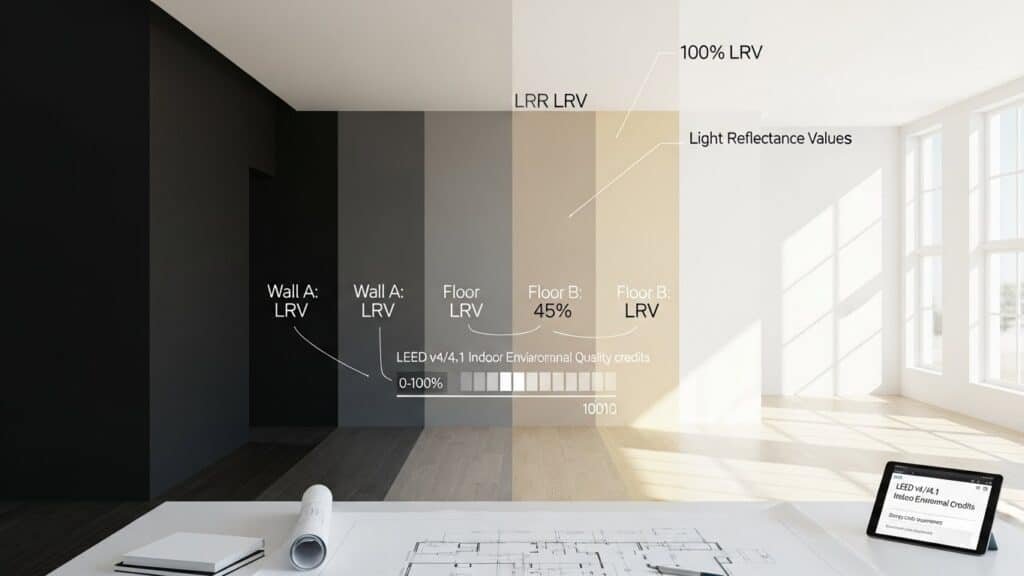
Light Reflectance Value (LRV) measures the percentage of visible light a surface reflects, from 0% (black) to 100% (white). For architects, this data is essential for meeting LEED v4/v4.1 Indoor Environmental Quality credits and energy code requirements, which set specific LRV thresholds for ceilings, walls, and floors to optimize daylighting and reduce artificial lighting energy use.
Understanding LRV and Its Role in Sustainable Design
LRV quantifies the percentage of visible light a material reflects, directly influencing a space’s brightness and perceived daylight. High-LRV surfaces are a passive design strategy, reducing the need for artificial lighting and improving energy efficiency.
LEED v4/v4.1 awards credits for interior lighting based on achieving minimum surface reflectance targets for ceilings, walls, and furniture. The Green Squared® certification for tile includes an elective LRV criterion, aligning material selection with broader sustainability goals. It’s important to note that LRV is distinct from Solar Reflectance Index (SRI), which is used for exterior surfaces like roofs to mitigate heat islands.
Key Compliance Thresholds and Testing Standards
For LEED IEQ credits, common targets are ≥80% LRV for ceilings and ≥55% for walls to enhance light distribution. LEED v4 Lighting Quality (Option 2) sets higher benchmarks: ≥85% for ceilings, ≥60% for walls, and ≥25% for floors on an area-weighted average. Furniture and finishes have separate targets, such as ≥45% LRV for work surfaces and ≥50% for movable partitions.
Tile is tested for LRV per the ASTM C609 standard, a definitive method for ceramic tile reflectance measurement. For example, light beige or grey tiles often have an LRV around 60%, while white tiles can exceed 85%, making them ideal for high-performance ceilings.
Sample Ordering Processes for Project Boards
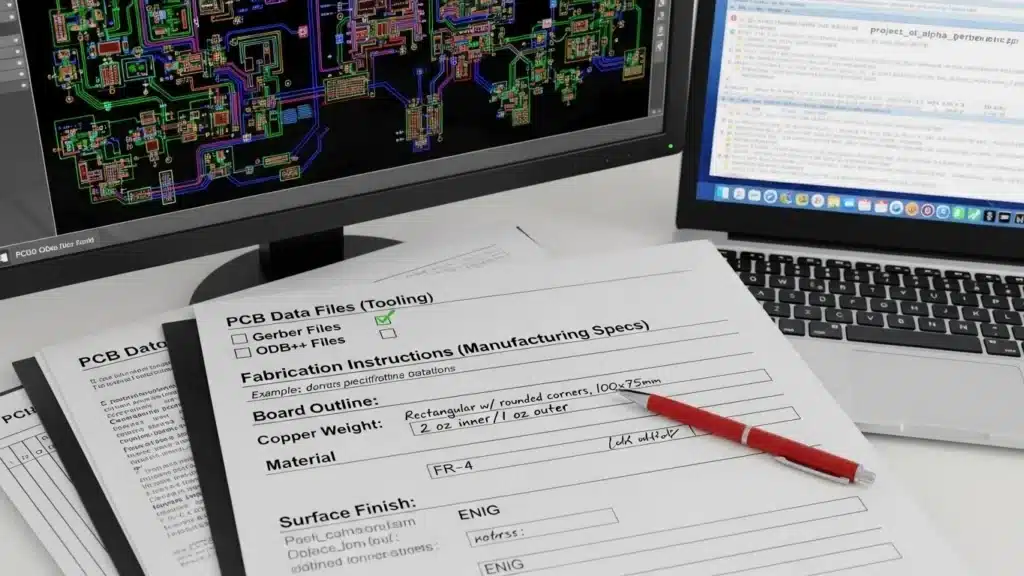
Ordering a project board requires submitting a complete dataset split into two parts: the PCB data files for tooling and the fabrication instructions for manufacturing specs. This includes Gerber or ODB++ files for the layout, plus detailed instructions on board outline, copper weight, material, and finish to ensure production can begin without delays for clarification.
The Required Dataset for PCB Fabrication
To enable manufacturing, you must provide two core components: the digital tooling files and the physical fabrication instructions.
Submit Printed Circuit Board Data in formats like Gerber RS-274X, ODB++ (.tgz), or IPC-2581 for layer stack-up and drill information.
Provide separate Fabrication Instructions detailing board outline dimensions, copper weight per layer, material type (e.g., FR-4), surface finish, and solder mask color.
Include a 1:1 scale board outline with tolerances and X/Y coordinates for all holes and slots to ensure precise routing and drill placement.
Supporting Documentation and Design for Manufacturing
Additional specifications and reports are needed to support fabrication, ensure manufacturability, and align with assembly requirements.
Attach a complete Bill of Materials (BOM) with component part numbers, quantities, and approved manufacturer lists for assembly.
Specify design rules including minimum trace width and spacing, controlled impedance requirements, and notes for high-speed or RF designs.
Include depaneling method details, such as tab-routed locations requiring a minimum 0.020-inch copper clearance from the board edge to prevent defects.
Integrating with Lighting & HVAC Systems
Networked lighting controls use sensors embedded in LED fixtures to share real-time occupancy and daylight data with HVAC systems. This integration allows for demand-based adjustments like ventilation resets, leading to up to 30% HVAC energy savings and ensuring compliance with standards like ASHRAE 90.1 through protocols like BACnet/IP.

How Integration Works and Its Core Benefits
Networked Lighting Controls (NLC) with Luminaire-Level Lighting Controls (LLLC) embed occupancy and daylight sensors in each LED fixture. These sensors provide granular, real-time data on space usage, which is shared with the Building Automation System (BAS) via protocols like BACnet/IP.
The HVAC system uses this data for demand-based control, such as implementing ventilation setbacks or temperature resets in unoccupied zones. This coordination can achieve up to 30% savings on HVAC energy consumption and contributes to a total building energy reduction of 20-26%.
Integration is specified under CSI Division 25 – Integrated Automation, requiring clear documentation of interoperability, IP addressing, and data point lists.
Technical Specifications and Project Requirements
Specify BACnet/IP as the primary interoperability protocol to meet Division 25 requirements and ensure communication between NLC and HVAC systems. Require point lists for monitoring and control, including dimming levels, occupancy status, and daylight sensor readings from each fixture.
Design for a Lighting Power Density (LPD) reduction, from a typical 1.07-1.46 W/ft² to an integrated target of 0.43-0.53 W/ft². Select LED fixtures with high efficacy (e.g., 166 lm/W) and embedded controls to maximize lighting energy savings, which can reach 60%.
Commissioning protocols must verify data accuracy and system interoperability before deployment, avoiding partial integrations or vendor licensing conflicts. Include network diagrams and quality control measures aligned with ASHRAE 90.1 to support aggregated energy reporting and demand response capabilities.
Managing Lead Times in the Construction Cycle
Effective lead time management starts by identifying long-lead items requiring 4 weeks or more for procurement. These items are tracked in project schedules using key dates—Install, Required On Job (ROJ), and Order—with statuses from Not Ordered to Delivered. Integrating this data into tools like Gantt charts allows for automatic schedule adjustments and risk mitigation, ensuring procurement aligns with the construction sequence.

Identifying and Scheduling Long-Lead Items
Any material with a procurement lead time of 4 weeks or more is flagged as a long-lead item for direct schedule tracking.
Three key dates are managed: the scheduled Install date, the Required On Job (ROJ) date to avoid delays, and the latest possible Order date to meet the ROJ.
Lead times are entered into scheduling software in a standardized format (e.g., 0m 2w 0d) for precise calculation and automatic date adjustment.
Order statuses—Not Ordered, Ordered, Delayed, Delivered—are tracked to provide real-time visibility into procurement progress and flag risks.
Mitigating Risk with CPM, PERT, and Proactive Planning
The Critical Path Method (CPM) identifies the sequence of tasks with zero float; delays to any task on this path directly impact the overall project completion date.
PERT analysis uses a weighted formula—(Optimistic + 4*Most Likely + Pessimistic) / 6—to calculate probabilistic task durations, building realistic buffers into the schedule.
Proactive strategies include creating contingency paths for volatile supply chains, integrating predictive data from key suppliers, and clarifying OFCI vs. CFCI responsibilities early to prevent scope delays.
Final Thoughts
Specifying a disco ball or any decorative architectural element requires the same technical rigor as any other building component. The process hinges on providing complete, accurate data. From the core material and weight for structural calculations to the precise LRV for energy compliance, every specification must be documented and verifiable. Successful integration depends on clear engineering drawings for rigging, coordination with MEP systems, and a realistic schedule that accounts for procurement lead times.
The goal is to transform a creative vision into a buildable, code-compliant, and safe installation. This is achieved through a meticulous submittal process. By preparing comprehensive packages with shop drawings, product data, samples, and test reports, architects and contractors create a clear roadmap. This documentation ensures the final installation not only looks spectacular but functions reliably within the larger building system for years to come.
Frequently Asked Questions
How do I specify a mirror ball in a project bid?
Include the diameter (e.g., 16″, 18″, 30″, 40″), core material (polyfoam or plastic), mirror tile size (0.4″ to 0.75″ glass or 10x10mm facets), and weight (from 6.94 lbs for a 16″ ball to 82 lbs for a 40″ ball). Specify motor compatibility for loads up to 89 lbs and required safety features like an integrated axle, security ring, and load-rated safety eyelets with chain or cable mounting.
Are CAD files available for disco balls?
Yes, CAD files are widely available from third-party model libraries and repositories. You can find models in common formats like DWG, OBJ, FBX, STEP, and SketchUp, including low-poly game-ready models with specific dimensions for accurate project integration.
Where can I find material data sheets for glass mirror balls?
Material data typically details high-quality glass mirror tiles ranging from 10mm x 10mm to 20mm in size, mounted on styrofoam or plastic cores. Specifications cover the full size range from 2″ to 40″ in diameter, with corresponding weights that scale with the size of the ball.
How can decorative elements be integrated with HVAC systems?
Integration involves using custom-designed grilles, registers, and finished ductwork that match the interior decor. Industry standards like CSI Division 25 for Integrated Automation help coordinate these systems with building controls, ensuring compatibility through established protocols and wiring standards for a cohesive design.
What is the submittal process for commercial decor items?
The process requires subcontractors to submit detailed shop drawings, product data sheets, material samples, and often a full-scale mockup for review. These documents are reviewed by the general contractor and the design team for compliance with project specifications before final approval for fabrication and installation is granted.
Can reflective materials contribute to LEED certification?
Yes, reflective materials can contribute to LEED credits under the Heat Island Reduction category. Credits are earned by meeting minimum Solar Reflectance Index (SRI) values for roofs—such as 82 for low-sloped roofs—or Solar Reflectance (SR) values for paving and other hardscape materials, helping to reduce heat absorption.
SEO
Title: Architectural Submittals: How to Specify Disco Balls in Tenders
Description: Architects and spec writers need technical specs for disco balls, including core material, weight, rigging points, and LEED LRV data for compliant submittals.
URL: architectural-disco-ball-specifications-guide
Keywords: architectural disco ball specifications