

Choosing hardware for B2B decor isn’t just about aesthetics; it’s a critical safety and compliance decision. Using decorative hardware that lacks a permanently stamped Working Load Limit (WLL) violates OSHA regulations, exposes your business to liability and fines, and risks catastrophic failure from overloading.
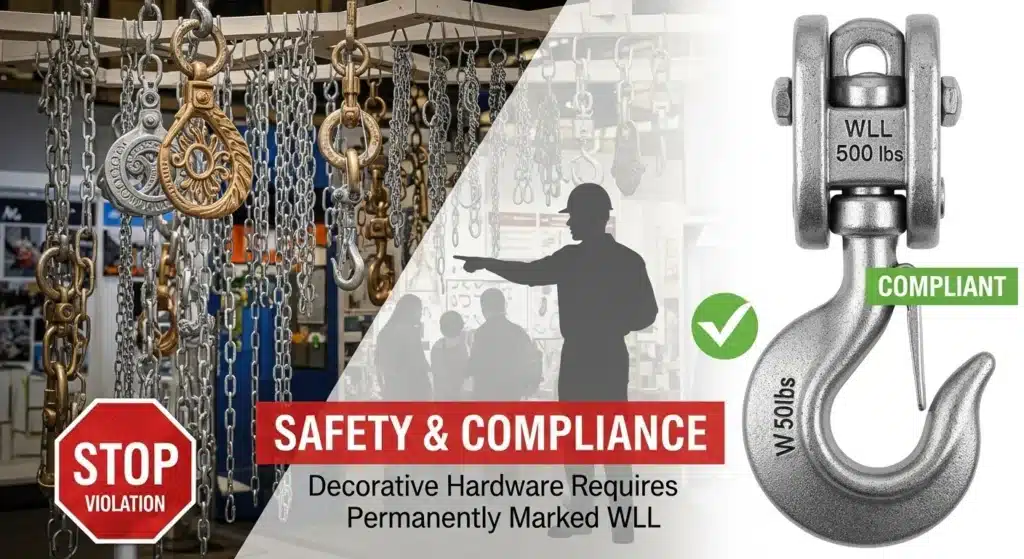
This guide cuts through the confusion, explaining why hardware standards like WLL are non-negotiable. We’ll cover the key differences between Grade 30 and Grade 80 chains, where a 1/2″ chain’s WLL jumps from 4,500 to 12,000 lbs. We’ll also detail why locking carabiners are mandatory for overhead use and how sling angles drastically affect capacity—a leg at 30 degrees bears roughly 40% more load than one at 60 degrees.
The Danger of “Decorative” Hardware
Decorative hardware lacks the mandatory Working Load Limit (WLL) markings required by OSHA for all rigging gear. Using it risks catastrophic failure from overloading, leads to significant OSHA fines, and creates liability for businesses. All load-bearing hardware must be permanently stamped with its WLL and inspected regularly to ensure safety.

The Critical Role of WLL Markings and Compliance
OSHA regulation 1910.184 is clear: all rigging hardware—shackles, hooks, slings—must be permanently marked with its Working Load Limit (WLL) and size. Any gear without these markings or with illegible stamps must be taken out of service immediately. Decorative hardware typically lacks this critical, forged-in-place identification, making it non-compliant from the start.
Using unmarked hardware is legally equivalent to operating with unsafe equipment. It exposes a business to direct liability in the event of an accident and opens the door to substantial OSHA fines during an inspection. For procurement teams, the verification step is non-negotiable. They must check for permanent stamps on the body or pin of the hardware; faded paper tags or missing stamps are major red flags that the item is unsuitable for any load-bearing task.
Engineering Standards and the Physics of Failure
Functional hardware is engineered to rigorous standards. For architectural components, the ANSI/BHMA A156 series grades hardware on operational cycles, strength, and security. For rigging, the ASME B30 series mandates periodic inspections—at least every 12 months, and more frequently in severe conditions—to ensure ongoing structural integrity. Decorative pieces are not subject to this certification process.
The absence of a known WLL creates a dangerous guessing game. Crews cannot accurately assess a component’s capacity in different configurations, such as a vertical lift versus a choker hitch. This can lead to accidental overloading, initiating stress fractures and potential structural collapse. The physics are unforgiving: a load exceeding an unknown limit will fail.
In life-safety applications like fire-rated doors, the requirements are even stricter. Hardware must pass tests like UL10C or EN1634-1, which simulate real-fire conditions with positive pressure and hose stream tests. Decorative hardware often fails these ancillary performance requirements for post-fire operability, rendering it completely unsafe for its intended critical role.
Stamped WLL (Working Load Limit) Explained
A stamped WLL is the manufacturer-assigned maximum safe load for hardware like chains or shackles. It’s calculated by dividing the item’s minimum breaking strength by a safety factor, typically 3:1 to 7:1, to account for real-world stresses. This stamped value is the legal and safe limit you must follow.
| Chain Grade & Diameter | Sling Angle | Working Load Limit (WLL) |
|---|---|---|
| Grade 100, 9/32″ (Double Leg) | 60° | 7,400 lbs |
| Grade 100, 3/8″ (Double Leg) | 45° | 12,400 lbs |
| Grade 100, 1/2″ (Double Leg) | 30° | 15,000 lbs |

What Stamped WLL Means and How It’s Calculated
The Working Load Limit is the maximum load a component can safely handle in normal service. It is not the breaking point. This value is a critical safety margin.
Manufacturers calculate WLL by dividing the hardware’s minimum breaking strength by a designated safety factor. This factor ranges from 3:1 to 7:1, depending on the application and industry standards. For example, a chain with a 24,000 lb breaking strength and a 3:1 safety factor has a WLL of 8,000 lbs.
In cargo securement, regulations require the aggregate WLL of all tiedowns to be at least half the weight of the cargo. Securing a 30,000 lb load, for instance, demands a total system WLL of at least 15,000 lbs.
International and federal standards, including ISO 17096:2015 and OSHA 1919.21, mandate clear, permanent WLL markings on hardware. This stamped information prevents overload and system failure by providing an unambiguous safe limit.
Applying WLL: Regulations, Angles, and Real-World Examples
Federal Motor Carrier Safety Regulation 49 CFR 393.108 is explicit: you must use the stamped WLL on the hardware itself. This manufacturer-assigned value overrides any generic load tables, and the lowest WLL in a system (tiedown, tensioner, anchor) governs the entire assembly.
Sling angle drastically affects effective WLL. As the angle between a sling leg and the load becomes shallower, the tension on each leg increases. A leg at a 30-degree angle bears roughly 40% more load than one at 60 degrees for the same vertical lift. This is why angle-specific WLL ratings are essential.
Chain grade and diameter are the primary scaling factors for WLL. Higher-grade chains (e.g., Grade 100, Grade 120) and larger diameters have proportionally higher WLLs. As shown in the table, a 1/2-inch Grade 100 double leg sling has a WLL of 15,000 lbs when configured at a 30-degree angle.
For rigging and lifting, WLL applies to “below-the-hook” accessories like slings and shackles. It has largely replaced the older term Safe Working Load (SWL). Full cranes are rated by Maximum Rated Capacity (MRC). Standards from ASME and OSHA enforce these markings to mitigate the risks of catastrophic failure.
Grade 30 vs. Grade 80 Chains for Aesthetics
Grade 30 chain is a low-carbon steel product with a basic zinc or galvanized finish, suitable for non-critical, visible applications like decorative installations or load securement. Grade 80 chain is a heat-treated alloy steel with a brighter, more durable galvanized or gold chromate finish, designed for safe overhead lifting where both strength and a professional appearance are required.
| Feature | Grade 30 Chain | Grade 80 Chain |
|---|---|---|
| Material | Low-carbon steel | Quenched & tempered alloy steel |
| Typical Finish | Standard zinc-plated or hot-dip galvanized (single-colored) | Bright galvanized or gold chromate |
| Primary Use | Non-lifting, decorative, load securement | Overhead lifting and critical rigging |
| WLL (1/2″ chain) | 4,500 lb | 12,000 lb |
| Aesthetic Role | Economical, general-purpose appearance | Professional, durable look for exposed applications |

Material and Finish: The Foundation of Form and Function
The visual and functional differences between Grade 30 and Grade 80 chain start with their core materials. Grade 30 is made from low-carbon steel and typically has a standard zinc-plated or hot-dip galvanized finish, resulting in a single-colored, economical appearance suitable for general-purpose or decorative roles.
Grade 80 is manufactured from quenched-and-tempered alloy steel, giving it a brighter galvanized or distinctive gold chromate finish that signals its high-strength, overhead-lifting capability. This finish is not just for looks; it’s part of the product’s identification.
The alloy composition and heat treatment of Grade 80 provide inherent toughness and wear resistance, meaning its finish is more durable and retains its professional look longer under stress compared to Grade 30.
Strength Data and Application Guidelines
The performance gap between the two grades is significant and dictates their safe use. For a 1/2-inch chain, Grade 30 has a Working Load Limit (WLL) of 4,500 lb, while Grade 80 offers a WLL of 12,000 lb—over 2.5 times stronger for the same nominal size.
Grade 80 chain meets NACM standards for overhead lifting, requiring a minimum elongation of 20% during proof testing to ensure ductility and prevent sudden failure. This combination of high strength and controlled stretch is critical for safety.
Grade 30 chain is appropriate for non-lifting applications like securing loads on a truck, tethering ground-based decor, or other visible installations where no dynamic overhead loads are present. Its aesthetic role is tied to these lower-risk scenarios.
Source the Unbreakable Standard. Direct from the Factory.

Why Locking Carabiners are Mandatory Overhead
Locking carabiners are mandatory for overhead applications because OSHA and ANSI standards prohibit non-locking types. These standards require connectors to withstand dynamic fall forces of at least 16 kN without failure. Non-locking gates can accidentally open due to vibration or angular loads, leading to catastrophic roll-out and equipment detachment during a fall.

The Regulatory Mandate and Physics of Failure
OSHA 1910.140 and ANSI Z359.12 explicitly require automatic locking carabiners for personal fall protection systems, banning non-locking or snap-hook types in these applications.
A dynamic fall generates multi-directional forces that can exceed 16 kN, which is the minimum proof-test load specified by standards.
Non-locking gates risk ‘roll-out,’ where the gate opens and the connector disengages from an anchor point under load, especially in choker-style connections or when subjected to vibration.
Engineering Specifications and Material Requirements
Certified carabiners must have a minimum breaking strength of 5,000 lbs (22 kN) along the major axis and 3,600 lbs (16 kN) for the gate in open, closed, and side-loaded directions.
Products like the 3M DBI-SALA or CMC ProSeries are proof-tested to 16 kN and are certified for NFPA General Use, meeting the rigorous demands of rescue and rigging.
Using recreational climbing carabiners for industrial overhead work violates standards like ASME B30.26, as they lack the necessary auto-locking mechanism and proven load ratings for static and dynamic forces.
Using Quick-Links and Bow Shackles Safely
Bow shackles and quick-links are high-strength steel connectors with a 6:1 safety factor, meaning their Minimum Breaking Load is six times the Working Load Limit. Safe use requires selecting the correct grade, inspecting for damage, and applying strict derating rules for sling angles and high temperatures to prevent catastrophic failure.

Core Safety Principles and Material Standards
The fundamental rule is the 6:1 safety factor. The Minimum Breaking Load (MBL) must be six times the Working Load Limit (WLL). This ensures a predictable safety margin under overload conditions.
These components are manufactured from high-tensile materials. Standard bow shackles use quenched and tempered grade 6 steel, while versions for corrosive environments are made from AISI 316 stainless steel. This material choice provides the necessary strength and durability.
Compliance with modern standards is non-negotiable. Key specifications include EN 13889 for forged steel shackles and DIN 82103 for screw pin types. These have superseded older standards like BS 3032. For offshore applications, standards such as DNV GL-ST-E271 and IMO/MSC Circular 860 apply.
Every piece of hardware must be permanently marked. Legible markings include the WLL, material grade (e.g., 6), a unique traceability code, and the manufacturer’s identification. Certifications like CE and material verification certificates (EN 10204 3.1) confirm compliance and allow for proper procurement and auditing.
Operational Limits and Mandatory Inspection Protocols
Load capacity is not fixed; it changes with the sling angle. When loaded inline, you can use 100% of the WLL. At a 45-degree angle, the capacity reduces to 70%. At 90 degrees, it drops to 50%. The absolute maximum angle between two slings attached to the bow of the shackle is 120 degrees.
High temperatures permanently reduce strength. Capacity remains at 100% up to 200°C. Between 200°C and 300°C, it derates to 90%. From 300°C to 400°C, it falls to 75%. Using any bow shackle or quick-link above 400°C is prohibited.
Correct installation is critical. Always use the manufacturer-matched securing pin, whether it’s a screw pin or a safety bolt. Position slings on the rounded bow of the shackle, not on the pin or the straight sides. The pin must face toward the hook to prevent unscrewing. Never allow the sling to make contact with the shackle’s eyes, as this induces dangerous side-loading on the pin.
A thorough pre-use inspection is mandatory. Check for clear, legible markings. Look for any signs of deformation, cracks, nicks, or excessive wear. Ensure the pin and body are a matched set and thread together smoothly. Any hardware found with a bent pin, evidence of welding, or significant damage must be immediately removed from service and destroyed.
Corrosion Resistance: Zinc vs. Stainless Steel
Stainless steel forms a self-healing chromium oxide layer, offering superior, long-term resistance to humidity, salt, and chemicals. Zinc provides a sacrificial coating that offers moderate, cost-effective protection but wears over time and fails in harsh conditions, exposing the underlying steel to rust.

How Corrosion Protection Works: Passive Films vs. Sacrificial Coatings
The fundamental difference in corrosion resistance lies in the protective mechanism. Stainless steel contains at least 10.5% chromium. This chromium reacts with oxygen in the air to form a thin, durable, and self-repairing chromium oxide passive film on the surface. If scratched, this layer reforms when exposed to oxygen, providing continuous protection.
Zinc protects steel through a sacrificial galvanic coating. The zinc layer corrodes preferentially, shielding the base metal until the coating is consumed or compromised. This process forms a zinc carbonate or oxide layer, which offers moderate protection.
The stainless steel passive film is highly resistant to a wide range of chemicals, humidity, and salt. In contrast, zinc’s protective layer breaks down more readily in acidic or saline environments, leading to a shorter lifespan in harsh conditions.
Performance Data and Application Guidelines
The choice between materials is dictated by their mechanical limits and environmental performance. Stainless steel grades like 304 and 316 (which contains molybdenum for enhanced resistance) maintain tensile strength from 400–800 MPa and perform reliably in marine and high-temperature settings, with melting points above 2500°F (1375°C).
Zinc-plated or galvanized steel has a tensile strength range of 150–380 MPa and a much lower melting point around 787°F (419°C), making it unsuitable for high-heat applications. Its impact strength is also significantly lower than stainless steel.
For long-term, safety-critical overhead rigging in humid or coastal areas, stainless steel is mandatory due to its consistent mechanical properties and durable passive film. Zinc-plated hardware is suitable only for indoor, light-duty, or short-term outdoor use where initial cost is a primary driver, acknowledging that it will require maintenance or replacement sooner in corrosive environments.
Inspecting Hardware for Stress Fractures
Inspecting for stress fractures involves classifying components as fracture-critical, using nondestructive evaluation (NDE) to find initial flaws, and applying fracture mechanics analysis. Standards like NASA-STD-5019 and ASTM E1820 define procedures for flaw screening, toughness testing, and proof testing to validate hardware integrity before use.

The Fracture Control Protocol: Classification and Initial Screening
The foundation of a fracture control program is the classification of hardware. Components are designated as fracture-critical if their failure could lead to loss of life or catastrophic system failure, a definition formalized in standards such as NASA-STD-5019.
Once classified, mandatory flaw screening begins. This involves nondestructive evaluation (NDE) methods to identify the initial size of any cracks or defects. The data from this inspection provides the critical starting point for all subsequent engineering analysis.
For critical infrastructure like bridges, inspection protocols are equally rigorous. Following FHWA guidelines, reports must document every crack, assign an AASHTO fatigue category to rate its severity, and measure any section loss in the member, with photographic evidence required.
Fracture Mechanics Analysis and Validation Testing
With initial flaw data in hand, fracture mechanics analysis predicts how cracks will behave under operational loads. Engineers use metrics like the critical stress intensity factor (Kc) and the Crack Tip Opening Angle (CTOA) to model crack growth and stability.
A material’s inherent resistance to crack propagation, or toughness, is quantified through standardized tests. ASTM E1820 and ISO 12135 specify methods using Compact Tension (CT) or Single Edge Notch Bend (SENB) specimens to generate J-R curves, which plot fracture resistance against crack extension.
The final validation step is often proof testing. This involves subjecting the hardware to loads significantly above its design limit—for example, pressurizing a vessel to 110-125% of its maximum operating pressure. Successfully passing this test provides empirical evidence that no critical, life-limiting flaws are present before the component enters service.
Final Thoughts
Choosing hardware for B2B decor isn’t just about aesthetics; it’s a critical safety and compliance decision. The stamped Working Load Limit (WLL) is the single most important identifier on any load-bearing component. It’s the manufacturer’s guarantee of safe capacity, backed by engineering standards and required by law. Using unmarked decorative hardware creates an unacceptable risk of failure, liability, and regulatory fines.
The right choice depends on the application’s demands. For visible, non-lifting decor, Grade 30 chain offers an economical look. For any overhead rigging or safety-critical installation, you need the certified strength of Grade 80 or 100 chain, locking carabiners, and properly rated shackles. In corrosive environments like coastal venues, 316 stainless steel is the only viable long-term option. Every piece must be inspected for clear markings and damage before use. By prioritizing rated, compliant hardware, you ensure installations are not only visually impressive but fundamentally safe and legally sound.
Frequently Asked Questions
What is the best chain for hanging disco balls?
Use a heavy-duty hanging chain rated for the disco ball’s weight, typically 5-10 lbs for standard 12-16 inch balls. For example, an 8-inch hanging chain is often bundled with 5 RPM battery-operated motors designed for mirror disco balls. The chain must be attached to a structurally sound ceiling beam to ensure a safe installation.
What does WLL mean on a carabiner?
WLL stands for Working Load Limit. It is the maximum safe load for normal use along the carabiner’s major axis with the gate closed. It is calculated by dividing the Minimum Breaking Strength (MBS) by a design factor, which typically ranges from 4:1 to 10:1 depending on the safety standard. For example, a steel carabiner with a 50 kN MBS and a 4:1 design factor would have a WLL of 12.5 kN.
Should I use locking or non-locking carabiners for decorative rigging?
Always use locking carabiners for decorative rigging. Their gate-locking mechanism provides security against accidental opening from vibration, wind, or contact. Non-locking carabiners rely solely on spring tension and are not suitable for unsupervised or static installations where a failure could compromise the entire system. For technical applications, locking carabiners must meet a minimum breaking strength, such as 27kN with the gate closed.
What is the weight limit of a 1/4 inch chain?
The working load limit for a 1/4-inch chain depends on its grade. For general-purpose Grade 30 proof coil chain, the WLL is approximately 1,250 lbs. For higher-strength applications like transport, Grade 70 chain can have a WLL of up to 3,150 lbs. Always verify the specific grade and manufacturer’s rating for your application.
Can I use quick links for disco ball rigging?
Yes, but they must meet specific technical requirements. For a standard 15-20 cm mirror ball, the quick link and chain should have a minimum working load limit of 20 kg and a diameter of 2.5mm. The quick link attaches to the installation eyelet of the disco ball and is secured with a fixation screw. For safety, the entire rigging system must be capable of supporting at least 12 times the weight of the installation, and the chain length must not exceed 100 cm.
Is stainless steel rigging suitable for coastal venues?
Yes, but you must select the correct grade. For coastal environments with salt spray, use 316 marine-grade stainless steel (AISI 316). This grade contains 2–3% molybdenum, which provides superior resistance to chloride-induced pitting and corrosion. Avoid using 304 grade stainless steel in these conditions, as it has a significantly reduced lifespan.