

Choosing the wrong ceiling anchor isn’t just an installation error; it’s a direct risk to safety, compliance, and project integrity. The correct choice hinges on two critical factors often overlooked: the specific density of your substrate and its age, which together determine the anchor’s true load-bearing capacity and long-term reliability.
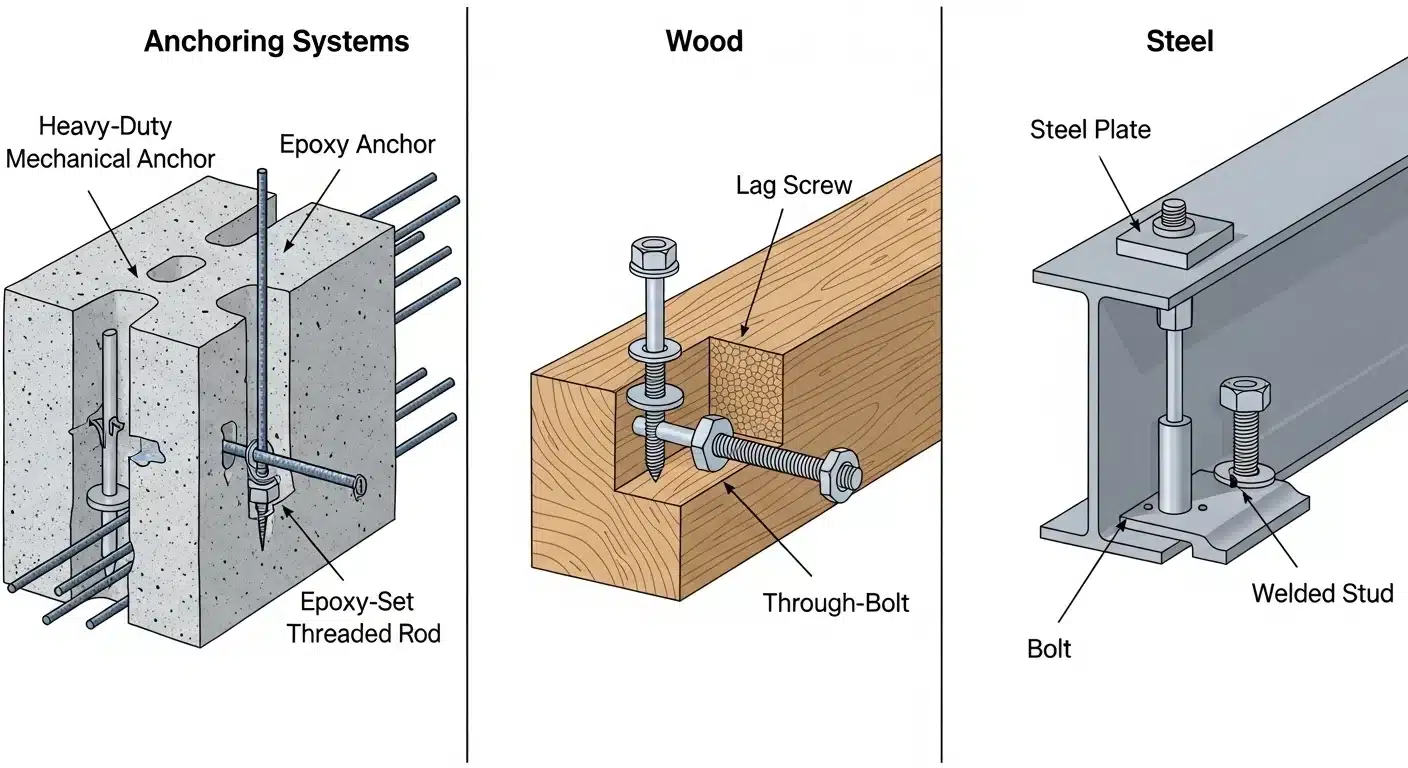
This guide provides a direct comparison of anchor systems for concrete, wood, and steel, detailing when to use wedge anchors, lag screws, or beam clamps. You’ll learn key specifications, such as how a half-inch anchor in 2,500 psi concrete can achieve nearly 5,000 lbs of pullout strength, and why anchors for aged structures may require materials like AISI 316 stainless steel to combat corrosion. We’ll also cover essential protocols for seismic zones, drop ceilings, and the pull-out testing required for commercial bids.
Assessing the Substrate: Material Density and Age
The load-bearing capacity and long-term safety of a ceiling anchor are fundamentally determined by the density and age of the substrate it’s installed into. Material density, measured as gauge for metals or compressive strength for concrete, dictates the maximum safe load. The substrate’s age affects its structural integrity and corrosion resistance, requiring specific anchor materials for long-term performance.

Why Material Density is the First Checkpoint
The load-bearing capacity of any ceiling anchor is dictated by the substrate it’s installed into. Material density, measured as gauge/thickness for metals or compressive strength for concrete, determines the maximum safe load.
For example, standard half-inch drywall has a low-density gypsum core, limiting pullout capacity to between 10 and 238 pounds depending on the anchor type. In contrast, a steel roof requires a minimum of 24-gauge thickness to safely use a heavy-duty anchor like the 3M 4000, which has a 5,000-pound tensile breaking strength.
Concrete slabs are graded by compressive strength, typically 2,500 to 4,000 pounds per square inch (psi). A half-inch diameter anchor in 2,500 psi concrete can achieve a pullout strength of nearly 5,000 pounds, while a three-quarter-inch anchor in 4,000 psi concrete can exceed 23,000 pounds.
How Substrate Age Affects Anchor Performance and Safety
The age and condition of a building material directly impact its structural integrity and the long-term performance of installed anchors. New substrates generally allow for standard materials, but aged materials require specific considerations.
In older buildings, drywall and plaster can become brittle and lose holding power. For metal structures, age often correlates with corrosion, especially in humid environments, near coastal areas, or where chemically treated lumber is present.
To combat corrosion in aged or harsh environments, specify anchors made from hot-dipped galvanized steel with a zinc coating over 45 micrometers or from AISI 316 stainless steel. These materials meet standards like ASTM A153 and resist degradation from moisture and chemical exposure.
Key Standards and On-Site Assessment Protocols
Compliance with industry standards is non-negotiable for commercial safety. Anchors must be tested and certified to standards relevant to their application, including OSHA 29 CFR 1910.66 for fall protection, ANSI Z359.1, and ACI 355.2 for concrete anchors in seismic zones.
Before installation, a pre-assessment is critical. For metal decks, use a gauge checker to verify thickness. For concrete, review original construction documents or use a test hammer to estimate compressive strength. Always confirm the underlying structure can support a minimum 5:1 safety factor relative to the intended load.
Facility managers should incorporate anchor and substrate inspections into annual maintenance routines, checking for signs of corrosion, cracking, or loosening that could compromise safety over time.
Wedge Anchors for Solid Concrete Installations
Wedge anchors are torque-controlled, expansion-type fasteners designed for reliable, permanent installations in solid, uncracked concrete. They are the go-to choice for structural supports, equipment mounting, railings, and machinery bases in commercial and industrial settings.
| Size | Minimum Embedment | Pull-Out (lbs) in 2000 psi Concrete |
|---|---|---|
| 1/4” | 1-1/8” | 877 |
| 5/16” | 1-1/8” | 892 |

What Are Wedge Anchors and When to Use Them
Wedge anchors are torque-controlled, expansion-type fasteners designed for reliable, permanent installations in solid, uncracked concrete.
They are the go-to choice for applications like structural supports, equipment mounting, railings, and machinery bases in commercial and industrial settings.
They are not suitable for use in hollow materials, cracked concrete, or masonry block. Their performance is specifically engineered for solid substrates.
Key Specifications and Load Capacity Data
Wedge anchors are available in diameters starting from 1/4″ and larger, with lengths determined by material thickness, minimum embedment depth, and nut/washer thickness.
Common materials include zinc-plated carbon steel for general use, hot-dipped galvanized for corrosion resistance, and stainless steel for harsh environments.
They require a concrete strength of at least 2000 psi at installation, with performance increasing in higher-strength concrete like 4000 or 6000 psi.
Step-by-Step Installation Guide for Solid Concrete
Drill a hole using a carbide-tipped masonry bit that matches the anchor diameter; the hole must be drilled 1/2″ deeper than the anchor’s minimum embedment depth to allow for dust.
Thoroughly clean the hole with a wire brush, vacuum, or compressed air to remove all debris, as this is critical for achieving full expansion and holding strength.
Insert the anchor with the clipped end first, hammer it in until about six threads remain below the surface, then wrench-tighten to the manufacturer’s specified torque value.
Toggle Bolts vs. Lag Screws for Wood Joists
Lag screws are the correct choice for wood joists; toggle bolts are not suitable for this application. Lag screws are heavy-duty wood fasteners designed for a direct structural attachment, while toggle bolts are engineered for hollow walls.

Lag Screws: The Correct Choice for Structural Wood Attachment
Lag screws, also called lag bolts, are heavy-duty wood fasteners designed specifically for gripping into solid wood like joists.
They provide maximum holding power, typically ranging from 200 to over 500 lbs per bolt, by creating a direct structural attachment.
Proper installation requires pre-drilling a pilot hole, with a 3/8-inch diameter being a common starting point for a standard 2×6 joist member.
Why Toggle Bolts Are Not Suitable for Wood Joists
Toggle bolts are engineered for hollow wall applications like drywall without studs or metal studs, where they expand behind a thin surface.
Their mechanism is ineffective for solid wood, as they cannot achieve the necessary grip and would not provide a secure, structural connection.
Using a toggle bolt in a wood joist is an incorrect application that compromises safety and load capacity.
Best Practices for Installing Lag Screws in Joists
Always use a washer under the head of the lag screw to distribute the load and prevent the head from pulling into the wood.
Ensure the pilot hole is the correct size for the screw’s shank and threads to maximize holding power without splitting the wood.
For critical overhead applications, consider consulting engineering specifications or performing a pull-out test to verify the installed capacity meets project requirements.
Source Commercial-Grade Mirror Balls, Direct from the Factory

Beam Clamps: Rigging to Steel I-Beams without Drilling
Beam clamps secure loads to steel I-beams by tightening a threaded bolt or setscrew onto the beam flange, creating a high-friction or mechanical interlock. This method eliminates drilling, welding, and hot work permits, preserving the beam’s protective coatings for quick, non-destructive installations.

How Beam Clamps Work and Their Core Advantages
Beam clamps secure loads by tightening a threaded bolt or setscrew directly onto the flange of a steel I-beam. This action creates a high-friction grip or a mechanical interlock with the beam surface.
The primary advantage of this system is that it completely avoids the need for drilling or welding. This preserves the beam’s structural integrity and its protective coatings, such as galvanization or fireproofing. It also means no hot work permits are required, significantly speeding up the planning and execution of rigging projects.
Other key benefits include rapid installation and removal, making beam clamps ideal for temporary setups, adjustable connections, or applications where future modifications are anticipated. Since there is no permanent alteration to the beam, the installation causes no structural damage.
Step-by-Step Installation and Safety Protocol
Begin by inspecting both the I-beam and the clamp for any signs of damage, wear, or corrosion. Check for compatibility and measure the beam’s flange thickness to ensure the clamp’s jaw opening range is appropriate for a secure fit.
Position the clamp so its mounting plate sits flush on the top of the I-beam flange. Tighten the fasteners—typically using a 17mm spanner—to the manufacturer’s specified torque value. It is critical to verify there is no movement between the clamp and the beam before considering the installation final and applying any load.
Safety is paramount. Always select clamps with a clearly marked Working Load Limit (WLL) and ensure they have an appropriate safety factor, typically 4:1 or 5:1 for general rigging. Never exceed the rated capacity or attempt to force a clamp onto a beam outside its specified jaw opening range, as this can compromise the clamp’s integrity and lead to failure.
Epoxy Anchors for Seismic or High-Vibration Zones
Epoxy anchors are chemical anchoring systems that create a strong bond with concrete, making them the preferred choice for areas prone to earthquakes or constant vibration. Their flexibility and ability to perform in cracked concrete provide superior safety and durability compared to mechanical anchors.

Why Epoxy Anchors Excel in Dynamic Environments
Epoxy anchors form a chemical bond with the concrete, distributing loads evenly and providing superior resistance to shear forces and lateral vibrations.
Unlike mechanical anchors that rely on friction and can loosen, the adhesive bond remains intact even in cracked or shifting concrete, a common condition during seismic events.
The flexibility of the epoxy resin helps absorb fluctuating forces, making these anchors ideal for high-vibration settings like traffic corridors, gymnasiums, or educational facilities.
Key Standards and Installation Requirements
For code compliance, select anchors with ICC-ES approval and specific qualification under the ACI 355.4 standard, now referenced in ACI 318 for adhesive anchors.
Look for European Technical Assessment (ETA) seismic categories like C1 or C2, which indicate high seismic resistance, as seen in products like Rawlplug’s R-KER II hybrid resin.
Installation is critical: holes must be thoroughly cleaned of dust, and the epoxy must cure fully before any load is applied. The minimum concrete compressive strength should be 2,500 psi (17.2 MPa).
For maximum safety and to meet commercial bid specifications, conduct post-installation pull-out tests to verify the anchor’s load capacity in the specific substrate.
Pull-Out Test Requirements for Commercial Bids
Pull-out testing is a critical verification step for commercial bids, ensuring anchors meet safety regulations and project specifications. The process involves following established standards, verifying load capacity through a controlled procedure, and compiling comprehensive compliance documentation.

Understanding the Standards and Mandatory Testing Rates
Testing must adhere to specific, recognized standards. For rock bolt anchors, ASTM D4435 is the benchmark, while ASTM C900 governs pullout strength tests for hardened concrete. The required testing rate depends on the anchor’s application. Structural anchors, which are critical to a building’s integrity, require 100% testing. For nonstructural anchors, a sampling rate of 50% is typically sufficient.
Standards like BS 8539 provide further guidance on statistical sampling, often specifying rates such as 1 in 25 or 1 in 40 anchors. These standards also define the acceptable safety margins that must be demonstrated during testing to ensure a reliable factor of safety in the final installation.
Load Capacity and the Testing Procedure
Regulations set clear minimum load requirements. OSHA mandates that rooftop safety anchors must be capable of supporting at least 5,000 pounds (22.2 kN) per attached employee. Alternatively, they can be part of a complete fall protection system designed and supervised by a qualified person, which must maintain a safety factor of at least two.
The test itself must accurately simulate real-world conditions. The anchor is installed in the same substrate material and using the same method planned for the project. A calibrated hydraulic tester then applies a controlled pulling force. During this process, key parameters are meticulously tracked: the ultimate load capacity at failure, the specific mode of failure (e.g., anchor pull-out, concrete breakout), and precise displacement measurements.
Documentation and Compliance for Bid Submissions
For anchors with pre-existing approvals like a European Technical Assessment (ETA) in known substrates, proof load testing can be used. This method verifies compliance without applying destructive forces that could damage the anchor, providing reassurance of performance.
The resulting documentation package is essential for bid submissions. It must comprehensively include the specific test standard followed, the verified load capacity, detailed data on the failure mode, and full proof of the testing procedure and equipment calibration. This documentation demonstrates clear compliance with safety regulations and project specifications, forming a legally and technically defensible part of the commercial bid.
Dealing with Drop-Ceilings and T-Grid Systems
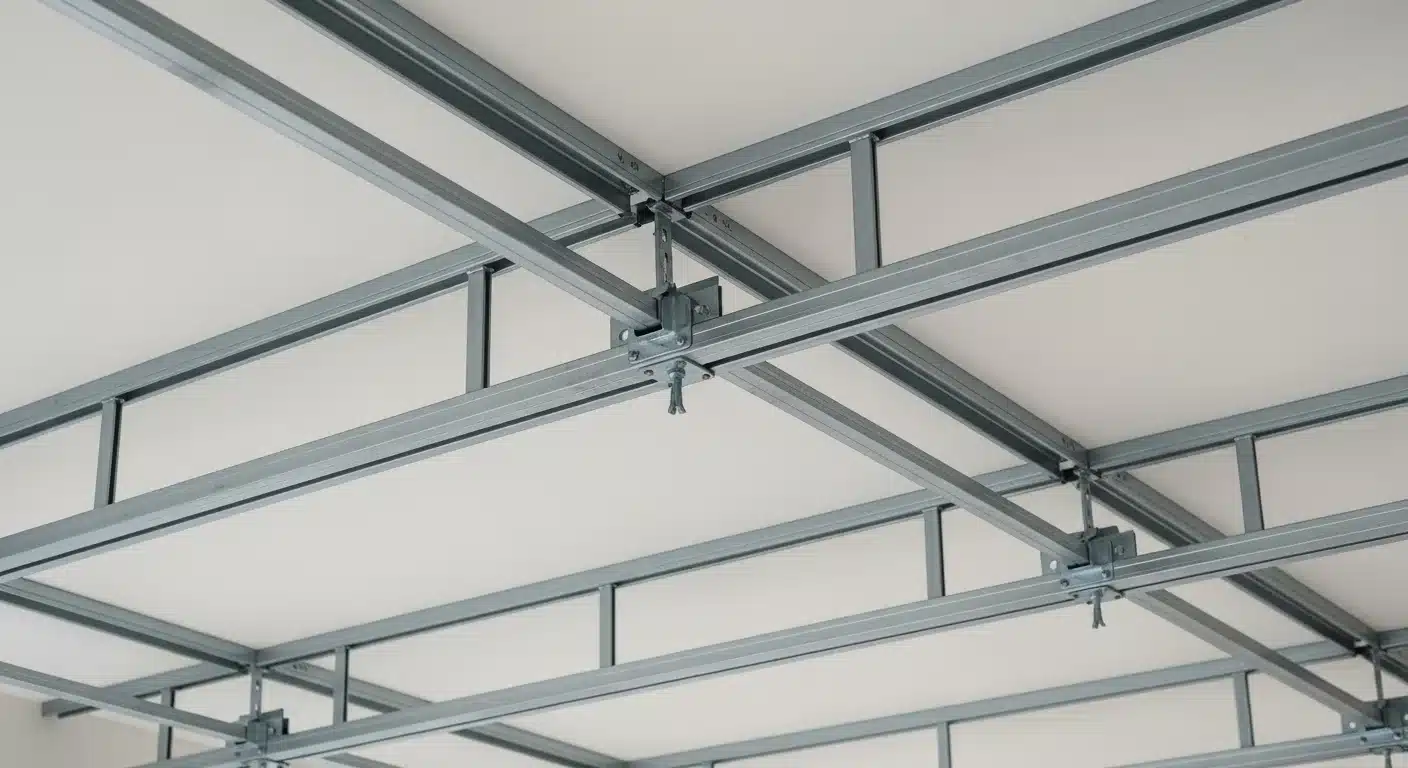
Drop-ceilings and T-grid systems require careful anchor selection to ensure secure installations without compromising the grid’s integrity. These lightweight metal frameworks support acoustic tiles and are not designed for heavy point loads, so anchors must account for grid deflection, load distribution, and the ceiling material above.
Understanding the Unique Challenges of T-Grid Systems
T-grid systems are lightweight metal frameworks designed to support acoustic tiles, not heavy point loads. The primary challenge is grid deflection; anchors must distribute weight to avoid exceeding the system’s load capacity.
A common specification is to limit loads to 2.0 kN per fixing point, using a minimum of three separate anchors for stability. Installations must also consider the ceiling material above the grid, such as drywall or concrete, which dictates anchor choice.
Selecting the Right Anchor for the Substrate
For concrete substrates above the grid, through-fixing anchors like the WCA1 are recommended, requiring a 6 mm drill hole and a minimum 32 mm embedment depth. In drywall drop-ceilings, toggle bolts or light-duty expansion anchors are suitable, but access to both sides of the panel is ideal for secure installation.
All anchor selections must account for load direction (shear vs. tension) and include a safety factor of 2-3 times the intended weight. In facilities like schools or transit hubs, prioritize anchors with fire ratings (e.g., R30 to R120) and those approved for use in cracked concrete (ETA-16/0971).
Best Practices for Installation and Long-Term Maintenance
Begin by accurately identifying the ceiling type and measuring the substrate thickness and the object’s total weight. Drill holes precisely to the anchor manufacturer’s specifications, using carbide-tipped bits for concrete per ANSI B212.15 standards.
During installation, splay hanging wires to the main T-grid runners to distribute load and use plenum-rated hardware to meet fire and acoustic codes. Conduct a visual check for correct anchor installation and test with a load not exceeding the recommended limit, such as 1.43 kN for a WCA1 anchor.
For facility managers, schedule regular inspections to check for grid warping and ensure no single fixing point exceeds its 2.0 kN load limit.
Frequently Asked Questions
How do I hang a disco ball from a concrete ceiling?
Use heavy-duty concrete anchors or screws rated for the combined weight of the ball and hardware. First, calculate the load; a standard 12-inch ball weighs 5-10 lbs, so select anchors like sleeve or wedge anchors with at least 50 lbs shear strength. Drill a pilot hole with a masonry bit into solid concrete, clean it, insert the anchor, and tighten. Attach the ball using clear fishing line or chain. For permanent installations or weights over 25 lbs, consult a structural engineer.
What is the best anchor for a 24-inch mirror ball?
For a 24-inch ball weighing 9-13 lbs, use a heavy-duty ceiling hook (1/4-inch or larger) or a reinforced eye bolt (5/16-inch diameter) installed into a ceiling joist or solid concrete. These provide the necessary static load support with a safety factor. For hollow ceilings or drywall, a toggle bolt anchor kit (M8 or larger) that expands to distribute over 30 lbs of load is recommended, though professional installation is advised for large spaces.
How do I hang decor from a drop ceiling grid?
Never attach decor directly to the grid or tiles, as they are designed for lightweight panels, not point loads. Instead, use tested ceiling anchors or hanger wires attached to the structural ceiling (joists, concrete, or beams) above the grid. Calculate the total weight and ensure the anchor capacity exceeds it with a safety factor. For loads above people, use manufacturer-tested anchors with proof load testing and follow local building codes, potentially requiring a structural engineer.
What is the pull-out strength for ceiling hooks?
Pull-out strength varies widely by anchor and substrate. Basic plastic expansion anchors in drywall hold about 10-30 lbs, while toggle bolts can achieve 90-100 lbs. For commercial and seismic applications, such as in suspended ceiling systems per IBC standards, connections like Unopposed Tee Clips require a minimum of 180 lbs pull-out strength. Always match the anchor to the load and verify the substrate; direct attachment to a joist can exceed 200 lbs, while drywall alone limits capacity to the anchor’s specifications.
Can I screw a disco ball directly into a wood beam?
No, you should not screw a disco ball directly into a wood beam. Disco balls are designed with a top hanging loop for suspension. Screwing into the ball risks damage and creates an unstable mount. Instead, install a lag screw eye or a toggle bolt rated for at least 4 times the ball’s weight into the beam. Then, attach a chain or motor to that hardware and link it to the ball’s loop. Ensure the beam is solid and test the load before use, especially if a motor is involved.
What professional hardware is used for ceiling rigging?
Professional rigging must comply with standards like ASME B30.26 and OSHA regulations. Key hardware includes shackles, links, eyebolts, and turnbuckles, all of which require inspection prior to each use. Load ratings are specific; for example, some venues specify 2,000 lbs per point for straight-down loads. ASSY screws for panel rigging are single-use only. All hardware must withstand a proof load of at least twice its rated capacity. Contractors should verify manufacturer specs and ensure inspections by trained rigging specialists.
Final Thoughts
Choosing the right ceiling anchor isn’t about finding a single best product; it’s about matching the anchor’s design to the specific properties of your substrate. The material’s density and age set the foundation for safety, determining the maximum load an anchor can hold and the materials needed to resist corrosion over time. From there, the correct anchor type—be it a wedge anchor for solid concrete, a lag screw for a wood joist, or a beam clamp for a steel I-beam—ensures a secure, code-compliant connection.
This matching process is critical for both immediate safety and long-term performance. In dynamic environments, epoxy anchors provide the necessary flexibility, while for commercial projects, pull-out testing offers the required verification. By starting with a thorough assessment of the ceiling material and following the specific installation protocols for your chosen anchor, you build a system that supports the intended load reliably and safely for years to come.