

Standard spherical mirrors and carved foam props are limiting your next brand activation or architectural installation. Designers are moving beyond these basic forms to custom geometric shapes—like parabolic and hyperbolic mirrors—that eliminate optical distortion and create unique, non-repeating light patterns.

This article details how FRP molds translate complex CAD designs into physical reality. We’ll cover the layered structure of a precision mold, including its 6-8 mm reinforcement layer, and explain how processes like L-RTM achieve part tolerances as tight as 0.01 inches. You’ll also learn about the upfront investment in custom tooling and how it enables repeatable, high-impact fabrication for retail rollouts.
The Creative Demand for Non-Spherical Mirrors
Non-spherical mirrors, including parabolic, hyperbolic, and ellipsoidal shapes, are increasingly sought after for their superior optical performance and unique visual effects. Unlike standard spheres, these custom shapes can precisely control light to eliminate distortions, create dramatic focal points, and enable innovative architectural and event installations that were previously impossible.

Beyond the Sphere: Why Designers Choose Custom Shapes
Standard spherical mirrors have inherent optical flaws. They cause field curvature and spherical aberration, which distort images and scatter light unpredictably. This limits their use in precision applications.
Aspherical, parabolic, and hyperbolic mirrors correct these flaws. They enable sharp, undistorted focusing and precise beam shaping. This makes them essential for architectural lighting, immersive art installations, and any project requiring clean light projection.
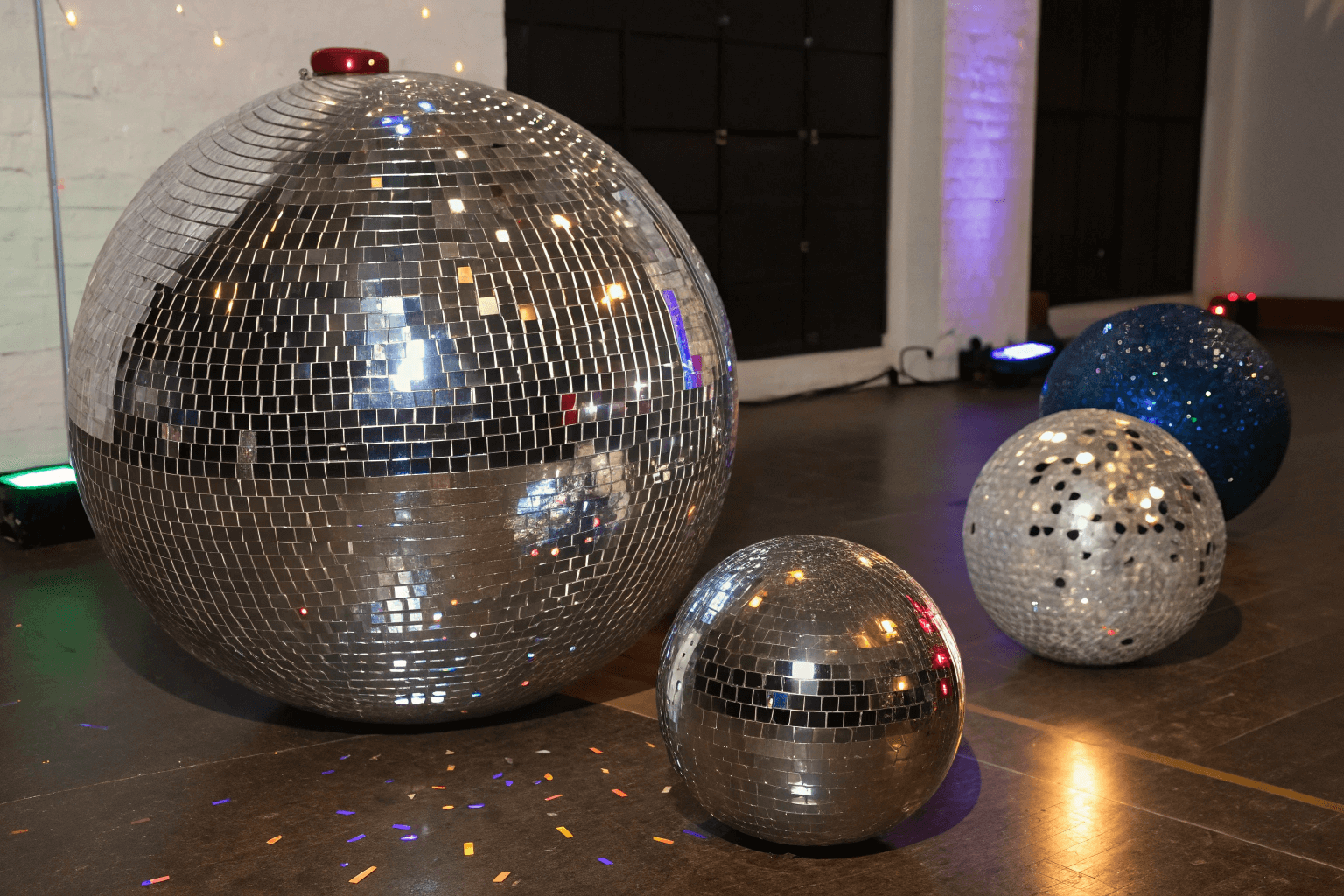
These custom shapes unlock unique aesthetics. They create non-repeating geometric patterns and complex light interactions that move far beyond the standard disco ball effect. This allows brands and artists to craft signature visual moments and one-of-a-kind installations.
For a fabrication partner, meeting this demand means translating complex CAD designs into physical reality. It requires the precision to produce large-scale, high-impact features that perform exactly as envisioned optically and visually.
Precision Engineering for Creative Vision: Key Specifications
Surface accuracy is paramount. High-performance mirrors achieve RMS irregularities as low as 25 nm, with global form errors down to 50 nm. This level of precision ensures clean, aberration-free light projection, which is critical for artistic and technical applications.
Extremely low surface roughness is necessary to minimize scattered light. For uses involving lasers or precise projection, roughness is often kept below 1 nm Rq to maintain wavefront integrity and maximize visual clarity.
Manufacturing scales to meet creative needs. While standard production covers diameters from 50 mm to 1200 mm, custom fabrication can handle specific requirements up to 420 mm in diameter with precise control over sag height.
Material selection ensures stability. Materials like ZERODUR® and fused silica are chosen for their near-zero thermal expansion. This guarantees the mirror’s shape and performance remain consistent in the varying environmental conditions typical of events and installations.
Advanced coatings maximize reflectivity and impact. Protected silver or aluminum coatings can achieve reflectivity greater than 95% across the visible and near-infrared spectrum. This ensures the mirrored surface delivers maximum visual brightness and effect.
The Limits of Carved Foam Shapes
Carved foam shapes are limited by material density and intended application, not absolute size. For hand carving, densities of 4–15 lb/ft³ offer the best balance of workability and detail. CNC milling overcomes size limits by sectioning and assembling parts, with material choice—from soft 2 lb/ft³ foam for ease to dense 40 lb/ft³ for intricate detail—driving the final precision and application suitability.

Material Density Defines Workability and Detail
The density of the foam is the primary factor that determines how easily it can be carved and the level of surface detail it can hold. Hand carving is most effective and practical with foam densities between 4 and 15 pounds per cubic foot (lb/ft³).
Softer foams, such as EPS polystyrene (1–3 lb/ft³) or prop foam (2–6 lb/ft³), are easier to carve and shape quickly, making them ideal for rough prototypes and large forms. However, their softer structure means they cannot hold fine, intricate details as well.
For high-detail work required in retail displays, architectural models, or final presentation pieces, much denser foams in the 20–40 lb/ft³ range are necessary. These materials allow for crisp edges and complex textures, though they are less common for standard prototyping due to higher cost and increased machining effort.
Overcoming Size Limits with CNC and Assembly
Modern CNC milling technology effectively removes any true maximum size limit for carved foam shapes. Instead of carving from a single massive block, large designs are digitally sectioned into parts, typically under 12 inches in any dimension for practical machining on standard CNC beds. These sections are then physically assembled and bonded together to create the final, large-scale form.
The choice of CNC machine also impacts capability. A 5-axis CNC machine can execute complex toolpaths, creating sophisticated geometries and undercuts in a single setup. For simpler shapes or initial rough cuts, a standard 3-axis machine is often sufficient and more cost-effective.
The practical starting point for any project is the maximum thickness of the available foam block. For common prop foams, these limits are: R20 Prop Foam up to 24 inches, R40 up to 18 inches, and R60 up to 12 inches. Projects larger than these block sizes must be built from multiple laminated layers or assembled sections.
Mold-Making: Creating High-Resolution Geometric FRP
Creating high-resolution FRP molds involves a multi-layered structure with a gel coat surface for detail, reinforced with fiberglass and metal grids for stability. The process uses methods like L-RTM and compression molding under controlled heat and pressure to achieve tight tolerances and complex geometries suitable for brand activations.
| Parameter | Specification / Range | Key Process / Material |
|---|---|---|
| Gel Coat Thickness | 0.5-1.0 mm (2-3 layers) | Spray application |
| Reinforcement Layer | 6-8 mm | Mat-cloth or chopped mat |
| Molding Pressure | 1.4-34.5 MPa | L-RTM, Compression Molding |
| Mold Temperature | 130-160°C | Copper heating pipes with 50-100 mm insulation |
| Part Tolerance | 0.01″ (tool side), 0.03″ (non-tool side) | Precision machining |
| FRP Part Thickness | 1.6 mm (1/16″) to 12.7 mm (1/2″) | Controlled resin infusion |
| Maximum Part Size | 70 ft² (6.5 m²) / 16 ft (4.8 m) length | Design for manufacturability limit |
| Mold Steel | AISI-4140 (Rockwell C30-32) | Pre-hardened for durability |
| Lead Time (L-RTM Mold) | 2-4 weeks | Standard manufacturing cycle |

The Layered Structure of a Precision Mold
A high-fidelity surface starts with a 0.5-1.0 mm gel coat, sprayed in 2-3 layers to capture intricate patterns.
This is backed by a 6-8 mm reinforcement layer of mat-cloth or chopped mat for structural integrity.
An insulation layer of 50-100 mm surrounds embedded copper heating pipes to maintain a stable mold temperature between 130-160°C.
Internal rigid metal grids, designed using plate-shell theory, prevent flexing under molding pressures of 1.4-34.5 MPa.
The design incorporates double sealing and strategic vacuum ports to ensure uniform resin flow and minimize porosity in complex shapes.
Process Specifications and Production Limits
Processes like Low-Pressure Resin Transfer Molding (L-RTM) and compression molding are standard, enabling a manufacturing cycle of 2-4 weeks for L-RTM molds.
Molds are machined from pre-hardened steels like AISI-4140 (Rockwell C30-32) for durability across thousands of cycles.
Achievable part tolerances are tight: 0.01 inch on the tool side and 0.03 inch on the non-tool side.
Final FRP part thickness can range from 1.6 mm (1/16 inch) to 12.7 mm (1/2 inch).
Design for manufacturability requires a minimum 3° draft angle and 1.5-3 mm radii for clean demolding, with a maximum part size of 70 ft² (6.5 m²) or 16 ft (4.8 m) in length.
Source Professional Mirror Balls, Direct from the Factory
Designing for Brand Activations and Retail Rollouts
Designing for brand activations and retail rollouts focuses on creating immersive, portable environments that guide consumer journeys. It prioritizes lightweight materials like polystyrene and polyurethane foam for custom props, integrates interactive technology, and uses spatial planning to control attendee flow and emotional response, ensuring memorable brand engagement.
| Design Principle | Material & Fabrication Strategy | Key Implementation |
|---|---|---|
| Environmental & spatial planning for controlled attendee flow. | Lightweight carving foams (polystyrene, polyurethane) for props and set pieces. | Creating modular, reconfigurable structures for different spaces. |
| Multi-sensory design to evoke emotional responses. | Embedded technology for interactive touchpoints (e.g., tablets, AR). | Integrating real-time design stations and dynamic content. |
| Consumer journey mapping for a cohesive narrative. | Fabrication of dimensional logos and textured surface elements. | Designing zones like arrival areas and engagement hubs. |

Core Design Principles for Immersive Experiences
Effective brand activations start with environmental and spatial planning. This involves defining specific zones—such as arrival areas, engagement hubs, and content capture spots—to logically control attendee movement and focus attention.
Integrating multi-sensory elements is critical for emotional impact. Strategic lighting, curated soundscapes, and intentional surface textures work together to reinforce brand identity and create a memorable atmosphere that resonates with visitors.
The design process employs consumer journey mapping to structure a logical sequence of interactions. This maps the attendee’s path from initial discovery through active engagement to final content sharing, ensuring a cohesive and impactful brand narrative.
Fabrication and Material Strategies for Portability
The primary fabrication strategy utilizes lightweight carving foams, specifically polystyrene and polyurethane. These materials are ideal for creating oversized replicas, textured panels, custom props, and set pieces that are easy to transport and assemble on-site, prioritizing speed and logistics.
Modern activations incorporate embedded technology to create dynamic engagement. This includes integrating tablets for real-time design stations or adding augmented reality (AR) layers to physical installations, transforming static displays into interactive experiences.
Fabrication focuses on modularity and reconfigurability. Dimensional logos and structural arrangements are built from components that can be quickly deployed, broken down, and adapted for various retail footprints or event spaces, maximizing versatility and reuse.
Lead Times and Tooling Costs for Custom Designs
Lead times for custom geometric mirrors depend on design complexity and production volume, ranging from a few weeks for simple projects to several months for intricate installations. While tooling costs are a significant upfront investment, they enable high-precision, repeatable fabrication for brand rollouts and large-scale activations.

Understanding the Timeline for Custom Fabrication
Lead times are not fixed; they vary based on design complexity, material sourcing, and production capacity. A simple, low-volume sheet metal part can be fabricated in as little as 2-3 weeks.
For complex, make-to-order products common in high-end retail or events, timelines often extend to several months. This accounts for engineering, prototype validation, and rigorous quality control.
Expedited production is possible. For example, a priority protocol can compress manufacturing to just 7 days for urgent projects, though this requires dedicated logistics planning like chartered air freight.
Investing in Precision: The Role of Custom Tooling
Custom tooling, such as molds or precision jigs, represents a primary upfront investment for non-standard geometric shapes. This cost ensures dimensional accuracy and repeatability across multiple units.
The investment in high-resolution tooling is justified for retail rollouts or multi-location brand activations, where consistent quality and efficient production of dozens or hundreds of pieces are required.
While specific cost benchmarks require a project quote, the value lies in enabling flawless execution of complex designs—turning unique architectural drawings into tangible, install-ready masterpieces.
Weight and Rigging for Irregular Geometric Decor
Rigging irregular decor requires calculating the total factored load from the object’s weight, then designing a certified system to support it. This involves locating the center of gravity, using engineered lifting hardware like spreader bars, and adhering to strict standards for screw penetration, sling angles, and point load limits to ensure safety.

The Engineering Process: From Unfactored Weight to Certified Load
The process begins with the unfactored weight (p) of the object. For example, a cross-laminated timber (CLT) panel can weigh up to 18,500 pounds.
You then apply the load factoring formula P = p ∙ KOS ∙ Kv. In this formula, Kv accounts for dynamic acceleration forces during lifting, and KOS is an optional safety factor. The result, P, is the total load the rigging system must be designed to handle.
The final, critical step is certification. The total capacity of the installed rigging system (Z’) must exceed the summation of all calculated sling forces (ST). This entire calculation and system design must receive final approval from a licensed professional engineer.
Hardware, Geometry, and Compliance for Complex Shapes
Hardware selection is dictated by material and geometry. For mass timber, the capacity of a yoke depends on screw type and penetration depth. A Yoke XL using 3/8” x 4” screws requires a minimum 3-1/8” penetration into the material to achieve its rated capacity.
Irregular shapes often have an offset center of gravity, which can cause dangerous tilting during a lift. Correcting this requires adjusting the lift points or adding counterweights, a technique commonly used when rigging scenic portals with uneven weight distribution.
Compliance involves both engineered solutions and venue rules. Custom lifting beams or spreader bars must be engineered to ASME/OSHA standards to manage complex geometries. Furthermore, event venues frequently impose strict limits, such as a maximum distributed load of 15 kg/m² and an absolute maximum of 150 kg per individual rigging point.
Case Study: Global Brand Pop-up Displays
Global brand pop-up displays use modular components like replaceable graphic sleeves and magnetic panels to enable rapid, cost-effective promotional updates across markets. A luxury skincare brand’s redesigned counter riser, featuring a carved gift slot and visual flow cues, achieved a 26% increase in gift-with-purchase redemption, proving the impact of structure-led design on in-store conversion.

Modular Design for Rapid Market Adaptation
These displays are engineered for quick setup and reconfiguration, such as the standard 8×8 ft pop-up backdrop, to meet the fast-paced schedules of trade shows and retail activations.
The modular system includes universal base frames, slide-in graphic cards, removable gift-with-purchase trays, and replaceable printed sleeves. This allows for complete visual updates without requiring a full structural replacement.
This approach significantly reduces shipping costs for global rollouts. It also minimizes staff training time in understaffed stores, as only specific components need to be swapped out for new campaigns.
Measurable Impact and Market Context
A specific case study with a luxury skincare brand showed a 26% uplift in gift-with-purchase redemption. This was achieved by redesigning a counter riser to include a carved slot for the gift, a visual arrow to guide the shopper’s eye, and a magnetic card system for clear, region-specific messaging.
The global point-of-purchase display market is currently valued at USD 13.2 billion and is projected to grow to USD 17.1 billion by 2030. The counter displays segment alone is expected to reach US$7.3 billion.
This growth is driven by demand for durable, eco-friendly materials and advanced printing techniques that support high-quality custom designs for brand activations and retail rollouts.
Final Thoughts
Custom geometric decor, from high-performance mirrors to sculptural installations, moves beyond simple aesthetics into the realm of functional design. The shift from standard spheres to parabolic or hyperbolic shapes isn’t just about looks—it’s about controlling light with precision to eliminate distortion and create specific visual effects. This technical capability, enabled by processes like precision FRP mold-making, allows designers and brands to execute visions that were once limited to concept drawings.
The real value of this approach lies in its application. Whether for a global retail rollout, a temporary brand activation, or a permanent architectural feature, the principles of modular design, material strategy, and engineering rigor ensure the final piece is not only visually striking but also practical to fabricate, install, and maintain. The upfront investment in custom tooling and detailed planning pays off by turning complex geometric concepts into tangible, impactful realities that engage audiences and define spaces.
Frequently Asked Questions
Can you make custom shape disco balls?
Yes. Custom shapes are manufactured using EPS foam cores shaped via hot wire carving and hot knives. The core is then covered with approximately 0.5-inch mirror tiles adhered with spray and tile adhesives. Providers offer unique shapes like flamingos and cowboy boots in sizes from 14 to 32 inches. For example, a 2’x2’x3′ custom foam core requires about 16 square feet of mirror tiles.
What is the minimum order quantity for custom shaped mirror decor?
The MOQ varies significantly by product type. For larger decor items or smart mirrors, many suppliers have no minimum, accepting orders for a single piece. For promotional items like compact mirrors, a minimum of 50 to 100 units is common. The industry standard ranges from 1 piece to 100 units depending on the specific product and supplier.
What is the lead time for a custom disco ball mold?
Lead times depend on mold complexity. Simple single-cavity prototype molds typically take 2 to 4 weeks. Complex multi-cavity production molds require 6 to 12 weeks. The full process from design to final delivery of molded plastic facets for mirrored disco balls generally takes 6 to 12 weeks or longer.
Are heart shaped disco balls available for weddings?
Yes, heart-shaped disco balls are popular for weddings and romantic events. They are available in various sizes, commonly from about 5 inches to over 25 inches in diameter. These decorative items are typically made from materials like polystyrene, glass, and metal, and feature mirrored tiles that create colorful reflections. They are designed specifically for events like weddings and Valentine’s Day.
What is ‘melted’ disco ball decor for retail?
Melted or ‘lazy’ disco ball decor is a handcrafted artistic variation. These pieces are constructed from resin and glass mosaics to create an organic, flowing form. Sizes range from about 7 inches to over 25 inches. Due to their artisanal nature, they are premium retail items, with prices typically between $299 and $799 per unit.
Can you create custom geometric mirror sculptures?
Yes. These are architectural-grade sculptures fabricated from mirror-polished 304 or 316 stainless steel, with material thicknesses of 1.5 to 3 millimeters. They can be produced in life-size or fully custom dimensions based on client specifications. As bespoke architectural pieces, prices generally range from approximately $1,300 to over $5,500 depending on size and complexity.