

The ‘Disco Floral’ trend is creating high-demand, high-value opportunities for B2B florists and wholesalers, but capitalizing on it requires more than just adding a shiny ball to a bouquet. It demands a professional understanding of technical specs, durable construction, and scalable logistics to ensure your arrangements are profitable, reliable, and ready for the rigors of events.

This guide breaks down the practical integration of mini disco balls into your floral wholesale and design business. We’ll cover the core technical requirements, like using LED fixtures with a minimum 300-lumen output and securing arrangements with industrial-grade adhesives for transport. You’ll also find actionable strategies for bulk sourcing to reduce per-stem costs and detailed protocols for packaging that meets carrier and safety standards, ensuring your dazzling creations arrive perfectly intact.
The Trending “Disco Floral” Aesthetic
The Disco Floral aesthetic merges automated LED lighting with floral arrangements housed in mirrored vessels. It’s designed for events and decor, requiring specific technical specs like high-lumen LEDs, durable materials, and custom floral scaling to ensure visual impact and reliability.

Defining the Core Concept and Visual Impact
This style combines automated LED fixtures that mimic petal-structured lighting effects with fresh or dried floral arrangements. The target is event decor and venue applications, with a focus on creating immersive, dynamic visual experiences.
The aesthetic is built around integrating light with organic material, often using disco ball vessels that can later serve as planters. The key design goal is to create a high-impact, reusable decorative piece suitable for professional settings like weddings and parties.
Technical Specifications and Floral Implementation
For reliable performance, LED fixtures require a minimum output of 300 lumens for medium rooms and a lifespan exceeding 25,000 hours. Mirror balls need a minimum of 96 facets for rooms under 20 m², scaling to 144+ facets for spaces over 35 m² to achieve optimal light dispersion.
Professional builds prioritize durability, using materials like food-safe acrylic, mirrored resin, and stainless-steel mounting rings to integrate seamlessly with floral components.
Arrangements are scaled by stem count: XSmall (5-10 stems), Small (10-15), Medium (16-20), and Large (20-25 stems). A standard 48-hour lead time is required for custom orders to accommodate design and material sourcing.
Waterproofing: Can Mirror Balls Sit in Vases?
Yes, commercially available mirror ball vases are designed for this purpose. They are constructed from materials like water-resistant glass mirror tiles, ceramic, or resin, which are suitable for holding water and plants. These products are explicitly marketed for floral and planter use, with features like drainage holes in ceramic versions to manage moisture.

Materials and Water-Resistant Design
These decorative vases are typically made from materials chosen for their durability and compatibility with water. Common constructions use high-quality glass mirror tiles, ABS plastic, ceramic, or lightweight resin.
The glass mirror tiles are often described as water-resistant and durable, making them suitable for outdoor planter use. This specification directly addresses the need for waterproofing when the object sits in a vase with water.
Ceramic versions frequently include a practical feature like a drainage hole. This design element indicates the product’s intent for plant moisture management, further confirming its suitability for holding water and floral arrangements.
Sizing and Application for Centerpieces
Mirror ball vases come in sizes that support their use as centerpieces. Common dimensions range from 5×6 inches, often sold in multi-packs, to 15x10cm, providing options for different design scales.
These products are marketed explicitly for holding plants or flowers, which implies their compatibility with standard vase applications involving water. There are no widespread commercial specifications or user reports indicating failures related to waterproofing in typical floral use.
The available data confirms functional use but is limited to commercial product descriptions. It lacks detailed engineering standards, specific mechanical property ratings, or failure rate analyses that would provide a physics-based assessment of long-term water exposure.
Weight Management for Tall Floral Arches
Managing weight for tall floral arches involves balancing the lightweight metal frame against the significant load of fresh florals. Key strategies include using frames with 13-16mm thick tubing, distributing weight across multiple attachment points, and anchoring the structure with wide bases and concealed sandbags to prevent tipping under loads that can exceed 20lbs.

Understanding Arch Capacity and Load Distribution
Commercial arch frames, often made of lightweight metal, have a typical weight capacity ranging from 20lbs to 55lbs (25-30kg) when the load is properly distributed.
The arch’s own weight, such as a 25lb metal frame, must be factored in alongside the floral load, which can be substantial—a single 36-inch-wide garland of eucalyptus and roses can weigh 12–18lbs.
Stability is engineered through robust tubing (13-16mm thick) and multiple attachment points, like the 16 holders found on some arches, to spread the floral weight evenly and prevent stress concentration.
Practical Stabilization Techniques and Floral Mechanics
Anchor bases measuring approximately 17.5in x 12.5in provide the primary footprint; this is supplemented by adding sandbags, bricks, or other weights hidden by greenery to counter tipping forces, especially for arches up to 8 feet tall.
To reduce the overall ‘soak weight’ from water, florists use water-tubed individual blooms or chicken wire instead of fully saturated floral foam, though wet installations still require extra base weighting.
For 360-degree installations or high-wind outdoor events, a 3-frame depth design increases stability, and all stabilization hardware must allow for quick assembly, often within 15 minutes, while remaining completely concealed.
Source Professional-Grade Mirror Balls, Direct from the Factory
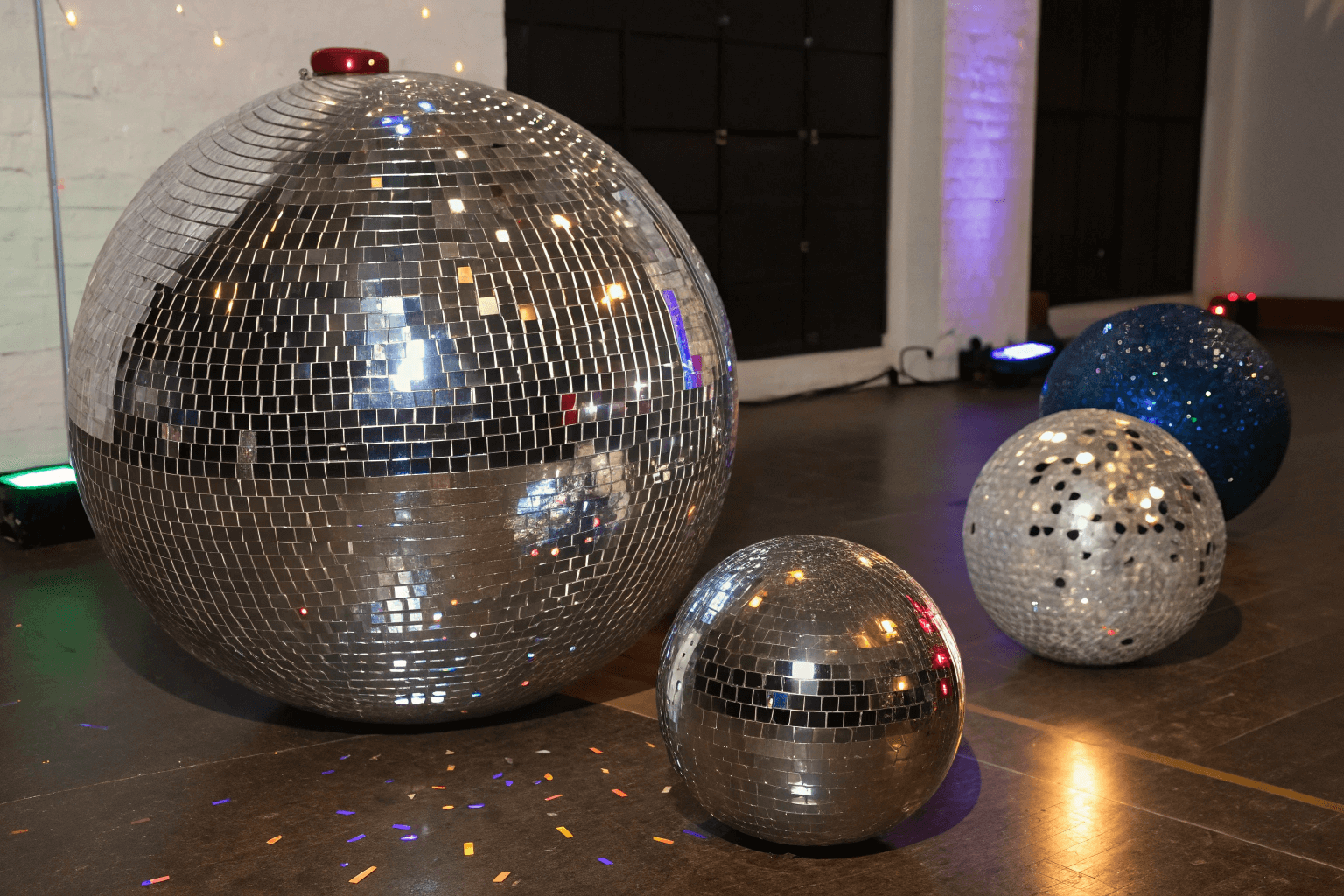
Attaching Mini Balls to Stems and Foam Bases
For B2B floral professionals, attaching mini balls requires methods that ensure durability for transport and display. Key techniques involve using specialized floral adhesives on foam bases and creating secure mechanical attachments to stems, which must withstand handling and environmental factors common at events.

Core Attachment Methods for Professional Durability
The primary goal is to create a bond that survives the rigors of commercial use, from warehouse handling to event setup and teardown. This requires moving beyond basic craft glue.
Industrial-grade floral adhesives are formulated to bond non-porous materials like glass or plastic to porous substrates like floral foam. These adhesives remain flexible when cured, preventing a brittle bond that could crack during transport. For high-stress points, such as on a centerpiece that will be moved repeatedly, a mechanical attachment provides critical reinforcement. Using thin-gauge wire or a specialized stem clip creates a physical lock, distributing stress away from the adhesive point alone.
Surface preparation is a non-negotiable step for professional results. Lightly scoring the surface of a foam base with a knife creates more surface area for the adhesive to grip. Applying a primer or degreaser to plastic stems removes manufacturing residues that can prevent a strong bond, turning a weak attachment into a tour-grade hold.
Technical Specifications and Workflow Integration
Selecting materials requires matching their specifications to project demands. Adhesive cure times and weight capacities must align with production timelines; a fast-set option is essential for last-minute orders, while a longer-cure, higher-strength formula is better for pieces destined for multi-day events.
In a B2B production environment, the attachment process should be a defined, repeatable stage in the workflow. This allows for batch processing of dozens or hundreds of units, ensuring consistency. It also establishes a clear checkpoint for quality control before pieces move to assembly or packaging.
The final inspection protocol focuses squarely on the attachment point. Each piece should be checked for any visible gaps in the adhesive, secure seating of mechanical fasteners, and overall stability when gently stressed. This ensures every item meets the durability standards expected by event rental companies and the presentation standards required for direct retail sale.
It’s important to note that general product listings for decorative items do not provide the technical data needed for professional application. The information above is based on industry best practices for durable assembly, as official engineering specifications or ASTM standards for this specific floral task are not typically found in consumer product descriptions. For formal technical documentation, consulting resources from floral industry associations or wholesale supplier specifications is necessary.
Bulk Sourcing for the Wedding Season Surge
Effective bulk sourcing for the wedding season involves planning 6–8 weeks in advance, working with trusted wholesalers to secure specific stem varieties and lengths, and leveraging bulk orders to reduce per-stem costs while ensuring consistent quality for large-scale event designs.
| Key Action | Timeline | Primary Benefit |
|---|---|---|
| Finalize selections & pre-book with growers | 6–8 weeks before season | Secures inventory and specific stem lengths |
| Place bulk orders with wholesalers | Ongoing, based on event schedule | Reduces per-stem cost by avoiding retail markups |
| Use special orders for exact stems | At time of order placement | Ensures color and size consistency across designs |

Strategic Planning and Supplier Coordination
Finalizing your floral selections and pre-booking key varieties with growers 6–8 weeks before the wedding season is critical. This lead time locks in your inventory and guarantees you get the specific stem lengths needed for structured arrangements, preventing last-minute substitutions that can compromise a design.
Developing partnerships with trusted wholesalers is foundational. These suppliers offer more than just flowers; they provide flexible delivery schedules and expert guidance on seasonal trends. They can recommend sturdy stem varieties that hold up in large installations, turning them into strategic allies for managing peak demand.
For wedding work, precision is non-negotiable. Instead of purchasing standard pre-packed boxes, use special orders to specify exact stem counts, colors, and bloom stages. This practice ensures uniformity across dozens of centerpieces and arches, which is essential for a cohesive event aesthetic.
Cost Management and Operational Execution
Bulk sourcing directly from wholesalers offers a direct financial advantage. The standard markup for fresh flowers in retail floristry ranges from 3.5 to 4 times the wholesale price. By ordering in volume for your wedding season events, you bypass these retail markups, significantly lowering your per-stem cost and improving project margins.
Proactive negotiation can yield further savings. Discuss surplus inventory discounts with your wholesaler and be open to their suggestions for budget-friendly alternatives. For example, garden roses can often provide a similar look and lushness to more expensive peonies, helping you maintain design integrity while adhering to client budgets.
Managing the operational surge requires clear agreements and disciplined handling. Implement written contracts with suppliers that include quality guarantees. Once the flowers arrive, prioritize hydration protocols and proper handling techniques to maintain vitality across the high volume, ensuring that the first arrangement looks as fresh as the last.
Packaging for Safe Delivery of Pre-Made Arrangements
Safe delivery of pre-made arrangements requires a two-part strategy: physical stabilization and regulatory compliance. Arrangements must be secured inside boxes using cable ties or bands to prevent shifting, with vases separated by corrugated dividers. Boxes must be sealed with the H-taping method and meet specific standards for opacity, child-resistance, and labeling.

Mechanical Stabilization and Carrier Protocols
The primary goal is to prevent any movement inside the shipping box. Secure the arrangement using cable ties or bands, attaching them directly to the box’s interior or a custom insert. For boxes with a maximum width of 26 inches (66 cm), add lateral cleats or bands for extra stability against side-to-side motion.
Always separate the vase from the floral components using corrugated cardboard dividers. Cushion fragile vases with additional packing material. Ship all arrangements without water to prevent leaks and damage. Seal the box using the H-taping method: apply three strips of 2-inch (5 cm) wide pressure-sensitive adhesive plastic tape across the top and bottom flaps to create a robust seal that withstands handling and humidity changes.
Regulatory Compliance and Specialized Fixation
Packaging must meet specific safety standards. It needs to be opaque, light-resistant, and in a neutral color like black, white, gray, or beige. The enclosure must be child-resistant and resealable in a child-resistant manner after opening.
Labeling is strictly regulated. A universal warning symbol, at least 1 x 1 inch in size, must be displayed on the front. Any accompanying text must be in a font no smaller than 6 pt, using standard typefaces like Times New Roman, Arial, or Helvetica, in black or white for contrast.
For preserved arrangements fixed with clear epoxy resin, control the environment during pouring. Aim for 30-40% humidity to ensure proper curing. Handlers must wear appropriate personal protective equipment, including butyl rubber gloves (shoulder or gauntlet length) and an apron to prevent skin contact.
Use corrugated shipping cartons with moisture-resistant adhesive. For the final transit leg, secure the shipment with additional tape and straps to guarantee it arrives intact.
Creating “Disco-Bouquets” for Retail Gifting
The Disco Bouquet is a 12-inch by 14-inch retail-ready arrangement featuring eucalyptus, solidago, and roses in a fiery orange-yellow palette. It’s designed for immediate gifting, backed by a 7-day freshness guarantee and specific care protocols for longevity.

Product Specifications and Design Rationale
Standard dimensions are 12 inches tall by 14 inches wide, a size optimized for easy handling, display, and inventory management.
Features a curated mix of eucalyptus, solidago, and roses in a cohesive orange-yellow color scheme designed for high visual impact.
Engineered as a complete, presentation-ready product requiring no assembly, ideal for direct sale in gift shops or as a scalable centerpiece for events.
Care Protocols, Logistics, and Safety Notes
Longevity requires daily water replacement and stem trimming every couple of days to prevent bacterial growth.
Local florist delivery starts at $19.99, supported by a 7-day fresh flower guarantee that allows for varietal substitutions to ensure quality.
Includes pet-toxic flowers and foliage; retail partners must communicate this safety warning clearly to end consumers for responsible gifting.
Final Thoughts
Integrating mini disco balls into floral designs is more than a fleeting trend; it’s a technical craft that merges aesthetics with practical logistics. Success hinges on understanding the specific demands of each application, from the waterproofing of vessels for centerpieces to the weight management of large-scale arches and the durable attachment methods required for professional use. Each step, from bulk sourcing to compliant packaging, is a critical link in a chain that ensures the final product is not only visually stunning but also reliable and safe for events.
For floral wholesalers and designers, this integration opens a path to higher-value offerings and more dynamic event decor. By mastering the technical details—like material specifications, stabilization techniques, and workflow efficiencies—businesses can reliably produce the “Disco Floral” aesthetic at scale. This approach transforms a decorative idea into a repeatable, profitable service, meeting the growing demand for immersive and memorable event experiences.
Frequently Asked Questions
How are disco balls used in flower arrangements?
Disco balls act as spherical vessels or centerpieces in floral designs. Standard sizes range from 6 to 12 inches in diameter, with mini versions around 4 inches. They are typically filled or surrounded by 10 to 25 stems of fresh, dried, or preserved florals like spray roses, pampas grass, or eucalyptus. For stability, they are secured using detachable skirts, wired stems, or stands, keeping table arrangements under 18 inches tall. Using shatter-resistant acrylic mirrors and UV-resistant flowers is recommended for durability.
Are mini disco balls waterproof for use in vases?
Most mini disco balls are not waterproof and should not be submerged in vases. Only models specifically designed with an IP44 or higher waterproof rating, constructed from sealed waterproof foam and reflective materials, are suitable for direct water exposure. Standard acrylic, plastic, or glass models lack sealed edges, and water ingress can damage the internal structure and adhesive. Always check for an explicit waterproof rating before using any decorative ball in a vase.
What is the best method for attaching mirror balls to floral foam?
For a secure attachment to floral foam, use a strong adhesive like hot glue. Apply it to the bottom of a netted floral foam sphere, such as an Oasis foam ball, and press it onto a supportive dowel rod or PVC pipe base. For directly gluing a mirror tile to foam in a frame design, use a specialized adhesive like Floralock stem adhesive or a small amount of construction adhesive, applied carefully to avoid excess seepage. Ensure stems are inserted 1 to 1.5 inches deep into wet foam for stability.
Where can florists source mini disco balls in bulk?
Florists can source mini disco balls in bulk directly from manufacturers and B2B wholesalers. Bulk orders typically offer sizes from 2 to 20 inches, with the 4 to 8 inch range being most practical for centerpieces. Wholesale pricing can start under $3 per unit for basic models, with minimum order quantities varying by supplier. For professional use, prioritize suppliers that offer commercial-grade durability, options like acrylic for safety, and features such as built-in hooks for easy integration into arrangements.
What are some wedding centerpiece ideas using small disco balls?
Small disco balls, typically 4 to 8 inches in diameter, are versatile for wedding centerpieces. They can be placed directly on mirrored trays as a standalone sparkle element. For a more integrated look, nestle them within a low floral arrangement or cluster them with pillar candles and greenery. Using sets of four 4-inch balls is a common design for standard round tables. This approach adds reflective light and a modern, festive touch without overwhelming the table’s floral design.
What is the best adhesive for attaching mirrors to flowers or bases?
For permanent, heavy-duty bonding of mirrors, industry-standard construction adhesives like Liquid Nails Mirror Adhesive or Loctite PL 520 are recommended. These products are formulated to bond to glass and mirror surfaces, offering a shear strength of approximately 60 psi. They are typically applied in a 1/4-inch bead, providing a strong hold suitable for decorative applications. These adhesives have a working time of around 10 minutes, allowing for precise placement before setting.