

Creating a stunning outdoor event is one thing; ensuring the decor survives the elements is another. For event planners and production managers, the choice of materials isn’t just about aesthetics—it’s a direct investment in durability and safety. Traditional decorative elements face relentless challenges: EPS foam can yellow and powder in as little as 14 days of sun, and porous materials risk mold growth when relative humidity exceeds 65%.

This article explains why Fiber Reinforced Plastic (FRP) is the non-negotiable material for outdoor resilience. We’ll detail how FRP overcomes the core failures of other materials, from resisting UV degradation and moisture to withstanding wind loads that require anchorage designed for pressures of 40-50 psf. You’ll get the specific performance benchmarks that make FRP a mandatory specification for any professional outdoor installation.
The Challenges of Exterior Decorative Installs
Exterior decorative installations must withstand environmental stresses like UV exposure, moisture, and structural movement. Success depends on strict adherence to material specifications—such as weight, thickness, and area limits for stone—and installation standards requiring full mortar coverage, rapid membrane application, and engineered movement joints to prevent failure.
| Material/Component | Key Specification or Limit | Governing Standard |
|---|---|---|
| Natural Stone (Direct Adhered) | Max 1/2″ (13 mm) thickness, 36″ (914 mm) dimension, 720 sq in (0.46 m²) area, 15 psf (73 kg/m²) weight | Industry Best Practice[1] |
| Liquid-Applied Membrane | Tile must be installed within 3 days of application to prevent UV degradation | Manufacturer & Industry Guideline[1] |
| Adhesive Mortar | Minimum 95% coverage; spot-bonding prohibited | ANSI A108[1] |
| Sealant (General) | Class 25 movement capability | ASTM C920[1] |
| Sealant (Natural Stone) | Must be non-staining | ASTM C1248 NS[1] |

Material and Substrate Limitations
Natural stone intended for direct adhesion comes with strict dimensional and weight constraints to ensure structural integrity. Units should not exceed a thickness of 1/2″ (13 mm), a largest dimension of 36″ (914 mm), a total area of 720 square inches (0.46 m²), or a weight limit of 15 pounds per square foot (73 kg/m²).
The substrate is the foundation of the entire system. It must be stable, flat, and plumb within ANSI A108 tolerances. It is also critical that the surface is free of bond-inhibiting contaminants like form release agents. Direct bonding of tile and stone is typically only approved for concrete or masonry substrates, not wood or metal framing.
When using liquid-applied waterproofing membranes, timing is a key factor. These membranes have a limited window of UV exposure before their bond strength can be compromised. Tiles must be installed within three days of the membrane application to ensure a durable, long-lasting bond.
Installation Protocols and Failure Prevention
Achieving a complete bond is non-negotiable. Adhesive mortar must be applied using the flat-back troweling method to achieve a minimum of 95% coverage on the back of the tile. Spot-bonding, where mortar is only applied to the corners and center, is prohibited per ANSI A108 standards as it creates voids and dramatically increases the risk of failure.
Movement joints are essential engineering components, not optional accessories. They must be installed at all substrate seams, perimeters, and at prescribed intervals to accommodate thermal expansion and contraction. These joints should be filled with a closed-cell backer rod and sealed with an ASTM C920 Class 25 sealant. For natural stone, the sealant must also meet ASTM C1248 NS to be non-staining.
Installation must follow proven assembly details from industry handbooks, such as the TCNA Handbook (details like W201, W211) and the TTMAC Manual (details like 302W, 303W). Industry analysis consistently cites poor jointing and inadequate substrate preparation as the leading causes of exterior cladding system failure, underscoring the importance of these protocols.
UV Degradation: How Sunlight Crumbles EPS
Sunlight causes a photochemical breakdown of the surface polystyrene cells in EPS foam, leading to visible yellowing within weeks and eventual surface powdering. This degradation is superficial, affecting only a thin outer layer while the core insulating and structural properties remain intact, provided the material is covered promptly after installation.

The Science of Surface Breakdown
Ultraviolet radiation from the sun initiates a photochemical reaction in the surface cells of EPS foam. This process, primarily involving chain scission and oxidation, breaks down the polystyrene polymer chains.
The first visible sign of this reaction is a yellowing or paling of the foam’s surface. For materials like extruded polystyrene (XPS), this discoloration can appear in as little as 14 to 28 days of direct exposure.
Critically, this damage is confined to a very thin outer layer. The underlying closed-cell structure—which provides the material’s insulation value (R-value) and compressive strength—remains completely unaffected during this initial phase.
Timeline, Progression, and Protective Measures
Without protection, prolonged UV exposure leads to the next stage: surface powdering or chalking. The damaged outer cells erode into a fine dust, which can be felt by simply dragging a finger across the foam’s surface.
Industry guidance provides clear timelines for action. For example, it’s recommended to cover installed FOAMULAR® XPS within 60 days to prevent the damage from progressing beyond this superficial stage. EPS variants, such as Korolite® 100, have a similar safe exposure window of a few weeks before yellow dust begins to form.
The rate of degradation isn’t uniform. It’s directly influenced by UV intensity and the panel’s orientation. A horizontal surface in a high-sun region will degrade significantly faster than a vertical surface in a cloudy climate.
Humidity and Mold Growth in Porous Cores
Mold grows in porous materials like certain decorative cores when relative humidity (RH) exceeds 65% for spore germination, accelerating at sustained levels of 70-75%. Unlike surface condensation, porous substrates absorb ambient moisture, creating internal microclimates ideal for fungal growth. Prevention requires maintaining RH below 60% through ventilation, dehumidification, and rapid response to moisture intrusion.

The Critical Humidity Thresholds for Mold Initiation
Mold spores become active in porous materials when relative humidity (RH) is greater than 65%, within a temperature range of 2-45°C (35.6-113°F).
For active, sustained mold growth to occur, RH must remain at or above 70-75% over time.
Guidelines from the EPA and conservation experts recommend maintaining RH below 60% to prevent growth, with an ideal target range of 30-50%.
Porous, hygroscopic materials—such as certain insulation, paper-based products, or fabric—absorb moisture from the air. They reach an equilibrium moisture content that matches the ambient RH, which creates the internal dampness mold needs to thrive.
Preventing Hidden Growth in Outdoor Decorative Elements
In outdoor installations, localized cold spots from ventilation gaps or soffits can cause condensation on porous surfaces. This enables mold growth even if the general area’s RH appears normal on a meter.
Capillary wicking, where moisture moves from soil or damp surfaces into porous substrates, is a common risk for ground-level installations or in crawl spaces.
Effective prevention involves maintaining airflow (0.35-0.7 air changes per hour) or using dehumidification to disrupt the moisture equilibrium within the material itself.
Responding to any water intrusion or sustained high humidity within 24-48 hours is critical to halt spore germination before established growth begins inside porous cores.
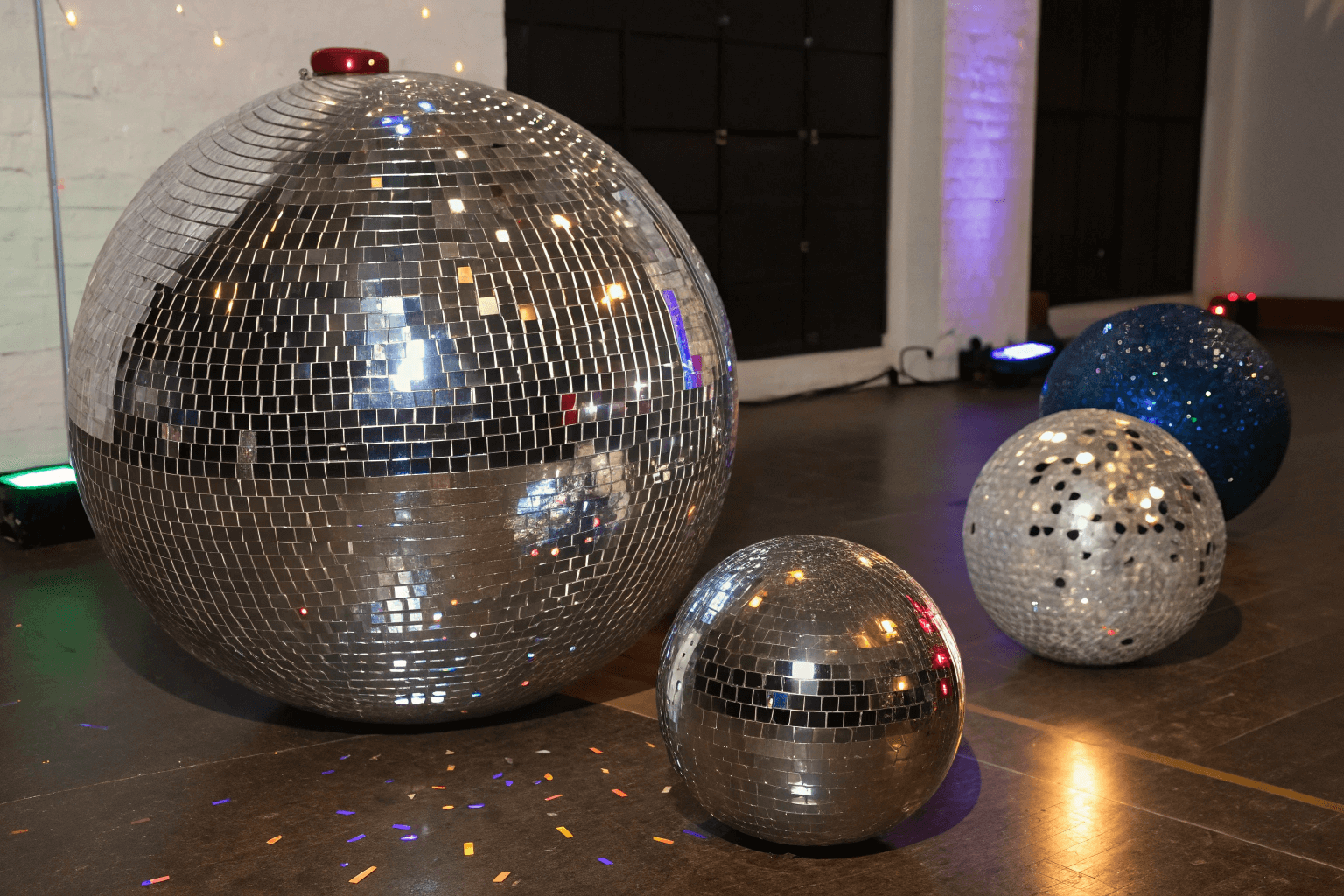
Source Professional-Grade Mirror Balls, Factory Direct.
Wind Load Resistance for Static Suspensions
Static wind load resistance ensures outdoor installations like decorative walls or suspended sculptures remain secure. It involves calculating forces like drag and lift using wind speed and pressure data, then designing anchorage to resist these loads per building codes such as ASCE 7 and AASHTO LRFD.
| Parameter | Value / Formula | Standard / Code Reference |
|---|---|---|
| Base Wind Pressure | 40-50 psf (adjusted for elevation, exposure) | AASHTO LRFD[3] |
| Base Wind Speed | 100 mph (3-second gust) | AASHTO LRFD[3] |
| Drag Force (F_D) | \( F_D = \frac{1}{2} \rho U^2 D B C_D \) | Aerodynamic Analysis[1] |
| Pressure Distribution (Vertical) | 60% windward, 40% leeward (suction) | 780 CMR 1611.5[4] |
| Angle of Attack (AOA) | −3° to 3° | Static Evaluation[7] |
| Test Standard for Rigid Materials | Uniform Static Pressure Difference | ASTM D5206-19[2] |

The Core Engineering Principles of Static Wind Loads
Static wind load analysis uses nonlinear methods to account for how a structure deforms under pressure, as linear models can overestimate safety.
Key forces include drag (F_D), lift (F_L), and torque (M_z), calculated using air density, wind speed, and the structure’s dimensions.
The analysis iterates from an initial state to find equilibrium, updating the structural stiffness matrix [K({δ})] as the installation deforms.
For design, a base wind speed of 100 mph (3-second gust) is commonly used, converted to a pressure range of 40-50 pounds per square foot (psf).
Design Standards and Application for Decorative Installations
Building codes like ASCE 7 and 780 CMR 1611.5 dictate pressure distribution: 60% on the windward side and 40% as suction on the leeward side.
The ASTM D5206-19 standard provides a test method for applying uniform static pressure differences, simulating wind on rigid materials like siding or panels.
Anchorage design must resist combined uplift, shear, and overturning moments, with specifications often derived from bridge engineering codes like AASHTO LRFD.
For event or retail installations, the ultimate design pressure must exceed the site-specific values calculated from local wind maps and exposure categories.
Corrosion-Resistant Rigging Hardware Specs
Selecting the right rigging hardware for outdoor decor requires materials like Type 316 stainless steel and advanced zinc-aluminum coatings to resist corrosion. Key specifications include wire rope construction (like 1×19 for rigidity or 7×19 for flexibility), breaking strengths from 7.5 to over 6,650 lbs, and adherence to a 20% working load limit for safety.

Material Selection and Corrosion Protection
For hardware exposed to harsh outdoor conditions, material choice is the first line of defense. Type 316 stainless steel is the superior choice for marine and saltwater environments due to its 2-3% molybdenum content, offering enhanced corrosion resistance over standard Type 302/304 grades.
Protective coatings provide another critical layer. Advanced coatings like 90/10 Zinc-Aluminum (V-Alloy) provide better corrosion resistance and ductility than standard hot-dip galvanizing, which can reduce a rope’s breaking strength by about 10%.
To ensure quality, hardware should meet material standards such as ASTM A475 Class A or CAN/CSA-G12-92 for galvanized strand, and military specifications like MIL-W-87161 for high-grade, corrosion-resistant steel wire.
Wire Rope Construction and Load Specifications
The internal construction of wire rope determines its application and strength. 1×19 construction is a non-flexible strand ideal for static, standing rigging applications like structural bracing, with breaking strengths ranging from 16.0 lbs for a 3/32″ diameter to 92.0 lbs for a 1/4″ diameter.
For applications involving movement, 7×19 construction offers high flexibility and fatigue resistance for dynamic loads, such as moving decor elements, with breaking strengths starting at 7.5 lbs for a 1/16″ diameter.
For heavier loads, galvanized strand minimum breaking strengths are substantial: 3/16″ diameter ranges from 1,900 to 3,990 lbs, while 1/4″ diameter can handle 3,150 to 6,650 lbs.
The critical safety rule is to never exceed a Working Load Limit (WLL) of 20% of the rope’s minimum breaking strength to account for dynamic forces, wear, and potential corrosion over time.
Cleaning Salt Air Residue from Mirror Tiles
Cleaning mirror tiles in coastal areas requires a specific, non-acidic approach to protect the reflective backing. The correct method uses warm water and soft cloths, while avoiding cleaners suitable for ceramic tile. A regular cleaning schedule with specialized tools prevents long-term damage.

The Critical Chemistry: Why Mirrors Are Different
Mirror backing and edges are vulnerable to chemical attack. Using acid or alkali cleaners can cause permanent damage to these sensitive areas.
Ceramic tile cleaning often involves a 5% hydrochloric acid solution, a method that is explicitly prohibited for mirror surfaces. This fundamental difference in material science dictates separate cleaning protocols.
The only safe chemical agent for mirrors is clean, warm water. It should be applied with soft, lint-free cloths and followed by immediate drying to prevent moisture from seeping into the edges.
Operational Protocol for Coastal Maintenance
In salt-air environments, professional services recommend a monthly or bi-monthly cleaning frequency. This regular schedule prevents corrosive salt residue from building up and becoming more difficult to remove.
Effective tools for this task include purified water systems and streak-free squeegees. Using purified water avoids leaving new mineral deposits, while a quality squeegee prevents water spotting for a clear finish.
A best practice for long-term preservation is using eco-friendly, non-abrasive solutions designed to inhibit future salt adhesion. These products help break down residue without damaging the mirror’s surface or backing.
Seasonal Storage Tips for Outdoor Decor
Effective seasonal storage for outdoor decor requires controlling moisture, temperature, and physical stress. Key steps include thoroughly cleaning and drying items, using climate-controlled spaces for sensitive materials, storing items 6-12 inches off the ground on pallets or shelves, and packing in sturdy, sealed plastic bins instead of cardboard to prevent mold and pest damage.

Pre-Storage Preparation and Environmental Control
Before packing anything away, proper preparation is essential to prevent rust, mold, and other forms of degradation. Start by cleaning and drying every item to a moisture content below 5%. This step is critical for metal and plastic furniture, as residual moisture accelerates corrosion.
For delicate materials like fabrics, electronics, wooden furniture, and high-value holiday decorations, a climate-controlled environment is non-negotiable. This type of storage maintains stable temperatures and keeps humidity levels consistently below 60%, protecting items from warping, brittleness, and mold growth.
Disassemble larger pieces, such as patio furniture. Bag and label all hardware separately to avoid loss. During this process, conduct a thorough inspection for any existing rust, cracks, or mold damage that should be addressed before storage.
Packing Strategies and Spatial Logistics
Your choice of packing materials directly impacts protection. Sturdy, sealed plastic bins are superior to cardboard boxes because they resist humidity and prevent pest access. For fragile ornaments, use bubble wrap, packing paper, or dividers inside these bins to prevent mechanical damage from shifting.
Never store items directly on a concrete or dirt floor. Elevate everything 6 to 12 inches using pallets, shelving units, or wall-mounted racks. This creates a vital air gap that prevents moisture from wicking into your belongings and deters pests.
Choosing the right storage unit size prevents overcrowding, which can cause crushing and restricts air circulation. Base your selection on volume: a small unit (20-80 sq ft) for a few bins, a medium unit (81-150 sq ft) for furniture and multiple bins, or a large unit (151-300 sq ft) for extensive collections.
For large items like patio sets or wreaths that cannot be boxed, use breathable, weatherproof covers. These covers allow for airflow to prevent condensation buildup underneath, which is a common cause of mold during storage.
Final Thoughts
Creating a stunning outdoor event involves more than just aesthetics. The environment presents a constant challenge to materials and structures. From the sun’s UV rays degrading foam and mirror coatings to humidity fostering mold in porous cores, and wind testing the limits of static installations, each element demands a specific, engineered response. The detailed specifications for materials, installation protocols, and hardware aren’t just guidelines—they are the proven methods for preventing failure and ensuring the installation’s safety and longevity.
This rigorous approach to material science and structural engineering is precisely why Fiber Reinforced Polymer (FRP) has become a mandatory choice for ambitious outdoor designs. FRP composites are engineered to meet these challenges head-on. They offer inherent UV stability, moisture resistance, and high strength-to-weight ratios that simplify structural requirements for wind load and rigging. By specifying FRP, designers and event planners can achieve the desired glamour and visual impact without compromising on durability or safety, effectively weatherproofing the glamour from the ground up.
Frequently Asked Questions
Can I use a disco ball outdoors?
Standard glass or plastic disco balls are not designed for outdoor use and should be kept under cover. For outdoor events, weather-resistant alternatives exist, including inflatable mylar balls, professional-grade mirror balls with IP33 ratings, and models specifically built for exterior installation.
Are disco balls waterproof?
Traditional disco balls are not waterproof. Glass versions are fragile, and plastic can degrade. For outdoor or poolside use, specialized waterproof models are available, constructed from materials like PVC tarpaulin, polycarbonate, or foam composites, with some boasting IP67 ratings for full dust and water immersion resistance.
Do disco balls fade in the sun?
Prolonged, direct UV exposure can degrade mirror coatings and plastic substrates over time, leading to fading and loss of reflectivity. For permanent outdoor installations, it’s critical to select products with UV-resistant materials and coatings or to install them in shaded areas to maximize longevity.
What is the best disco ball for pool parties?
The best option for pool parties is a lightweight, inflatable mirror ball, typically around 20 inches in diameter. Made from weatherproof PVC tarpaulin, these are designed to be safe, easy to hang, and resistant to the humid, splash-prone environment of a pool area.
What are the effects of UV on styrofoam decor?
Styrofoam (polystyrene foam) begins to show cosmetic yellowing or fading after 14 to 28 days of direct sunlight. Surface powdering follows, and after 90 days of unprotected exposure, structural integrity can start to degrade. For temporary outdoor displays, this fading is often acceptable, but long-term installations require UV-blocking sealants or coverings.
SEO
Title: Weatherproofing Glamour: Why FRP is Mandatory for Outdoor Events
Description: Event planners need durable materials for outdoor decor. FRP resists UV degradation, mold growth, and wind loads up to 50 psf for long-lasting installations.
URL: fiber-reinforced-plastic-frp-outdoor-event-decor
Keywords: Fiber Reinforced Plastic (FRP)