

For wholesalers and manufacturers shipping fragile goods like glass and mirrors, arrival damage isn’t just a nuisance—it’s a direct hit to your bottom line, costing the industry billions annually. This financial drain, often 0.5% to 2% of gross sales, is compounded by hidden operational costs and reputational damage when products fail to arrive intact.

This article examines how Fiber Reinforced Polymer (FRP) shells offer a structural solution to this persistent problem. We’ll compare the impact absorption of FRP’s flexural strength against traditional foam, explain why a simple dent in a foam core can lead to a total loss, and detail how proper packaging design—informed by principles like packing density and validated by global shipping stress tests—can reduce damage, minimize insurance claims, and protect your margins.
The True Cost of “Arrival Damage” in Wholesale
Arrival damage costs wholesalers 0.5% to 2% of gross sales, translating to billions in annual losses. The true expense includes replacement, return freight, administrative labor, lost sales, and environmental waste, not just the product’s price tag.

The Direct Financial Drain on Wholesale Margins
Damaged products cost manufacturers 1% to 2% of total gross sales, a direct revenue loss. For American businesses, in-transit damage alone costs about 0.5% of gross sales, or roughly $1 billion yearly.
The average cost per damaged and late LTL (Less-Than-Truckload) shipment was $1,988 in 2022. Direct costs include the product’s wholesale value, replacement production or repurchase, and return freight charges.
Hidden Costs and Operational Multipliers
Administrative processing for claims, customer service, and logistics coordination adds significant labor overhead. Damage rates of 11% at distribution centers create operational bottlenecks, delaying order fulfillment and sales.
Environmental costs are substantial: each reshipped package consumes about 1.7 gallons of fuel, and damaged goods contribute to landfill waste. Reputational harm and lost future sales from dissatisfied B2B clients erode long-term profitability and partnership trust.
Damaged products cost manufacturers 1% to 2% of total gross sales, equating to $15 billion annually in lost revenue. In-transit damage costs American businesses 0.5% of gross sales, or about $1 billion yearly. 11% of unit loads arriving at distribution centers suffer damage. Freight damage costs the global logistics industry $50 billion to $60 billion annually.
The average cost per damaged and late LTL shipment was $1,988 in 2022. Ecommerce package damage rate is 1 in 10 (10%), leading to 860 million reshipped packages from 8.6 billion annual shipments. Recent U.S. shipped package damage rate is 3-4%, with 85 million damaged in 2024 from 21.5 billion packages.
Shipping arrival damage, often termed in-transit or freight damage, imposes direct financial losses through replacement, repackaging, return freight, and foregone profits, alongside indirect costs like administrative processing, insurance hikes, and reputational harm. For manufacturers and distributors, these aggregate to 0.5-2% of gross sales, scaling to billions industry-wide due to high shipment volumes—e.g., 11% unit load damage at distribution centers amplifies wholesale impacts.
Hidden multipliers include environmental fallout (e.g., 10 lbs. per damaged product to landfills, 1.7 gallons fuel per reship) and operational disruptions like delays or recalls, eroding margins for logistics managers.
Prevention hinges on packaging design and handling protocols, as root causes precede transport; calculating per-unit damage costs (sale price + replacement + admin) reveals ROI for robust solutions over reactive fixes. Freight-specific data underscores LTL vulnerabilities, with $1,988 average claims reflecting shared truckload stresses. While no ASTM/ISO standards for “arrival damage” appear, these metrics from logistics reports provide benchmarks for wholesale cost modeling.
Impact Absorption: FRP Flex vs. Foam Compression
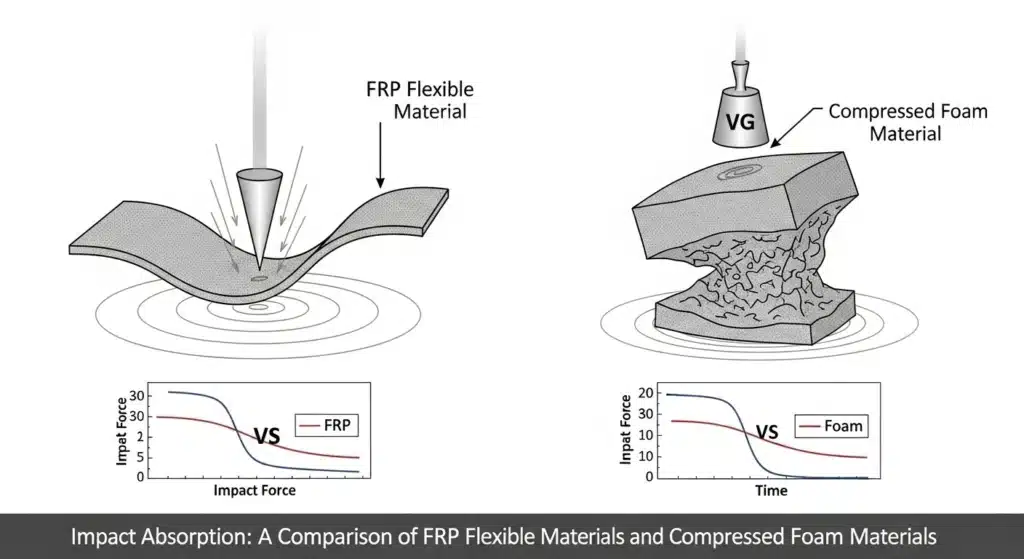
FRP absorbs impact through flexural strength and elastic recovery, distributing force without permanent deformation. Foam absorbs energy through controlled compression and cell deformation, cushioning against vibration and shock. The choice depends on the type of impact and the fragility of the cargo.
| Material | Primary Absorption Mechanism | Key Performance Metric |
|---|---|---|
| FRP (Fiber Reinforced Polymer) | Flexural strength and elastic recovery | Flexural strength up to 30,000 psi |
| Foam | Compression and cell deformation | Compression Deflection (psi) and Density (PCF) |
How FRP Flexural Strength Creates a Protective Shell
FRP’s protective action comes from its flexural strength, which can reach 30,000 psi in the longitudinal direction. This allows the material to bend under a high-velocity impact, such as a drop, without cracking or permanently changing shape.
The mechanism works by distributing the force of the impact across the entire panel. The material’s structural rigidity absorbs the energy, and its elastic properties allow it to rebound. This flex-based resistance is key to preventing a failure called “bottoming out,” where a softer material fully compresses and transfers the shock directly to the cargo.
Compared to metals like steel or aluminum, FRP offers greater ductility under sudden, high-strain impacts. This makes it particularly effective for protecting rigid, high-value items where maintaining the integrity of the shipping container itself is the top priority.
Foam Compression Deflection and Density for Cushioning
Foam protects cargo through a different principle: the controlled compression and recovery of its internal cellular structure. Its performance is primarily measured by Compression Deflection, which is the force in pounds per square inch (psi) required to compress a sample by 25%.
Density, measured in pounds per cubic foot (PCF), is equally critical. A medium density of 2.0–3.0 PCF offers balanced energy absorption for general fragile items. For heavy components or applications requiring resistance to repeated impacts, a high density of 4.0 PCF or greater is necessary.
Industry standards like ASTM D3575 (for compression and recovery) and ASTM D1596 (for shock cushioning) ensure predictable foam performance. This makes foam excellent for isolating cargo from constant vibration and low-velocity shocks. However, under extreme or concentrated loads, foam can permanently compress or bottom out, a scenario where FRP’s rigid structure would continue to provide protection.
Why “Dented” Foam Cores Lead to Total Loss
A dent in a foam core composite panel is not just cosmetic. It indicates internal shear failure at the core-facesheet interface, which critically compromises the panel’s ability to distribute loads. Once the core material is crushed beyond its failure strain of 0.0035 mm/mm, the structural integrity is permanently lost, making the panel unsafe for use under load and leading to a total loss classification.

The Hidden Structural Failure Behind a Dent
A visible dent is the external sign of a critical internal failure. It shows where the foam core material has sheared and detached from the fiberglass facesheet.
This damage starts at the bond between the core and the facesheet. This interface is what allows the composite panel to transfer loads efficiently; when it fails, the entire structural mechanism is disrupted.
The dent is often accompanied by other failure modes you can’t see. The facesheet may buckle locally under the impact, and the resin matrix that holds the fibers together can fragment.
This differentiates it from surface damage on solid FRP. A scratch on fiberglass is often just cosmetic. A dent in a sandwich panel is a symptom of internal, structural damage.
The Catastrophic Failure Threshold and Load Risk
Engineering research defines a precise point of no return for these panels: a catastrophic failure strain of 0.0035 mm/mm. Once the core material is compressed past this limit, the damage is irreversible.
The energy from common shipping impacts—comparable to the slamming events studied in naval contexts with energy ranges of 161 to 779 joules—can easily exceed this strain threshold, especially at low impact angles.
Crossing this threshold permanently and severely degrades the panel’s flexural strength. It can no longer bend or carry weight as designed.
A panel with a crushed core cannot safely handle the stacking loads in a container or the dynamic stresses of transit. Using it poses an unacceptable risk of sudden collapse, which is why it is classified as a total loss—to prevent a catastrophic failure later in the supply chain.
Supporting Research & Data
Studies on foam core sandwich composites, common in marine applications, show that impacts within an energy range of 161-779 J cause progressive damage. Lower impact angles (0°-45°) result in more severe material degradation.
While pressure measurements don’t always correlate with visible damage, strain analysis is definitive. The research identifies 0.0035 mm/mm as the critical strain threshold for total failure.
The dominant failure mode is core shear at the facesheet interface, accompanied by local buckling of the facesheet and fragmentation of the resin matrix. It’s worth noting that for dents that do not exceed the failure strain, the reduction in flexural capacity can be minimal, indicating potential for controlled reuse.
Quasi-static models that account for hydroelasticity can accurately predict the strain from slamming impacts, providing a reliable tool for assessing damage tolerance. In logistics, a dent from handling mimics this slamming effect, compromising the panel’s integrity. The core shear failure disrupts load distribution, reducing the panel’s overall tolerance and aligning with the strict standards for composite structures in demanding applications, justifying the total loss classification to mitigate risk.
Source Commercial-Grade Mirror Balls, Not Party Favors.

Packing Density and Weight-to-Strength Ratios
Packing density is the ratio of solid particle volume to total volume. Higher packing means fewer voids, requiring less binding material and less water. This creates a denser, stronger structure for a given weight, a principle that informs the design of protective packaging to minimize damage and shipping costs.

The Physics of Packing: Minimizing Voids for Maximum Strength
Packing density is the volume of solid particles divided by the total bulk volume of a mix. A higher value means less empty space.
In concrete science, optimal aggregate blends (e.g., 42% 20mm, 18% 12.5mm, 40% fine) achieve a maximum packing density of 0.722 gm/cc, reducing voids to just 28.66%.
This gradation fills larger gaps with smaller particles, creating a dense skeletal structure that requires less paste or resin to bind it together.
The ‘wet packing method’ uses this principle with superplasticizers to achieve ultra-low water-to-powder ratios, enabling exceptional strength from a minimal material framework.
From Lab to Loading Dock: Applying the Principle to Protective Packaging
A denser, well-packed material structure achieves higher compressive strength with less overall mass. For example, optimized concrete mixes achieve strengths over 74 MPa.
This principle informs material selection for protective packaging: a solution with a better weight-to-strength ratio protects fragile goods without adding excessive shipping weight or bulk.
Reducing void content minimizes points of failure and compressibility, leading to packaging that better resists the static and dynamic loads encountered during global shipping.
The ultimate goal is to apply this engineering mindset to lower the risk of ‘arrival damage,’ reduce freight costs per unit, and minimize the total loss incidents associated with inferior, compressible materials like standard foam.
Case Study: Global Shipping Stress Tests
Global shipping stress tests are standardized lab simulations that replicate the vibration, drops, compression, and environmental conditions of real-world transit. Protocols like ISTA 3A for parcels and ASTM D4169 for distribution profiles help manufacturers identify packaging weaknesses before products ship, reducing damage and insurance claims for fragile goods like mirrors and disco balls.

How Lab Tests Simulate Real-World Shipping Hazards
Standardized tests replicate specific supply chain dangers to move packaging design from guesswork to physics-based validation. For example, ISTA 3A specifies parcel drops from 30 inches for packages under 21 lbs, simulating common handling errors. Vibration tests use ASTM D4169 profiles to mimic the random, sustained shaking experienced during road, air, and rail transport.
Environmental conditioning is another critical layer. Protocols like ISO 11607 define thermal cycling and humidity control to simulate the climate changes a shipment might encounter from a warehouse to a delivery truck. The core purpose of these combined tests is to identify failure points—such as weak corrugation or insufficient cushioning—before a product ever enters the logistics network.
Applying Test Protocols to Protect Fragile Shipments
For high-value, fragile items, applying the right combination of protocols is key to engineering robust packaging. Shipping a large mirrored furniture piece, for instance, requires validating the crate’s strength against warehouse stacking. A test plan might combine ISTA 3E for unitized loads with ASTM D642 compression testing to ensure the structure can handle the static load of other pallets.
Protecting complex assemblies, like a motorized mirror ball, involves testing for multiple failure modes. Vibration profiles from ASTM D4169 can reveal if internal components resonate at certain frequencies during ocean freight, while horizontal impact tests per ISO 22248 simulate the shocks from container handling. This lab data is then complemented with field trials to account for the unpredictable variability of real-world handling, creating a comprehensive strategy to minimize total loss rates for distributors.
Insurance Claim Minimization for Distributors
Distributors minimize claims by transferring risk to cargo insurance, which provides coverage beyond carrier liability caps, and by implementing rigorous documentation and process controls. Effective management cuts the average 90-120 day resolution time and prevents denials based on packaging or procedural errors.
| Key Concept | Impact on Claims | Data Point / Convention |
|---|---|---|
| Claim Resolution Time | Defines the administrative burden and cash flow delay for a distributor. | 90-120 days average after formal submission. |
| Carrier Liability Limit | Caps recovery, often below the full value of lost or damaged goods. | Capped by the Montreal Convention (air) and COGSA (ocean), based on weight or piece count. |
| Preliminary Notice (PNC) | Critical to preserving legal rights to file a formal claim later. | Must be filed within strict, mode-specific time limits. |
| Claims Handling Expense | Internal costs that reduce the net recovery from a claim. | Reduced via automation and process streamlining in modern systems. |

The Core Strategy: Risk Transfer vs. Carrier Liability
Relying solely on a carrier’s liability for cargo loss or damage leaves a distributor exposed to significant financial risk. Carrier liability is not designed to make the shipper whole but is instead limited by international conventions.
For air freight, the Montreal Convention limits liability, while the Carriage of Goods by Sea Act (COGSA) governs ocean shipments. These frameworks calculate compensation based on the weight or number of pieces, not the commercial invoice value of the goods. A high-value, low-weight shipment could see a recovery of only a fraction of its worth.
Furthermore, carriers can deny claims outright for specific reasons. Common exclusions include “inherent vice” (a natural defect in the goods), improper packaging, or events classified as “Acts of God.” In these cases, the shipper bears a total loss.
A dedicated cargo insurance policy directly addresses these gaps. It transfers the risk from the distributor’s balance sheet to the insurer. More importantly, it shifts the legal and procedural burden. Under an insurance claim, the insurer must typically prove an exclusion applies, whereas with a carrier claim, the shipper must prove the carrier’s negligence. This fundamental shift enables full recovery of the insured value, protecting the distributor’s profit margins.
Operational Controls for Faster Recovery & Lower Costs
Having insurance is the first step; managing the claims process efficiently is what minimizes cost and disruption. The process begins immediately upon discovering an issue. Filing a Preliminary Notice of Claim (PNC) with the carrier within the legally mandated timeframe is non-negotiable. This formal notice reserves your right to file a detailed claim later, even before a full inspection is complete.
A successful formal claim, whether to a carrier or insurer, is built on documentation. Essential evidence includes the original Bill of Lading, independent inspection reports, commercial invoices, packing lists, and photographs of the damaged goods and packaging. Incomplete documentation is a primary cause of delays and denials.
Beyond managing single claims, distributors should analyze claims data to prevent future losses. Advanced claims management systems can identify patterns, such as frequent damage on a particular lane, consistent issues with a certain product type, or recurring packaging failures. This intelligence informs corrective “loss control” measures, like modifying packaging specifications, selecting different carriers for specific routes, or adjusting warehouse handling procedures.
Finally, streamlining the claims process itself reduces internal handling expenses. Automating document collection, using standardized claim forms, and integrating claims management with other logistics software cuts down on administrative labor. These efficiencies directly contribute to reducing the average 90-120 day resolution timeline, improving cash flow and operational focus.
Repairing Minor FRP Scuffs vs. Major Foam Failure
Minor FRP scuffs are cosmetic surface damage that can be repaired in the field with sanding and patching to prevent moisture ingress. Major foam failure involves core exposure, requiring advanced structural repairs like scarfing or full panel replacement to restore load-bearing integrity and prevent total loss.

Field Repairs for Superficial FRP Damage
Minor FRP damage is defined as scuffs and scrapes that affect only the outer gelcoat or laminate layer. The key indicator is that there is no exposure of the underlying fiberglass or the panel’s core material.
The standard repair procedure begins by sanding a perimeter of at least 2 inches around the damaged area. Technicians then clean the surface thoroughly with a wire brush and solvent to remove all contaminants. The final step is applying a cosmetic filler or a patch.
The primary objective of this repair is to restore the panel’s moisture barrier. A common, cost-effective method is a patch repair using a wet lay-up technique with glass fibre mats and cold-cure resins. This approach is fast and can often be completed on-site.
These techniques are designed to restore the surface’s integrity and prevent further environmental damage. They are considered suitable for field conditions and do not address the structural load-bearing capacity of the panel, which remains intact with minor damage.
Workshop Repairs for Structural Core Compromise
Major failure occurs when damage, typically a gouge 2 inches wide or more, penetrates through the outer skin and exposes the foam or plywood core. This exposure creates an immediate risk for moisture absorption, which can lead to delamination and a complete bond failure within the sandwich panel.
Repairs for this level of damage are structural. Methods include installing filler plugs, laminating with glass cloth patches that overlap the sound laminate by at least 2 inches, or creating scarf repairs with a precise taper ratio between 20:1 and 50:1. These techniques require controlled workshop environments.
Executing these repairs demands skilled technicians and often specialized equipment like vacuum bagging or heat curing systems. The goal is to meticulously restore the panel’s original stiffness and lap shear strength, which are critical for its load-bearing function.
If the core damage is too extensive, the only viable solution is a full panel replacement. Delaying repair of core exposure is not an option, as it leads to progressive degradation from moisture ingress, significantly increasing the likelihood and cost of a total loss.
Final Thoughts
The data shows that arrival damage is a significant and costly reality for wholesalers, with losses often hidden in administrative overhead and lost sales rather than just product replacement. While traditional materials like foam offer cushioning, their structural vulnerability—where a simple dent can signal a total loss—presents a major risk for high-value, fragile shipments. FRP shells, with their flexural strength and elastic recovery, provide a different kind of protection, one based on structural integrity and the ability to distribute impact forces without permanent failure.
For logistics managers and distributors, the choice of packaging material directly influences the bottom line. A solution that combines high packing density for strength with a favorable weight-to-strength ratio can reduce both damage rates and freight costs. Validating this choice through standardized stress tests and managing the financial risk with proper insurance and claims processes creates a comprehensive strategy. Ultimately, investing in robust, damage-resistant packaging like FRP is not just a cost of doing business; it’s a proactive measure to protect revenue, customer relationships, and operational efficiency in a complex global supply chain.
Frequently Asked Questions
How should I pack disco balls for international shipping?
Use a rigid outer box, such as plywood-reinforced cardboard, that can withstand a 4-foot (1.2-meter) drop test. Wrap each ball individually in bubble wrap or equivalent cushioning to prevent movement and absorb impact during transit.
Why did my disco ball arrive dented?
Dents typically result from packaging that fails against compressive forces, impact, and vibration. Industry standards recommend packaging that can survive a minimum 15 cm (6 in.) drop test. Using reinforced structures like double-wall boxes is crucial to prevent crush damage.
Is fiberglass more impact resistant than foam?
No. Rigid foam boards and spray foams generally offer higher durability and compressive strength. For example, closed-cell spray foam has a compressive strength of about 25 psi, while fiberglass has low compressive strength and is more susceptible to damage and settling.
What should I know about shipping insurance for mirror balls?
Standard insurance for fragile items like mirror balls often requires custom crating. Without proper packaging, damage rates can reach 15-20%. Premiums are influenced by the declared value and the item’s weight, which for common models ranges from 1.5 to 6.94 lbs (0.7 to 3.15 kg).
How can I reduce breakage in bulk mirror ball orders?
Implement secondary safety attachments, like chains or cables, rated to hold 12 times the ball’s weight. Limit chain length to 100cm, ensure mounting structures can support 10 times the weight for an hour, and restrict the maximum drop distance during handling to 20cm.
Can a dented disco ball be repaired?
Typically, no. Disco balls with plastic cores and glass mirror facets cannot be reliably repaired due to the fragility of the facets. Industry safety standards require replacing damaged facets or the entire unit to prevent hazards, with regular inspections for loose fittings.