

Choosing between glass and plastic mirror tiles isn’t just about aesthetics—it’s a critical specification decision that impacts the longevity, performance, and perceived value of your project. The wrong material can lead to yellowing, distorted reflections, and a compromised finish that fails to meet client expectations.

This guide breaks down the technical and commercial realities. We’ll compare the physics of reflection, where glass provides a stable 4% reflection per surface versus the variable performance of polymers. We’ll examine long-term durability, including how plastic yellows due to photo-oxidation while glass remains inert. You’ll get the data needed to justify material selection, from refractive indices and UV resistance to weight calculations and total cost of ownership.
The Physics of Reflection: Glass vs. Polymer
Glass provides a crisper, more stable reflection than plastic due to its higher and more consistent refractive index. A standard glass surface reflects about 4% of light per interface, leading to predictable, specular reflection ideal for mirrors. Polymers have lower, more variable refractive indices and are sensitive to temperature changes, which can distort the reflected image.
| Material | Refractive Index (n) | Key Optical Property |
|---|---|---|
| Window Glass | ~1.52–1.53 | ~4% reflection per surface; stable across temperature & spectrum. |
| Common Polymers (e.g., PMMA, PC) | < 1.6 | Lower, variable n; high thermal coefficient (dn/dT) causes distortion. |

How Refractive Index Defines Reflection Clarity
Reflection is governed by the Fresnel equations, where the amount of light reflected depends on the material’s refractive index (n).
Standard window glass has a refractive index of approximately 1.52 to 1.53 for green light (λ = 0.547 μm), resulting in a consistent 4.1% to 4.4% reflection per surface.
For a typical glass tile or mirror, this means about 8.5% to 8.8% of incident light is reflected from the front and back surfaces combined, creating a sharp, specular image.
Common polymers like PMMA (acrylic) and polycarbonate have lower refractive indices, typically below 1.6, which inherently reduces their reflective capability compared to glass.
Material Stability: Thermal and Spectral Performance
Glass maintains a stable refractive index across a wide range of temperatures and the visible light spectrum, ensuring consistent reflection angles.
Polymers exhibit a high thermal coefficient of refractive index (dn/dT), meaning their reflective properties can shift with temperature changes, potentially distorting images.
Glass has a high hardness and negligible thermal expansion compared to polymers, preventing surface deformation that scatters light.
Polymers like PMMA have a glass transition temperature (Tg) of 88°C, above which they soften, while specialized polymers may reach 156°C, but all are less thermally stable than inert glass.
UV Resistance: Why Plastic Yellows Over Time
Plastic yellows due to photo-oxidation, where UV light breaks chemical bonds, creating chromophores that absorb visible light. This process, measured by standards like ASTM G154, causes a visible color shift (Delta E) and loss of strength. In contrast, glass is inert and does not undergo this chemical degradation.

The Chemistry of Yellowing: Photo-Oxidation Explained
The core process is photo-oxidation. Ultraviolet light, typically between 280-390 nm for common plastics, provides enough energy to excite reactive sites within the polymer. These sites, often carbonyl groups (C=O), absorb the UV energy and undergo Norrish I or II reactions.
These reactions initiate a free radical chain reaction with atmospheric oxygen. This leads to polymer chain scission—the breaking of the long polymer chains—and the formation of new chemical structures with conjugated double bonds.
These conjugated structures, such as quinones in aromatic polymers like polycarbonate, are chromophores. They absorb light in the visible spectrum, specifically in the blue/violet range, which causes the material to reflect or transmit a yellow or brown hue. The same chemical reactions that cause discoloration also lead to embrittlement and a significant loss of mechanical properties like tensile strength and impact resistance.
Quantifying Degradation: Testing Standards and Material Performance
Industry standards like ASTM G154 (using fluorescent UV lamps) and ISO 4892-2 (using xenon arc lamps) allow for accelerated aging. These tests simulate years of outdoor UV exposure in a matter of weeks, enabling precise tracking of color change (measured as Delta E) and the loss of material properties.
Performance data reveals a clear hierarchy. For instance, polyethylene (PE), when properly formulated with UV stabilizers, can achieve an outdoor service life exceeding 10 years, maintaining color and strength better than many competitors at exposures up to 5000 kJ/m². In contrast, unstabilized plastics like ABS and nylon show rapid, significant yellowing and embrittlement, making them unsuitable for long-term outdoor use without protective coatings.
Mitigating UV damage primarily relies on additives. Hindered Amine Light Stabilizers (HALS) are highly effective at scavenging the free radicals generated during photo-oxidation. For the highest resistance, inherently stable fluoropolymers like PTFE (Teflon) or PVDF are used. Their strong carbon-fluorine bonds are highly resistant to the UV-initiated reactions that cause yellowing in standard plastics.
Color Depth: The Brilliance of Silver-Backed Glass
Silver-backed glass creates unmatched color depth through a combination of acid-etched surface texturing and a hermetically sealed metallic silver coating. This process, applied to a low-iron glass substrate, yields high light reflection with minimal color variation (ΔE* ≤2), delivering a consistent, brilliant finish that plastic cannot replicate.
| Property Category | Key Specification | Value / Standard |
|---|---|---|
| Mechanical | Characteristic Bending Strength | 45 N/mm² |
| Mechanical | Knoop Hardness | 6 GPa |
| Optical | Light Reflection (ρ’v) Tolerance | ±5% (per EN 410) |
| Optical | Color Uniformity (ΔE*) | ≤2 (CIE LAB D65 10° SCI) |
| Thermal | Softening Point | ~600°C |
| Quality | Mirror Standard Compliance | Fed. Spec. DD-M-411C, ASTM C1036-91 |

How Silver Backing Creates Unmatched Depth
Color depth refers to the richness and three-dimensional quality of a reflective surface, a key differentiator for luxury interiors.
The process begins with acid-etching the glass surface to create a uniform haze, which scatters light to reduce glare and enhance the perception of depth.
A low-VOC, water-based silicone paint containing metallic silver is then applied to the back of a low-iron glass substrate.
This silver coating is often sealed with an electrolytic copper layer, creating a hermetically sealed, durable reflective surface that prevents tarnishing.
The combination of textured front and reflective back creates multiple light paths, resulting in a deeper, more complex visual than a simple surface reflection.
Technical Specifications for Consistent Brilliance
Optical performance is quantified by light reflection (ρ’v) per EN 410, with tight tolerances (±5%) to ensure batch-to-batch consistency.
Color uniformity is strictly controlled, with a ΔE* value of ≤2 (CIE LAB D65 10° SCI) between panes from the same production batch.
The glass substrate provides structural integrity, with a characteristic bending strength of 45 N/mm² and a Knoop hardness of 6 GPa.
Defect limits are rigorously defined; for example, in jumbo panels, punctual faults over 2mm are not accepted, and clusters are prevented.
The material meets industry standards including Fed. Spec. DD-M-411C and ASTM C1036-91 for mirror quality, ensuring reliability for architectural specifications.
Source Professional Mirror Balls, Engineered for Impact.
Weight Implications for Rigging Real Glass
The weight of glass is predictable, calculated by multiplying panel area by thickness and the material’s density constant of 2.5 kg per mm per m². This data is critical for selecting the correct lifting equipment, such as vacuum lifters, and for planning structural support and logistics in architectural projects.

The Predictable Physics of Glass Weight
Glass density is a universal constant of 2,500 kg/m³, or 2.5 kg per mm of thickness per square meter. This consistency makes weight a reliable engineering factor.
The standard formula is Length (m) × Height (m) × Thickness (mm) × 2.5 = Weight (kg). For example, a 1 m² panel of 10 mm glass weighs about 25 kg.
This principle applies to common architectural glass types like clear, tempered, and laminated, making weight estimation straightforward for specification.
Rigging Equipment and Installation Logistics
Vacuum lifters are the primary rigging tool, with capacities ranging from 320 kg for single-pad systems to over 1,000 kg for multi-cup industrial systems. The technical constraint is often the lifting apparatus, not the glass itself.
Panel surfaces must be clean, smooth, and free of protective film to ensure a secure vacuum seal and prevent lifting failures. Air-impermeable surfaces are a key safety requirement.
Weight directly influences three key project decisions: the required strength of structural framing, the need for mechanical assistance during installation, and the associated costs for transport and labor.
Scuff Resistance in High-Traffic Hospitality
In hospitality settings, glass offers superior scratch resistance and a non-porous surface for hygiene but can be vulnerable to abrasive cleaners and shattering. Plastics like coated polycarbonate provide unmatched impact resistance and flexibility, though their surface is more prone to scuffing without protective hard coatings. The choice balances long-term surface integrity against resilience to physical damage.

The Core Trade-off: Surface Hardness vs. Impact Resilience
Glass materials, including architectural tiles and tempered glass, have an inherent hardness that makes them highly resistant to scratches from everyday contact, outperforming most untreated plastics.
Plastics like acrylic (PMMA) have a surface hardness of 4H-5H on the pencil scale, resisting marks from dust and fingernails, but are softer than glass and more susceptible to abrasion.
Polycarbonate is 250 times more impact-resistant than glass in its raw form, making it ideal for areas prone to impacts, but it scratches easily without a protective hard coat.
The non-porous, 0% water absorption nature of glass prevents staining and aids hygiene but leaves it vulnerable to damage from abrasive cleaning tools and sanded grout.
Application and Specification for Hospitality Durability
For floors in lobbies or corridors where fine abrasives like dust and sand are present, glass maintains its optical clarity longer but requires careful cleaning protocols to avoid surface damage from abrasives.
In dynamic spaces like bars or restaurants where dropped items are a risk, hard-coated polycarbonate provides a critical balance, offering near-glass-level abrasion resistance with extreme impact strength to prevent shattering.
Tempered or laminated glass should be specified for vertical surfaces like feature walls where impact risk is lower, prioritizing pristine reflection and ease of cleaning with oleophobic coatings to reduce smudges.
Architects should always specify hard-coated variants for plastic tiles to match glass-like abrasion performance, as uncoated plastics like TPU or PET will degrade faster under repeated cleaning and foot traffic.
The “Luxury Feel” Factor for Interior Designers
Luxury in interior design is defined by premium, authentic materials that offer superior texture, warmth, and durability. For surfaces like tiles, glass provides a clean, integrated aesthetic and subtle tactile quality that aligns with high-end standards, while plastic often conveys a synthetic, inferior feel that undermines a space’s refinement.

Defining Luxury Through Material Authenticity
Luxury prioritizes natural, authentic materials like polished marble, quarried stone, solid wood, and hand-woven fabrics over synthetic laminates or veneers.
These materials provide deep sensory qualities: rich grain textures in book-matched oak, subtle veining in single-slab marble, and the softness of velvet or boucle textiles.
Authenticity and craftsmanship are key, with seamless joints and bespoke installations ensuring every surface contributes to a cohesive, high-end experience.
Applying the Luxury Standard to Surface Finishes
In surface design, materials like smoked glass or expansive glazing are favored for their clean lines, integrated look, and subtle, cool-to-the-touch tactile quality.
Glass tiles support the luxury principle of layering—combining their smooth, reflective surface with soft elements like plush textiles or weathered woods to create inviting elegance.
Plastic tiles, by contrast, often lack the depth, weight, and authentic feel of natural materials, risking a perception of cheapness that contradicts a luxury interior’s goals.
Cost-Benefit: Why Glass is the Better Long-Term Asset
While glass carries a higher initial cost, its superior durability, minimal maintenance, and enduring aesthetic quality deliver a lower total cost of ownership over time. For professionals, this translates to fewer replacements, sustained client satisfaction, and a stronger brand reputation for quality.

The True Cost of Ownership: Upfront Investment vs. Long-Term Value
Glass products typically command a 20-30% premium over ceramic or plastic alternatives due to material quality and specialized fabrication. Professional installation for glass is more complex, requiring precise tools and expertise to manage its fragility.
Once installed, glass offers exceptional longevity, often matching the lifespan of the building structure itself when used in appropriate applications. Its inherent resistance to stains, mold, and mildew eliminates the need for harsh chemical cleaners and frequent deep maintenance.
Performance Metrics That Protect Your Investment and Reputation
Glass maintains high scratch resistance and optical clarity, unlike plastic which can yellow and become hazy from UV exposure over time. It exhibits low thermal expansion and contraction, reducing stress on installations and adhesives in environments with temperature fluctuations.
The material offers better insulation properties and superior resistance to weather and chemical corrosion compared to many plastics. For architects and event pros, this means the reflective brilliance and ‘luxury feel’ specified on day one remain intact for years, protecting the design intent and client relationship.
Final Thoughts
The choice between glass and plastic for reflective surfaces comes down to a fundamental trade-off between optical authenticity and practical compromise. Glass delivers a crisp, stable reflection with unmatched color depth and long-term durability, rooted in its consistent physical properties and inert chemistry. Plastic offers advantages in weight and impact resistance but makes concessions in image clarity, UV stability, and perceived quality.
For professionals specifying materials where visual performance and longevity are paramount—such as in luxury hospitality, high-end retail, or permanent architectural features—glass remains the definitive choice. Its higher initial investment is justified by a lower total cost of ownership, sustained aesthetic integrity, and the assurance that the design vision will endure without degradation. In applications where temporary use, extreme weight constraints, or safety from breakage are the primary drivers, advanced coated plastics provide a viable, though optically different, alternative.
Frequently Asked Questions
How can I tell if a disco ball uses real glass mirror tiles?
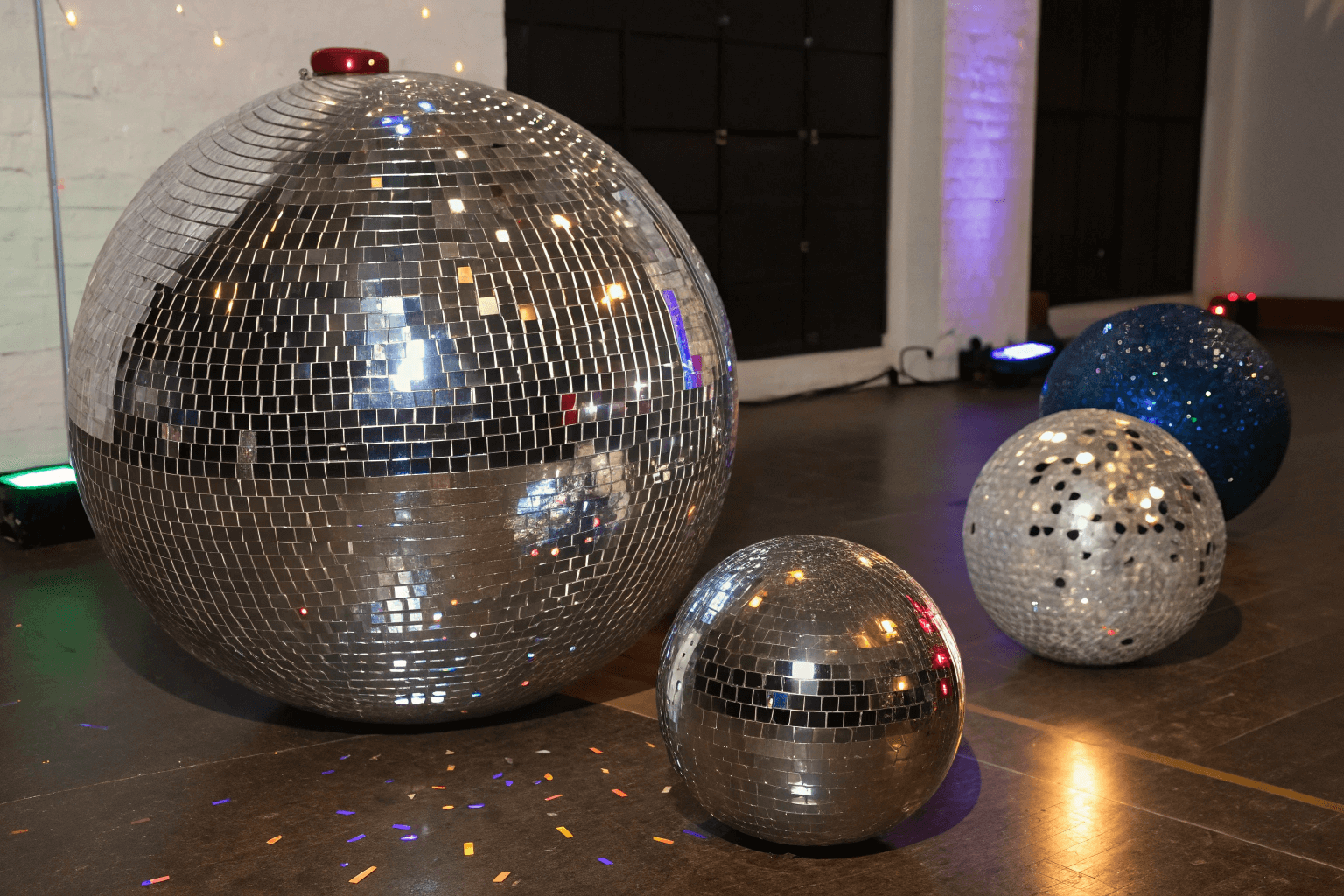
Real glass tiles are identified by their 10mm thickness on premium models, sharp 1/2-inch to 1-inch square facets, and significantly heavier weight—an 20-inch glass ball weighs around 18 lbs. A simple tap test produces a solid ‘clink’ sound, and the edges feel crisp without any flexing, unlike plastic’s dull ‘thud’.
Do plastic mirror tiles scratch easily?
Standard uncoated acrylic plastic tiles are softer and can scratch more easily than glass. However, many plastic mirror products now include an optional scratch-resistant hard-coat layer, available on 3mm and 6mm thicknesses, which significantly improves abrasion resistance and extends the product’s usable life.
Why should I choose glass over PVC for decorative applications?
Glass is chosen for its superior clarity, timeless aesthetic, and long-term durability. It is fully impervious to liquids and stains, requiring only simple wipe-down cleaning, and will not yellow or degrade over time. PVC, while useful for insulation, lacks the visual premium and longevity required for visible decor like backsplashes or feature tiles.
What is the best way to clean glass mirror tiles?
The industry standard is to use clean, warm water with a soft, lint-free cloth. Wring out excess water before wiping the surface, then dry immediately with a separate dry, lint-free cloth. For hard water stains, a water-vinegar solution can be applied and left for 5 to 10 minutes before wiping and drying to protect the tile edges and silver backing.
What is the weight difference between a glass and a plastic disco ball?
Glass balls are substantially heavier. The density of soda lime glass is about 2.5 g/cm³, while common plastics like acrylic or polycarbonate have a maximum specific gravity around 1.4 g/cm³. This means a glass ball can weigh approximately 1.6 to 2.8 times more than a plastic ball of the same size, a critical factor for rigging and installation.
Do real glass disco balls or their mirrors fade over time?
No, real glass mirror tiles do not fade. They are manufactured from highly reflective glass designed for maximum and consistent light reflection. There are no industry standards or specifications that indicate a loss of reflectivity or fading over time, making glass a permanent solution for installations where lasting brilliance is required.