

Specifying a large-scale disco ball for a commercial space is more than an aesthetic choice—it’s a structural and logistical challenge. The weight of a 48-inch model can exceed 105 pounds, and standard shipping methods often fail for diameters over 20 inches, requiring specialized freight. Getting the scale, support, and lighting wrong doesn’t just dim the effect; it introduces significant safety and budget risks.

This guide breaks down the critical engineering decisions for architects and designers. We’ll cover how to correctly size a ball for ceiling heights over 8 meters, compare the structural demands of steel truss versus concrete support, and detail the professional maintenance protocols, including mandatory load tests and four-year acceptance inspections, required for permanent, code-compliant installations.
The Impact of Scale in Modern Design
Scale is the primary factor determining a disco ball’s performance. Larger diameters increase facet count and weight, creating more dramatic light coverage for bigger venues. The choice of size follows a proportional rule, with specific engineering and logistical considerations escalating for balls over 20 inches in diameter.

How Size Dictates Visual Impact and Space Suitability
The physical scale of a disco ball directly determines its visual impact and the 360-degree pattern of light it casts. A larger diameter ball contains more mirrored facets, which creates a denser, more dramatic field of light beams. The relationship between ball size and room size is proportional. A common guideline is to add 4 inches of ball diameter for every 100 square feet of floor space. This helps achieve balanced lighting that fills the room without being overwhelming or too subtle.
For intimate spaces under 150 square feet, smaller balls between 8 and 12 inches are suitable. Medium-sized balls, from 12 to 16 inches in diameter, effectively cover rooms between 150 and 300 square feet. To create a truly dramatic lighting effect in larger venues over 300 square feet, a ball that is 20 inches or larger is typically required. As the ball’s diameter increases, the size of the individual glass mirror tiles also grows. While a 12 to 16-inch ball uses ½” x ½” tiles, models 20 inches and larger shift to 1” x 1” tiles. This maintains an optimal density of reflective surfaces for the larger surface area.
Engineering and Logistical Demands of Larger Scales
The engineering requirements for a disco ball increase significantly with its scale. Weight scales exponentially, not linearly, with diameter. A 12-inch ball may weigh around 5 pounds, but a 48-inch model can weigh 105 pounds or more. This increase comes from the sheer accumulation of glass mirror tiles and the necessary internal support structure, often a dense foam core.
Installation demands change fundamentally for balls over 20 inches in diameter. Standard mounting hardware is insufficient; reinforced brackets, swivels, and motors rated for the specific weight are mandatory. Before installation, the load capacity of the ceiling structure must be verified. Logistically, shipping becomes a major consideration. Balls in the 20 to 22-inch range often hit a dimensional weight limit of 75-95 pounds for standard carriers like UPS. Models 28 inches and larger almost always require common carrier freight shipping on pallets and incur additional crate fees.
For permanent installations in retail or event spaces where a full sphere is not necessary, half-sphere variants offer a practical alternative. By reducing the surface area and material, a half-sphere can cut the total weight by 20-30%. For example, a 48-inch full sphere might weigh 105 pounds, while a half-sphere of the same diameter could be around 100 pounds, simplifying handling and mounting.
Choosing the Right Diameter for High Ceilings
For high ceilings, the disco ball diameter must scale up significantly to project reflections effectively across the vertical space. A 30cm ball works for standard 2.4m rooms, but heights over 3.66m require at least 50cm. In spaces exceeding 8m, an 80-100cm diameter is optimal for maximum light coverage, with weight and mounting requirements increasing accordingly.

| Ceiling Height | Recommended Diameter | Key Considerations |
|---|---|---|
| 2.4m (Standard Room) | 30cm (12 inches) | Baseline starting point for effective light dispersion. |
| 3.66m (12 feet) | 50cm (20 inches) minimum | Weighs approx. 16 lbs; requires reinforced ceiling mount. |
| Over 8m (26 feet) | 80-100cm | Optimal for maximum, even beam spread in very tall volumes. |
The Physics of Scale and Light Dispersion
Light from a disco ball scatters based on its surface area and facet count. A larger ball has more mirror facets, which creates denser and farther-reaching reflections. This is critical in tall spaces where light must travel a greater vertical distance.
If the ball is too small for the ceiling height, the reflections become diluted and weak. They fail to fill the volume of the room, resulting in a lackluster visual effect. The intensity of the light pattern diminishes over distance.
The standard baseline is a 30cm (12-inch) ball for a 2.4m ceiling. For every significant increase in height, the diameter must increase proportionally to compensate for the expanded projection area. This scaling ensures the reflection density remains effective.
For ceilings over 8m (26ft), an 80-100cm diameter is optimal. This size provides enough surface area and facet count to achieve an even beam spread, preventing visual hotspots or dark shadows in the large space.
Practical Sizing Guidelines and Installation Data
The minimum recommended diameter for a 3.66m (12ft) ceiling is 50cm (20 inches). A ball of this size weighs approximately 16 lbs. The increased weight and rotational forces mean it requires a professionally installed, reinforced ceiling mount, not a standard hook.
A useful sizing proxy ties diameter to room area: add about 10cm (4 inches) in diameter for every 100 square feet of floor space. For example, a 500+ sq ft room with high ceilings will typically need a ball that is at least 50cm in diameter to adequately cover the area.
Installation for high ceilings involves several critical factors. Maintain a minimum clearance of 7-8 feet from the floor to the bottom of the ball. Use a motor with a speed of 15-30 RPM to handle the rotational torque of a heavier ball. Always verify the ceiling’s load capacity can support the static weight and dynamic forces.
For safety in elevated installations, acrylic mirror facets are often preferred over glass. Acrylic is shatter-resistant, reducing risk if the ball is impacted or if a facet were to detach from a significant height.
Static Suspension vs. Clustered Layouts
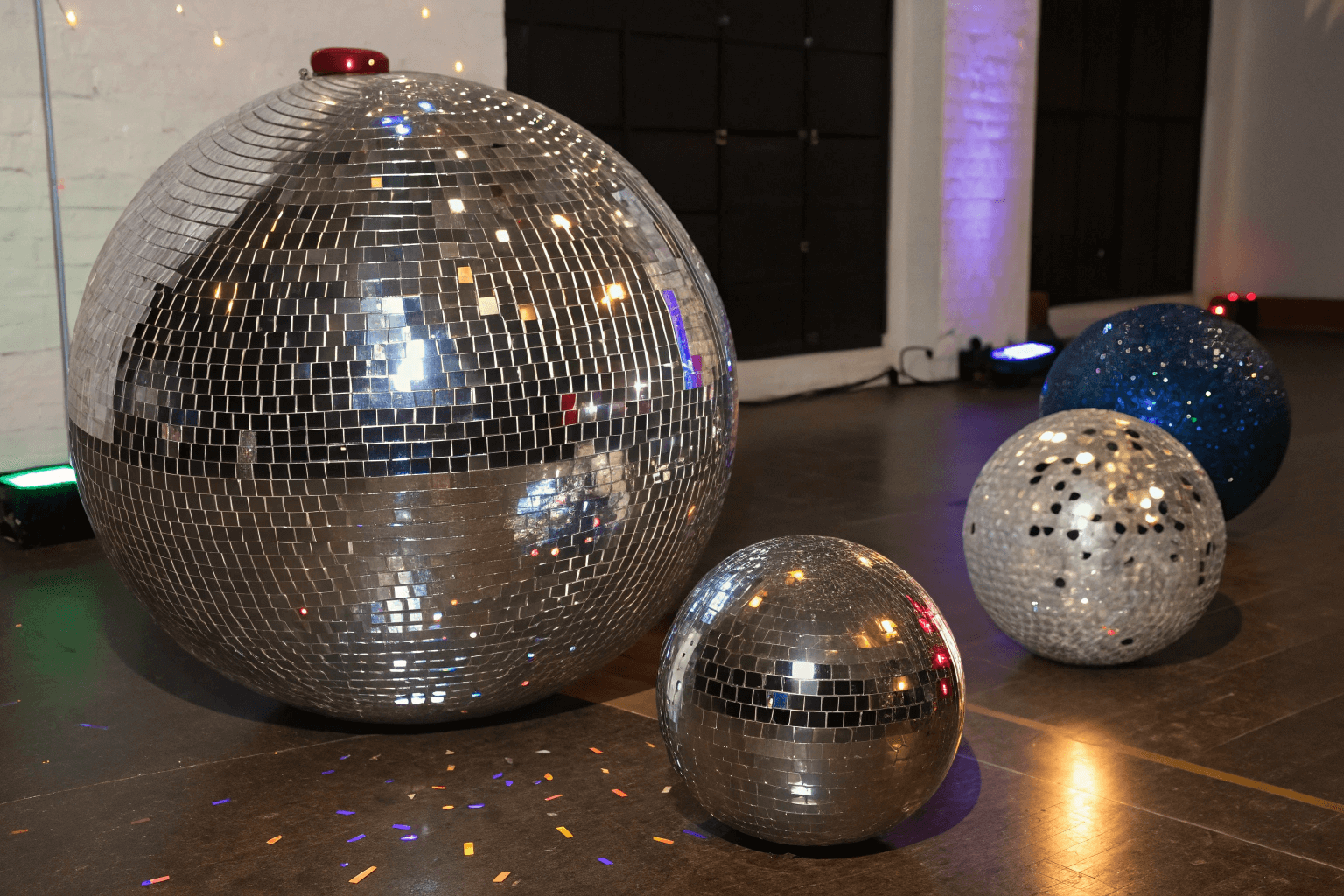
Static suspension uses a single, central rigging point for a solitary, dramatic focal point, ideal for architectural features. Clustered layouts involve multiple balls hung from a grid or at varying heights to create a dynamic, immersive canopy effect, better suited for large event spaces.

| Aspect | Static Suspension | Clustered Layout |
|---|---|---|
| Primary Goal | Create a singular, anchored focal point. | Form a volumetric field of light for immersion. |
| Typical Use Case | Hotel lobbies, retail atriums, architectural statements. | Concert stages, large wedding venues, immersive installations. |
| Structural Focus | Single anchor point load capacity and ceiling engineering. | Distributed weight, cable management, and visual balance across multiple points. |
| Project Complexity | High for the anchor point; often requires custom engineering. | High for logistics, planning, and simultaneous production of multiple units. |
Defining the Two Core Layout Approaches
Static Suspension creates a singular, anchored focal point. This approach is often used in spaces like hotel lobbies or retail atriums where a bold, commanding statement is the primary design goal. The installation becomes a centerpiece.
Clustered Layouts form a volumetric field of light, designed to create an enveloping atmospheric experience. This method is ideal for immersive environments like concert stages or large wedding venues where the goal is to surround guests with light and reflection.
The choice between these two approaches hinges on the design intent. It’s a decision between creating a commanding centerpiece and crafting an enveloping atmospheric experience.
Technical and Logistical Comparison
A static installation demands rigorous analysis of the single anchor point’s load capacity and the integrity of the ceiling structure. This often requires custom engineering to ensure safety and stability, making the initial structural assessment critical.
Clustered layouts distribute weight across multiple points, which can reduce the load on any single connection. However, they require precise planning for cable management, height variation, and the overall visual balance of the entire array to achieve the desired effect.
From a fabrication and project management perspective, clustered projects involve complex logistics. They typically require the simultaneous production, quality control, and coordinated shipping of multiple units to meet installation deadlines, adding a layer of operational complexity.
Source Professional-Grade Mirror Balls, Direct from the Factory
Structural Weight Considerations for Concrete vs. Truss
Steel truss systems are significantly lighter than concrete, with a strength-to-weight ratio up to eight times greater. This reduces dead load on buildings, simplifies handling and installation, and lowers foundation requirements, making trusses the preferred choice for weight-sensitive installations like large disco balls.

The Fundamental Weight and Strength Disparity
Reinforced concrete has a density of up to 2,700 kg/m³, resulting in structural weights 72% to 120% higher than equivalent steel frames.
Steel’s compact cross-sections provide a superior strength-to-weight ratio, with ultimate tensile strength between 400-500 MPa compared to concrete’s compressive strength of 17-70 MPa.
This efficiency means steel structures can be approximately 60% lighter than reinforced concrete while offering greater resilience to tension and shear forces.
Practical Implications for Installation and Support
An empty concrete floor can weigh 180 lbs./sq. ft., while a steel structure weighs 55-65 lbs./sq. ft., drastically affecting load calculations for ceiling suspensions.
Lighter steel trusses require foundations that are up to 43% less massive than those for concrete, reducing material and labor costs.
The reduced weight and bulk of steel components simplify on-site handling, transport, and assembly, often requiring 10-20% less workforce compared to concrete construction.
Surface Finish: Real Glass vs. Lightweight Film
Real glass offers superior rigidity and optical clarity for precise, long-lasting reflections, while lightweight films provide a practical solution for reducing structural load and simplifying installation in large or suspended applications. The choice hinges on balancing aesthetic requirements, durability, and logistical constraints.

Material Properties and Aesthetic Impact
Real glass, such as tempered or float glass, provides a perfectly flat, rigid surface that resists warping and moisture, ensuring consistent, sharp reflections over time.
Acrylic sheets and self-adhesive films are significantly lighter (1.5 lbs/ft² vs. glass’s 2.9 lbs/ft² at 0.250″ thickness) but can bend or cloud with humidity, potentially distorting reflections.
Optically, acrylic transmits light with 0% absorption and no green edge tint, while clear float glass has a visible light transmission (VLT) of 90% at 3mm, decreasing with thickness and exhibiting a slight green hue.
Application Scenarios and Durability Data
For permanent, high-traffic installations where reflection precision is critical, tempered glass is preferred for its impact resistance (15.5-29.1 ft-lbs) compared to brittle plate glass (1.0 ft-lbs).
Lightweight films or acrylic are the pragmatic choice for large, suspended decor or retrofits, drastically reducing structural load and minimizing shipping breakage risk.
Films underperform in thermal retention (U-values of 0.70-0.81 vs. low-E glass’s 0.02-0.20) and may peel or discolor long-term, making them less suitable for environments with significant temperature fluctuations or demanding longevity.
Lighting Angles for Static Reflections
For a static disco ball, the goal is to create a dense, even sparkle without motion. This is achieved by positioning 2-4 narrow-beam lights at a 30°-45° angle to the ball’s surface, from a distance of 3–10 feet. This specific geometry ensures light strikes the mirrored facets optimally to scatter reflections broadly across the space, avoiding dim or patchy areas.

The Physics of Angled Illumination
A disco ball’s facets act as precision mirrors; light must strike them at a non-perpendicular angle to be scattered widely. Angles between 30° and 45° from the ball’s surface maximize reflection coverage and create a broad, even sparkle distribution.
Flat or direct overhead lighting, with angles under 20°, causes light to glance off or concentrate poorly. This results in sparse or uneven reflections. For a static setup, this fixed, multi-source approach compensates for the lack of rotation to ensure consistent 360° coverage.
Technical Specifications for Setup
Use 2-4 pinspot lights with a narrow beam width of 10°-15° to create sharp, defined reflections. Position these fixtures slightly above or at the ball’s level, at a distance of 3–10 feet, and arrange them around the ball to achieve full coverage.
A light intensity of 500–1000 lux is typically required for clear, visible reflections in large venues or spaces with ambient light. This approach aligns with professional stage lighting practices, as validated by standards like those from PLASA.
Professional Maintenance for Permanent Installs
Permanent mirror ball installations demand a professional maintenance approach focused on structural safety and code compliance. This includes rigorous initial load testing, annual inspections by a skilled person, and a full acceptance test every four years by a qualified expert. Routine operator checks and strict cleaning guidelines are essential to preserve the installation’s integrity and public safety.
Safety Protocols and Initial Verification
The foundation of a safe permanent installation is a verified structural system. During the initial setup, structural support points must undergo a load test to bear at least 10 times the combined weight of the ball and its hardware. This load must be held for one hour with no visible deformation to the ceiling or truss fixing points.
A secondary safety chain or cable, completely separate from the primary suspension, is mandatory. This redundant system must be rated for at least 12 times the total suspended load. It should be slightly longer than the main suspension so it only engages if the primary fails.
Installation hardware is critical. You must use all manufacturer-provided fixing holes with appropriate screws anchored directly into structural material like steel truss, concrete, or rated joists. Mounting solely into drywall or other non-structural substrates is unacceptable for significant loads.
Compliance with all applicable local, national, and commercial electrical and construction codes—such as NEC and NFPA standards—is non-negotiable. Finally, the fixture must be positioned out of reach of the public, away from walking paths and seating areas to prevent accidental contact.
Ongoing Inspection and Care Regime
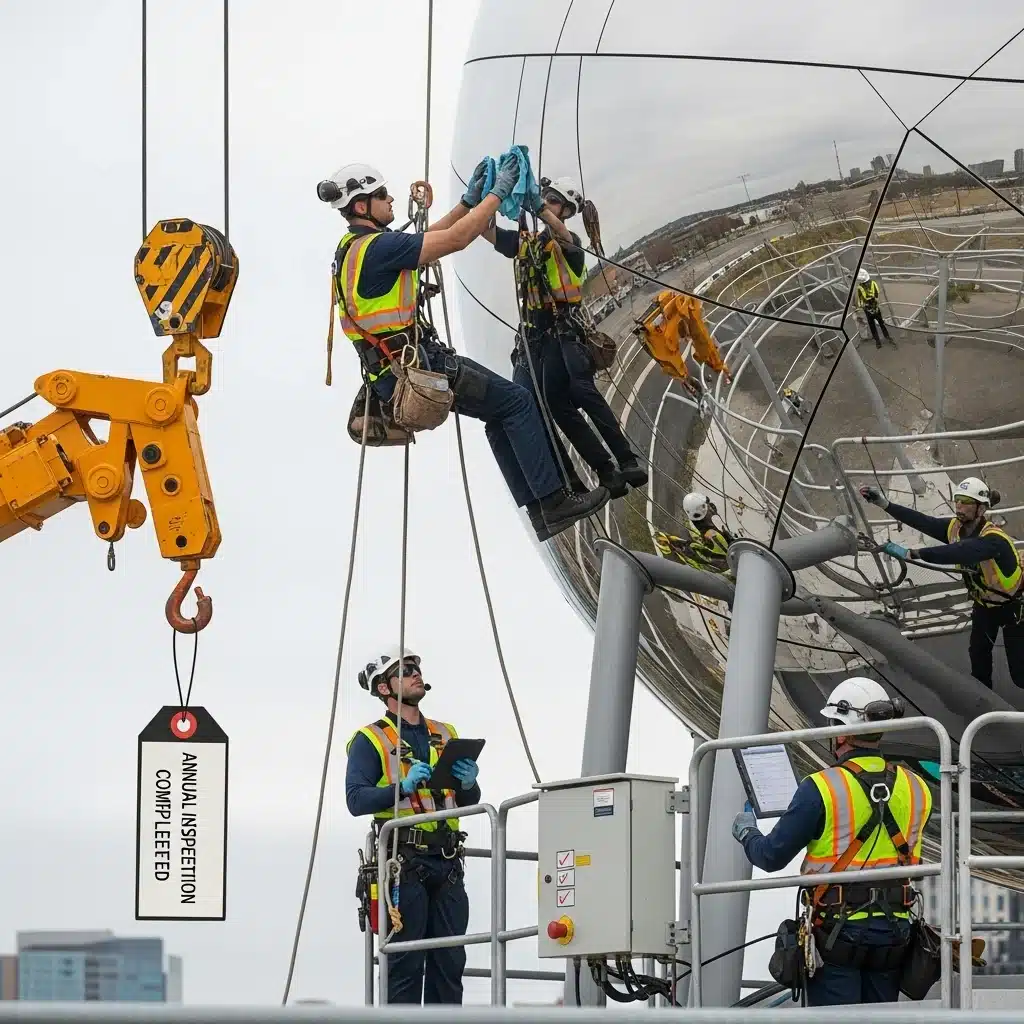
Permanent installations require a scheduled, professional inspection regime similar to overhead lifting equipment. A formal annual inspection must be conducted by a skilled person, focusing on all safety-related and machine-technical parts of the system.
Beyond annual checks, a comprehensive acceptance test must be performed by a competent, qualified expert at least every four years. Any signs of deformation, corrosion, or damage discovered during these inspections should trigger immediate decommissioning for repair or replacement.
Daily or weekly operator checks are also essential. These should include verifying the tightness of all screws and fasteners, and checking for any corrosion or deformities on the motor housing, fixings, and supporting trussing or ceiling points.
Preserving the mirror ball itself requires careful cleaning. Use only a soft, dry cloth. Avoid solvents, alcohol, ammonia, or water, as these liquids can weaken the adhesives holding the mirror tiles and damage protective coatings.
For installations that integrate lighting or are near special effects, maintain a minimum clearance of 1.5 meters (5 feet) from any flammable materials or pyrotechnics to mitigate fire risk.
Final Thoughts
Planning a large-scale disco ball installation is a technical exercise that balances artistic vision with practical engineering. The core challenge lies in scaling the concept appropriately. A ball’s diameter must be matched to the room’s volume and ceiling height to create the intended visual impact, while its weight and mounting requirements dictate the structural support needed. The choice between a singular statement piece and a clustered canopy further defines the project’s scope and complexity.
Ultimately, success depends on integrating these elements from the start. Material selection, lighting angles, and a rigorous maintenance plan are not afterthoughts but foundational decisions. By treating the disco ball as an architectural component—with defined loads, safety protocols, and long-term care—you can ensure the installation is not only visually spectacular but also structurally sound and durable for years to come.
Frequently Asked Questions
What is the largest disco ball diameter?
The largest disco ball on record has a diameter of 10.33 meters (33 feet 10 inches). This record was certified by Guinness World Records in 2014.
How do you hang a large disco ball without a motor?
For a static installation, attach the ball’s hanging ring to a certified overhead structural point, like a beam or rated truss, using a ceiling anchor and a steel safety cable. The hardware should have a safety factor of at least 5 times the ball’s weight. Position the ball so its center is roughly 7 to 8 feet above the floor.
What is the weight of a 24-inch mirror ball?
A standard 24-inch disco ball typically weighs between 12 and 17 pounds. The exact weight can vary by model and construction.
What is the best lighting for a static disco ball?
Use 2 to 4 narrow-beam pinspot or ERS fixtures with a 10° to 15° beam angle. Position the lights 30° to 45° off-axis from the ball to create clear, high-contrast reflections. Aim for an illumination level of 500 to 1000 lux on the ball’s surface.
What safety cables are needed for decor over 20 inches?
Use stainless steel safety cables 20 to 31.5 inches long, with a diameter of 3 to 5 mm. The cable should have a minimum working load limit of 70 kg (154 lbs) to securely anchor the installation to a structural point.
How do you scale disco balls for large commercial lobbies?
Match the primary ball’s diameter to the lobby’s clear height. For ceilings 18 to 30 feet high, use a 40 to 72-inch ball as the main feature, hung so its bottom is 10 to 15 feet above the floor. Complement it with smaller 12 to 24-inch balls around the perimeter to fill the space with reflections.