

For professional buyers, the choice between a fiberglass and a foam core isn’t just about material—it’s about risk management. A foam core rated for thermal insulation at 15 psi can’t support the 300 kg loads and intense heat of a live event, leading to failures that compromise safety and budgets.

This article breaks down the engineering and procurement specs that matter. We’ll compare the structural integrity of FRP, with its 27,000 psi compressive strength and Class 1 fire rating, against common foams, and analyze the long-term ROI across factors like heat resistance, moisture protection, and impact durability over 100+ events.
The Secret Inner Shell of Mirror Balls
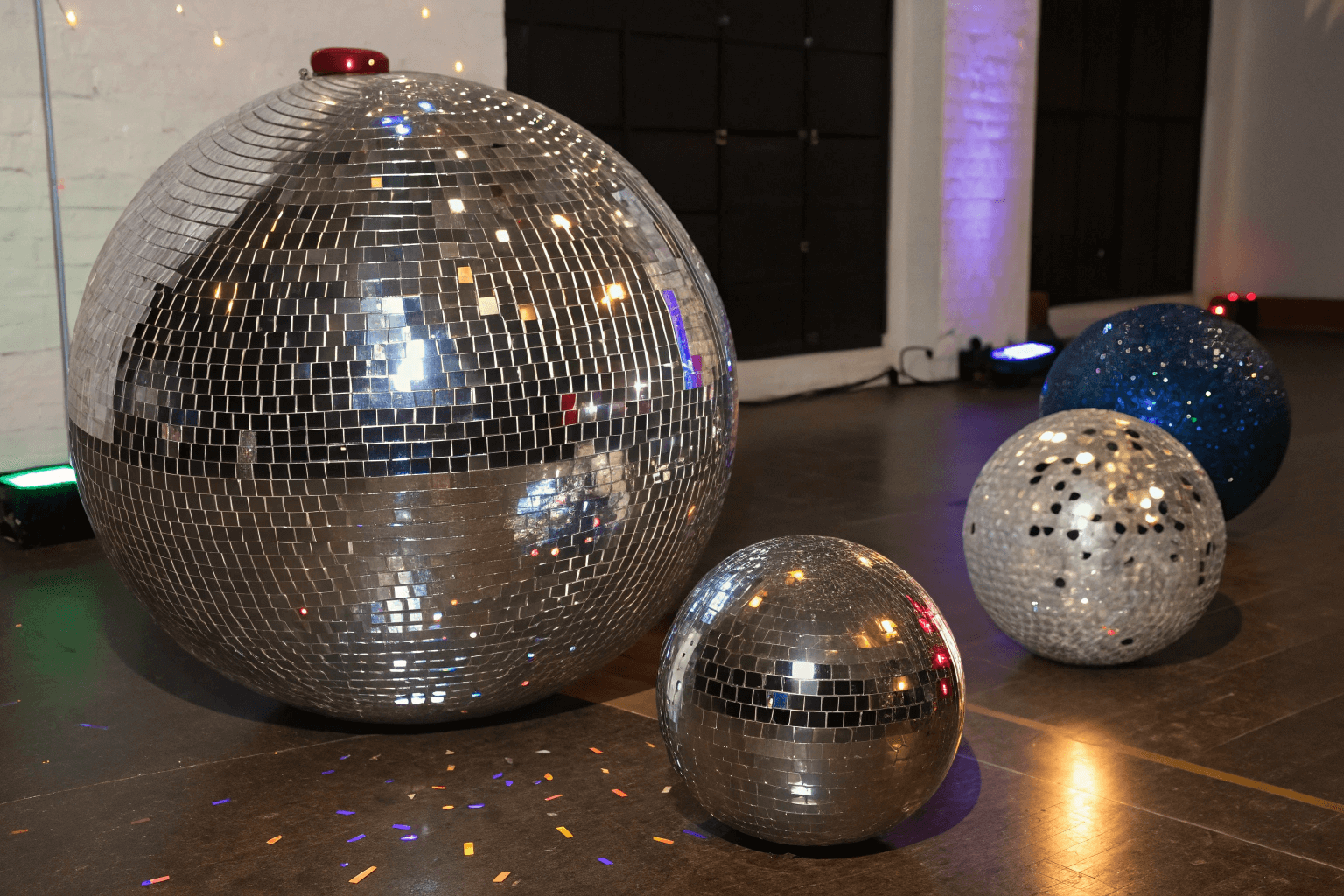
The inner shell is a rigid, load-bearing core, typically made from dense polyfoam or ABS foam. It provides the spherical shape, supports the weight of the glass tiles, and integrates safety-rated eyelets to handle the full suspended load during rigging and operation.

The Core: More Than Just a Shape
This inner shell acts as the primary load-bearing structure. It transfers all hanging forces from the eyelets through the entire sphere, forming the critical skeleton of the ball.
Manufacturers commonly construct it from dense polyfoam or ABS foam. These materials are chosen for their rigidity and ability to be formed into a perfect sphere, which is essential for an even, consistent reflection.
The shell serves as the substrate for the glass mirror tiles. This tile layer is a thin composite skin that adds surface hardness and sparkle but contributes little structural mass or strength to the overall assembly.
This design contrasts sharply with inflatable mirror balls, which use a thin PVC inner liner. The rigid foam core is a defining feature for permanent installations and high-duty event applications where structural integrity is non-negotiable.
Engineering for Load and Safety
Motor load ratings provide an indirect specification for the core’s strength. Heavy-duty motors rated for suspended loads up to 300 kg imply the inner shell and its hardware must sustain at least this weight with a safety margin.
Integrated safety hardware is paramount. Rated main and secondary eyelets are embedded directly into the foam core, creating an internal load-bearing skeleton designed to handle the full rigging load via chains and safety wires, not the fragile glass surface.
The substantial weight of a large mirror ball—for example, 105 pounds (48 kg) for a 48-inch model—confirms the core’s density and robustness. This mass indicates a structure capable of withstanding the stresses of transport, rigging, and dynamic spinning.
Professional specifications explicitly call out the core material (e.g., ABS foam) and eyelet construction. These details are key indicators for procurement, signaling long-term durability and compliance with event safety standards.
Styrofoam: The Cheap Consumer Trap
Styrofoam cores, while inexpensive, are governed by ASTM C578 standards for thermal insulation, not structural support. Their low compressive strength (15-100 psi) and viscoelastic nature make them prone to permanent deformation under the sustained weight of mirrors and spotlights, leading to core failure and product damage over multiple events.

The Illusion of Strength: ASTM Standards vs. Real-World Loads
The official specifications for rigid polystyrene foam create a misleading picture of durability. The ASTM C578 standard classifies these materials primarily for thermal insulation. A key metric, compressive strength, is measured at 10% deformation—a point where the foam core is already critically compromised and unusable for a precision application like a mirror ball.
Common XPS foam types, such as DuPont’s Type IV, have a minimum compressive strength of just 25 psi. Lower-grade options can be as weak as 15 psi. These values are insufficient for the combined static weight and dynamic loads a mirror ball experiences when mounted and in motion.
Styrofoam exhibits viscoelastic creep, meaning it permanently deforms under a sustained load over time. For this reason, manufacturers recommend a 3:1 safety factor for static applications. Budget mirror ball cores rarely account for this, leading to a slow, inevitable collapse of the core structure.
Why Low-Cost Foam Fails: Heat, Moisture, and Impact
The operating temperature range for Styrofoam is typically -65°F to 165°F. Prolonged exposure to the heat from stage spotlights can cause the foam to warp and lose its dimensional stability. This directly compromises the adhesive bond holding the mirrors, causing them to detach.
While water absorption is low (0.1-2% by volume), any moisture that penetrates the core weakens the foam’s cellular structure. This can lead to mold growth and further reduces the material’s already poor tensile strength, which has a minimum of just 50 lb/in².
The foam’s low flexural strength—for example, a minimum of 50 psi for Type IV—provides almost no protection during shipping and handling. This vulnerability leads to dents, cracks, and a drastically shortened product lifespan, turning a low upfront cost into a recurring expense.
Fiberglass Reinforced Plastic (FRP): The B2B Standard
Fiberglass Reinforced Plastic (FRP) is a composite material made of glass fibers embedded in a thermoset polyester resin. It meets B2B standards through high tensile strength (11,500 psi), compressive strength (27,000 psi), and a Class I fire rating, providing structural integrity, durability, and safety for commercial applications.

| Property | Specification | Standard |
|---|---|---|
| Tensile Strength | 11,500 psi (9,000-18,000 psi typical) | ASTM D-638 |
| Compression Strength | 27,000 psi (15,000-25,000 psi typical) | ASTM D-695 |
| Flexural Modulus | 1.38 ksi (0.8-1.4 x 10^6 psi typical) | ASTM D-790 |
| Coefficient of Thermal Expansion (CTE) | 23.2 x 10^{-6} in/in/°F (12-20 x 10^{-6} typical) | ASTM D-696 |
| Fire Rating | Class I, Flame Spread ≤25 | ASTM E84 |
| Construction Panel Standard | Type CC1, Grade 1 | ASTM D3841 |
| Tolerances (Thickness/Warpage) | ±3/16″; ≤1/4″ in 8 ft | Manufacturing Spec |
Core Properties and Material Composition
FRP is engineered from a composite matrix of 14.9% glass fiber, 43% ATH filler, and 41.6% isophthalic polyester resin. This specific formulation creates a robust material structure.
The material features a resin-rich inner surface layer, 0.010-0.020 inches thick, and an external NPG isophthalic gel coat applied at 18-25 mils. This dual-layer system provides superior chemical and UV resistance, protecting the core from environmental degradation.
A Class I fire rating with a flame spread of 25 or less (ASTM E84) is achieved without using Antimony Oxide, ensuring safety in public venues. The thermoset polyester resin provides permanent dimensional stability and will not melt or re-flow under heat, a critical distinction from thermoplastic materials.
Engineering Specifications and Compliance Standards
Quantifiable mechanical data validates FRP for structural applications. It demonstrates a tensile strength of 11,500 psi (ASTM D-638) and a compression strength of 27,000 psi (ASTM D-695). The flexural modulus is 1.38 ksi (ASTM D-790).
FRP meets specific industry standards for professional use. It complies with ASTM D3841 for construction panels (Type CC1, Grade 1) and ASME RTP-1 for the fabrication of corrosion-resistant vessels, confirming its suitability for regulated B2B procurement.
The material’s low Coefficient of Thermal Expansion (CTE) of 23.2 x 10^{-6} in/in/°F minimizes warping and dimensional change under the heat generated by stage lighting. Manufacturing to tight tolerances—part thickness within ±3/16″ and warpage limited to 1/4″ over 8 feet—ensures consistent quality for reliable assembly and installation.
Source Commercial-Grade Mirror Balls, Factory Direct.
Heat Sensitivity: How Spotlight Heat Deforms Foam
Stage spotlights can permanently warp foam cores. The issue is thermal deformation, not fire. Different foams have specific temperature limits: closed-cell XLPE foam softens above 175°F, while premium polyurethane can withstand up to 225°F. Exceeding these limits for even a few hours causes permanent dents and loss of panel flatness.

The Science of Thermal Deformation
The primary risk from stage lighting is thermal deformation—warping, sagging, or permanent dents—not ignition, which is governed by separate fire codes.
Foams lose stiffness when heated. A 500–750W halogen or high-power LED spotlight at short range can push surface temperatures into a foam’s critical softening range.
Permanent set occurs when heat combines with the foam’s low compression force deflection (CFD), often less than 1 psi, allowing it to take a new shape under minimal stress.
Material Limits and Stage-Ready Data
Closed-cell crosslinked polyethylene (XLPE) foam has a working range of -70°F to 175°F. It shows less than 0.6% dimensional change after 24 hours at 158°F (ASTM C177).
Premium polyurethane foams like ISOLOSS LS are rated for continuous use up to 225°F (107°C) and retain over 70% tensile strength after 22 hours at 284°F dry heat (ASTM D3574).
Open-cell polyether foam retains 70% strength after 5 hours at 248°F steam, but its very low CFD makes it prone to denting under localized heat from a spotlight.
Rigid insulation foams (EPS/XPS) have implicit max service temperatures around 165–190°F; exceeding these can cause bowing or delamination over repeated events.
Moisture Resistance for Outdoor and Humid Venues
In outdoor or humid settings, fiberglass insulation can absorb water, losing up to 50% of its thermal resistance and risking mold growth. Foam core materials, like closed-cell spray foam and rigid foam boards, provide inherent moisture resistance, acting as vapor barriers to maintain performance and durability in damp conditions.

The Problem with Fiberglass in Damp Conditions
Fiberglass insulation absorbs moisture readily. When wet, its thermal resistance, or R-value, can drop by as much as 50%. This significant loss in performance means the insulation fails to provide the intended thermal barrier.
The absorbed water doesn’t just sit in the material; it gets trapped against wooden framing and structural elements. This creates a perfect environment for mold and mildew to grow, which can lead to indoor air quality issues and, over time, cause rot and structural damage to the building itself.
Because of these risks, standard fiberglass batts or blown-in insulation are not suitable for unconditioned outdoor venues, basements, or crawl spaces unless they are paired with a complex and perfectly installed secondary vapor barrier system, which adds cost and installation difficulty.
How Foam Cores Provide Superior Moisture Protection
Closed-cell spray foam and rigid foam boards—such as those made from polystyrene, polyisocyanurate (polyiso), or polyurethane—have a closed-cell structure that does not absorb water. This inherent property allows them to function as their own vapor barrier, blocking moisture migration.
This moisture resistance prevents condensation from forming within wall or ceiling cavities. By keeping dry, the material maintains its published R-value over the long term and protects the structural integrity of the building envelope from water-related decay.
Foam cores also deliver higher thermal efficiency in a thinner profile. While fiberglass offers about R-3.5 per inch, rigid foam boards can provide R-6.5 to R-7 per inch. This near-doubling of R-value means you can achieve the same or better insulation performance with less material, which is particularly advantageous in space-constrained or high-humidity areas.
Impact Resistance during Freight & Unpacking
Fiberglass mirror balls are built like industrial sandwich panels. A high-strength fiberglass outer shell protects the mirror surface, while a specialized foam core inside absorbs and distributes impact energy from drops and vibrations during freight. This design prevents dents, cracks, and internal damage that can occur with cheaper, solid-core alternatives.

The Sandwich Panel Principle: How It Protects from Drops
The structural design separates the functions of surface protection and energy absorption. The rigid fiberglass facesheet acts as a protective shell to prevent punctures and surface cracks on the mirror finish.
Inside, a low-density foam core, such as PVC, SAN, or polyurethane, compresses upon impact. This action dissipates the force from a drop or bump, preventing that energy from transferring to and damaging the outer shell.
This principle is validated by standardized tests like ASTM C393, where panels withstand maximum loads from 482 to over 1,000 pounds. The design specifically prevents shear failure and delamination, which are common points of failure in solid or poorly bonded structures during rough freight handling.
Foam Core Specifications for Logistics Durability
The core’s shear strength is a critical metric. For example, polyester foam cores demonstrate yield strengths between 99 and 138 psi, with ultimate shear strength reaching up to 159 psi. These values quantify the panel’s ability to resist the twisting and bending forces encountered during shipping.
Higher-performance foams like SAN (Styrene Acrylonitrile) and PU (Polyurethane) offer greater toughness. PU cores typically provide a compressive strength of at least 160 kPa, which translates to better resistance against repeated impacts from unpacking and setup.
Specialized materials, such as FR-3700 polyurethane foam, are certified for extreme dynamic loading equivalent to a 30-foot free drop, meeting stringent standards for nuclear material transport. This level of certification highlights the potential for exceptional freight durability.
Engineers select core density and panel thickness based on expected logistics stresses. PVC foam densities range from 30 to 300 kg/m³, allowing for a balance between a high stiffness-to-weight ratio and the specific energy absorption needed to tolerate vibrations and low-speed impacts.
ROI: Longevity Comparison over 100+ Events
Foam cores last 3-4 times longer than fiberglass, providing stable performance for 80-100 years versus 20-25 years. This translates to fewer rebuilds, lower lifetime costs, and consistent quality over hundreds of event cycles.

| Material Type | Documented Service Life | Key Performance Notes |
|---|---|---|
| Spray Polyurethane Foam (SPF) | 80–100 years | No required maintenance, sagging, or settling. Maintains R-value. |
| Fiberglass Insulation | Up to ~25 years | Performance degrades earlier in practice due to moisture, settling, and compression. |
| Rigid Foam Boards (EPS, XPS, Polyiso) | High durability, long functional life | Excellent moisture resistance, maintains R-value and structural integrity. |
The Core Data: Documented Service Life
Spray polyurethane foam (SPF) has a documented service life of 80–100 years with no required maintenance, sagging, or settling. This longevity is a foundational advantage.
In contrast, fiberglass insulation has an average functional lifetime of up to 25 years if kept dry and undisturbed, but performance degrades earlier in practice. Real-world factors like handling and environmental exposure often shorten this span.
Rigid foam boards (EPS, XPS, polyiso) are characterized by high durability and excellent moisture resistance, maintaining their R-value and structural integrity over time, which is critical for reusable event structures.
Translating Years into Event Cycles and Cost
Over 100+ deployments, the 3–4x longer life of foam cores means avoiding the labor and material costs of at least one full panel rebuild or core replacement. This direct cost avoidance is a primary component of ROI.
Fiberglass is susceptible to moisture absorption and settling, which reduces insulating effectiveness (R-value) and can force premature replacement, adding hidden costs from downtime and unscheduled maintenance.
The stable performance of foam means the product’s specifications—like insulation and rigidity—remain consistent for its entire life. This protects the quality of the event experience across hundreds of cycles without performance drift.
Final Thoughts
The choice between foam and fiberglass for a mirror ball core isn’t just about material—it’s about application. For a one-time event or a low-budget installation, a dense polyfoam or ABS core provides the necessary shape and basic support. But for professional buyers who manage equipment across dozens or hundreds of events, the decision shifts. The structural weakness, heat sensitivity, and long-term creep of even high-grade foams present real risks to safety, reliability, and budget. Fiberglass Reinforced Plastic (FRP) addresses these risks head-on with quantifiable strength, fire safety, and dimensional stability that meets documented B2B engineering standards.
This distinction clarifies the procurement process. Specifying an FRP core isn’t an upsell; it’s a direct investment in reducing long-term costs and liability. It means your mirror balls will arrive undamaged, perform consistently under hot lights, and safely handle the rigors of repeated rigging and transport. For rental companies, venues, and production houses, that reliability translates directly to client trust and operational efficiency. The initial higher cost is offset by the avoidance of premature failure, costly replacements, and the potential safety issues associated with a compromised core.
Frequently Asked Questions
Is fiberglass better than foam for disco balls?
Fiberglass is better than foam for disco balls due to superior durability and fire safety. Fiberglass shells offer shatter resistance and longevity, while foam cores, which are about 98% air, require epoxy coatings to mitigate flammability risks.
Why are my mirror tiles falling off?
Mirror tiles fall off primarily due to adhesive incompatibility with the mirror’s backing, moisture damage, or insufficient support for large tiles. For tiles over 48 inches wide, industry guidelines recommend using compatible adhesives like neutral-cure silicone and adding a built wooden support structure.
What is the heat resistance of foam vs fiberglass?
Spray foam insulation has superior heat resistance to fiberglass. Closed-cell spray foam has an industry standard R-value of R-6 to R-7 per inch, while fiberglass typically ranges from R-2.9 to R-3.8 per inch.
What is the best disco ball for a permanent install?
For a permanent install, use a metal-cored mirror ball, typically with an aluminum shell or metal cage and glass tiles, 12–24 inches in diameter. It should be hung from rated overhead hardware with a continuous-duty motor and installed by a qualified expert. A typical 20″ professional ball weighs 8–10 lb and requires a structure rated for 150 lb capacity.
Do foam disco balls break easily?
Under normal hanging use, foam-core disco balls with a hard outer shell of mirror tiles do not break easily. However, the foam core itself, often expanded polystyrene (EPS) which is ~98% air, is mechanically weak and can dent or fracture if dropped or heavily impacted.
What is the core material comparison for mirror balls?
Commercial mirror balls use three main cores: expanded foam (EPS/ABS), plastic (styrene/ABS), and metal (typically spun aluminum). Foam and plastic cores are lighter and standard for budget to mid-range balls. Metal cores, which include a central steel rod for strength, are about 50–70% heavier and provide higher structural integrity for permanent, heavy-duty use. For example, a 20″ metal-core ball weighs ~18 lb, while a foam/plastic-core ball of the same size weighs ~11–12 lb.