

When you install an overhead decorative sphere, the legal and financial liability for its safety rests entirely with you. Major venues include contract clauses that explicitly transfer this risk to the installing contractor, and non-compliance can result in immediate removal at your expense.

This guide breaks down the engineering principles you need to manage that liability. We’ll cover how to calculate the total point load, including dynamic forces from airflow that can be several times greater than static weight. You’ll learn why a 10:1 safety factor is the standard for public spaces, how sling angles below 60 degrees dramatically increase tension, and the specific hardware ratings—like a carabiner’s 22 kN major axis strength—required for a compliant and safe installation.
The Liability of Overhead Decorative Spheres
Installing overhead decorative spheres involves significant liability, primarily borne by the contractor or installer. Venues typically disclaim responsibility for non-compliant rigging, requiring adherence to OSHA standards like 29 CFR 1910.184 and specific venue engineering limits. Load plans must be submitted for items over 1,000 lbs, and all hardware must be rated and inspected to prevent structural failure and ensure public safety.

Who Bears the Legal Responsibility?
The legal responsibility for an overhead installation rests squarely with the installing contractor. Major venues, such as the Moscone Center, include clauses in their contracts that explicitly disclaim liability for any rigging performed by contractors. This transfers the risk of structural failure or accidents to the party performing the work.
To manage this liability, contractors are required to submit detailed, load-specific engineering plans for any item weighing 1,000 pounds or more. These plans must be submitted at least 30 days before the event for review and approval by the venue’s engineering team. Without this approval, the installation cannot proceed.
Every piece of rigging hardware—from shackles and wire ropes to eyebolts—must carry the manufacturer’s stamp certifying it meets OSHA, ANSI, and ASME standards. Using certified equipment is a primary method for transferring liability away from the installer and onto the equipment manufacturer, provided it is used within its rated limits.
Failure to comply with venue rules or applicable safety standards carries immediate consequences. The venue has the authority to order the removal of a non-compliant installation at the contractor’s expense. The contractor is then billed for all costs associated with the removal and any required remediation.
Key Regulations and Venue-Specific Limits
The foundational regulation is OSHA 29 CFR 1910.184, which mandates the regular inspection of all slings, wire ropes, and chains used for rigging. Inspections must be documented and occur as required by the standard, often before each shift or use, to identify wear, deformation, or damage.
Venues establish strict physical limits based on their structural engineering. A common limit in large exposition halls is a maximum vertical downward load of 5,000 pounds and a horizontal load limit of 2,500 pounds. These are absolute ceilings that cannot be exceeded, regardless of the number of attachment points.
It is critical to understand that a hang point’s capacity is not a fixed number. For example, an eyebolt rated for 2,000 pounds in a straight vertical pull may see its safe working load drop to 500 pounds if used in a bridle configuration with angles between 45 and 90 degrees. These angle-induced side loads dramatically reduce capacity and are a common cause of rigging failure.
Venue guidelines universally prohibit rigging from any element not designed for structural load. This includes sprinkler pipes, ceiling grid systems, airwall tracks, and light fixtures. Installations must only attach to engineered hang points identified and rated by the venue’s engineering department. “Dead hanging” items from these non-structural elements is not permitted.
Static Weight vs. Airflow Dynamic Loads
Static weight is the constant downward force from gravity on a stationary object, like a disco ball. Airflow dynamic loads are the variable, often much larger, forces created when wind pushes against the object’s surface area. For safe rigging, engineers must calculate and plan for both, as dynamic loads from wind can be several times greater than the static weight alone.

Defining the Two Forces in Rigging
Static load refers to the constant, downward force exerted by gravity on a stationary object, such as the weight of a disco ball and its hardware.
Dynamic loads are variable forces created by motion, acceleration, or environmental factors like wind; they are often significantly more forceful than static loads.
In rigging, a dynamic load from a 600-pound object being lowered too quickly can generate over 800 pounds of force due to impact loading.
The primary risk is designing a system only for static weight, which will fail under the higher stresses of dynamic forces like wind gusts or accidental movement.
Applying Load Principles to Disco Ball Installations
For permanent installations in atriums or lobbies, engineers must reference local building codes that specify wind load calculations based on structure height and location.
In high-vibration environments like nightclubs, dynamic loads are compounded by sound system vibrations and crowd movement, requiring specialized dampeners and hardware.
The safety factor for dynamic load scenarios is higher than for static loads; industry standards may require a 10:1 safety factor for public spaces where motion is involved.
A comprehensive rigging audit must always consider the combined ‘worst-case’ load, which is the static weight plus the maximum anticipated dynamic load from wind or other forces.
The available research data supports the core principle that dynamic loads exceed static loads, but it focuses on forces from motion and acceleration, not specifically from airflow. For example, a 600-pound load can generate over 800 pounds of force during a sudden stop. To properly assess wind loads, specific data on aerodynamic pressure calculations and standards like ASCE 7 is required.
Calculating Total Point Load (Ball + Hardware)
The total point load is the combined weight of the disco ball and its mounting hardware, multiplied by dynamic and safety factors to account for motion and operational risk. This factored load is then distributed across sling legs, with tension increasing significantly as the sling angle decreases from the recommended 60 degrees.

| Sling Angle (from horizontal) | Tension Factor | Standard Requirement |
|---|---|---|
| 60° | 1.155 | Industry minimum benchmark angle |
| 45° | 1.414 | Never exceed 45° from horizontal (90° included angle max) |
| 30° | 2.000 | Requires a formal Critical Lift Plan per ASME B30.9 |
The Core Load Formula and Dynamic Factors
The fundamental calculation for the total factored load (P) is P = p × KOS × Kv. Here, ‘p’ represents the unfactored, static weight of the disco ball and all its mounting hardware.
The dynamic acceleration factor (Kv) accounts for additional forces generated by the motor starting and stopping, air currents, or vibration during operation. The optional safety factor (KOS) can be applied for specific risk assessments, particularly in public venues or high-vibration environments.
The result of this calculation, the total factored load P, is the load that the primary rigging hardware—such as carabiners, shackles, and the anchor points themselves—must be rated to support.
Sling Geometry and Load Distribution
Once the total load P is known, it is distributed to the individual sling legs. The load per sling leg is calculated as (Total Load / Number of Legs) × (1 / cos(sling angle)), or equivalently using the L/H (length-to-height) ratio method. As shown in the table, tension increases dramatically as the sling angle measured from horizontal decreases.
The industry standard mandates a minimum sling angle of 60 degrees from horizontal. Angles at or below 30 degrees are considered critical and require a formal Critical Lift Plan as defined by the ASME B30.9 standard.
The anchoring system’s total capacity, often denoted as Z’ (which includes screws penetrating a minimum of 3 plies and other rigging devices), must exceed the sum of the tensions (ST) from all sling legs supporting the load.
Source Commercial-Grade Mirror Balls, Engineered for Professionals
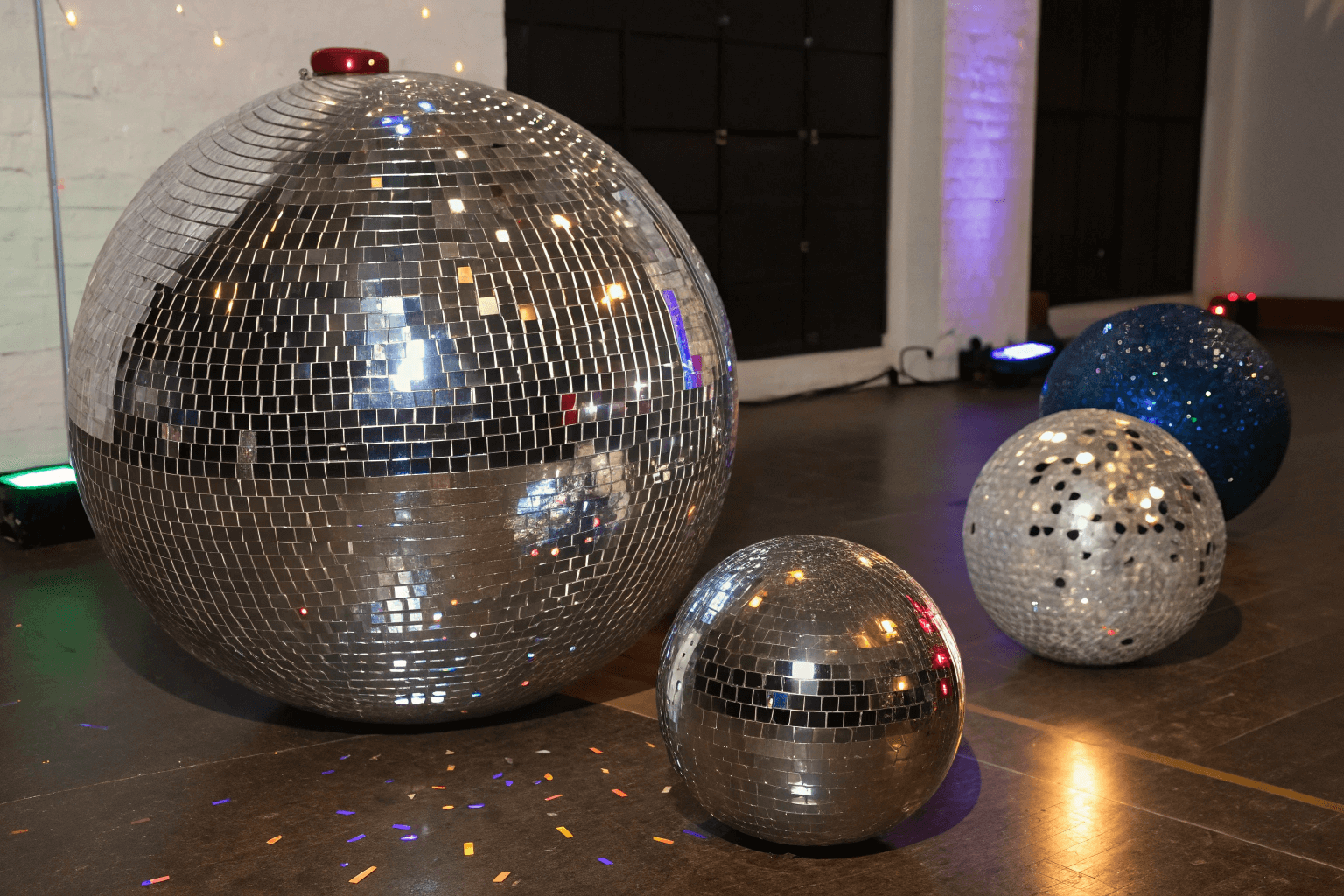
The 10:1 Safety Factor in Public Spaces
The 10:1 safety factor is a critical engineering principle for permanent overhead loads in public spaces. It means the rigging system’s ultimate breaking strength must be at least ten times greater than the calculated maximum expected load. This margin accounts for unpredictable dynamic forces, material fatigue, and the severe consequences of failure in crowded areas.

| Industry / Application | Typical Safety Factor | Key Context |
|---|---|---|
| Permanent Overhead Structural Loads (e.g., Wire Ropes) | 10:1 | Standard for public spaces like hotel lobbies or retail atriums. |
| Temporary Rigging | 5:1 | Common for non-permanent installations. |
| U.S. Entertainment Rigging | 7:1 | North American industry standard. |
| EU Rigging Components (e.g., Shackles) | 10:1 | Mandated for components, creating a higher baseline for global projects. |
| NFPA 1983 Rope Rescue | 15:1 | Due to life-safety criticality; uses a 300 lb load per person for calculations. |
Why 10:1 is the Standard for Public Safety
The 10:1 ratio is mandated for permanent overhead structural loads, such as wire ropes in architectural settings, where failure could cause public injury. It provides a substantial margin beyond the 5:1 factor used for temporary rigging or the 7:1 common in North American entertainment rigging.
This higher factor compensates for unpredictable dynamic loads from crowds, HVAC airflow, and long-term material degradation that static calculations cannot capture. The standard reflects the severe liability and reputational damage associated with a structural failure in a public venue like a hotel lobby or retail atrium.
Applying the Factor: From Calculated Load to Hardware Selection
The process starts with the Total Point Load (ball + hardware + dynamic allowance). For a 50kg disco ball system with a 100kg calculated load, the minimum ultimate strength required is 1000kg (100kg x 10). All components in the load path—shackles, carabiners, chains, and anchor points—must individually meet or exceed this 1000kg ultimate strength rating.
European Union rigging standards commonly enforce this 10:1 requirement for components, whereas U.S. entertainment standards may differ, creating a higher baseline for global projects. This calculation directly informs the specification of hardware, ensuring every link in the chain is rated for the amplified safety load, not just the working load.
Hardware Specs: Carabiners, Chains, and Anchors
Rigging hardware must meet specific, axis-dependent load ratings derived from destructive testing. Carabiners require a minimum 22 kN (5,000 lbs) major axis strength with the gate closed, and 16 kN (3,600 lbs) for gate-open or minor axis loading. Compliance with standards like ASTM F1774 and ANSI Z359.12, along with a clear Working Load Limit, is essential for safety and liability reduction in public installations.

Understanding Carabiner Load Ratings and Standards
Carabiner strength is not a single number but varies by load direction: major axis (gate closed), major axis (gate open), and minor axis.
The minimum Breaking Strength (MBS) for the major axis with the gate closed is 22 kN (5,000 lbs) per ANSI Z359.12, OSHA 1910.66, and NFPA 1983 standards.
Gate-open and minor axis strengths have a baseline rating of 16 kN (3,600 lbs) to protect against cross-loading or accidental side forces.
ASTM F1774-20 mandates destructive mechanical tests across six configurations to validate these ratings for steel and aluminum alloy carabiners.
The 3-sigma statistical method ensures the Minimum Breaking Strength has a failure rate below 0.15%, providing high confidence in the rated value.
From Breaking Strength to a Safe Working Load
The Working Load Limit (WLL) is calculated by applying a Design Factor (e.g., 4:1 or 5:1) to the carabiner’s Minimum Breaking Strength (MBS).
For a steel carabiner with a 50 kN MBS and a Design Factor of 4, the resulting WLL is 12.5 kN for rigging a static load.
Proof load testing, often to 16 kN, is a non-destructive test to verify hardware integrity before use in the field.
Standards like ANSI A10.48 permit carabiners for lifted loads only if the manufacturer provides a rated WLL or safety factor, as seen with products from Buckingham Mfg.
Chains and anchors must be selected with a WLL that matches or exceeds the carabiner’s rating, creating a fully rated assembly from the anchor point to the load.
Secondary Safety Line Protocols
A secondary safety line is a redundant wire rope system attached to a fixed anchorage separate from the primary rigging. It acts as an emergency device, not a primary load-bearer, designed to keep a platform level and prevent catastrophic failure if the main rope or outrigger support fails. Protocols require the line to be taut and comply with specific OSHA and ANSI standards for public safety.

Purpose and Redundant System Design
The secondary safety line functions as an emergency backup. It is not designed for primary load-bearing but to protect against a failure in the main rigging system.
OSHA standards require this line to be fastened to a fixed anchorage that is completely separate from the primary rope’s outrigger or scaffold support. This creates a dual-reinforcement system. If the main rope fails, the platform is still held by the outrigger and the secondary anchorage. If the outrigger fails, the secondary line prevents it from falling.
For this system to work, the wire rope must remain taut on both sides of its attachment point. This tension allows it to function as two independent lines—one for support and one as a tieback.
Installation Standards and Attachment Specifications
Installation must comply with ANSI A10.8-1988 or specific OSHA standards. These rules ensure the platform stays level if the primary rope or rigging fails.
Acceptable anchor points include structural parts of a building, such as parapet clamps or cornice hooks. The key requirement is that the anchor point must be suitable for supporting a lifeline. The wire rope itself must be protected from sharp edges, just like a standard rope lifeline.
For specific systems like boatswains chairs, all rigging hardware must support at least five times the maximum intended load. This safety factor is mandated by OSHA to ensure redundancy and worker safety.
Rigging for High-Vibration Environments (Clubs)
Rigging in clubs requires evaluating floor vibration serviceability to prevent resonant failures, with peak acceleration limits and natural frequency thresholds defined by AISC. Strict OSHA and ASME standards mandate pre-shift inspections, proof-testing custom rigging to 125% of its rated load, and using hardware with a minimum 5:1 design factor to manage dynamic loads from dancing and music.

Vibration Serviceability and Floor Dynamics
The core engineering challenge in club settings is managing rhythmic vibration from activities like dancing. The primary risk is resonant response in lightweight, long-span floor systems.
Evaluation follows AISC guidelines, with peak acceleration as the key metric. Tolerances range from 0.5%g in quiet areas to higher limits for rhythmic loads. Floors with a natural frequency above approximately 9 Hz typically avoid significant resonant responses; those below require detailed analysis.
Total load deflection dictates frequency, meaning long-span floors often require deeper framing to achieve sufficient stiffness and safety.
Inspection and Hardware Standards for Dynamic Loads
Rigorous inspection and hardware protocols are mandated to mitigate vibration-induced failures. Pre-shift inspections are critical. For wire rope slings, removal criteria include 10 randomly distributed broken wires in one lay or 5 in one strand, or outer wire wear exceeding 1/3 of the original diameter.
Custom rigging accessories must be proof-tested to 125% of their rated load before initial use, as per ASME standards. Adjustable hardware like turnbuckles must have a minimum design factor of 5:1 according to ASME B30.26.
These inspections follow OSHA 29 CFR 1910.184/1926.251 for slings and the ASME B30 series (including B30.20/BTH-1) for below-the-hook lifting devices.
Final Thoughts
Installing a decorative sphere overhead is a serious engineering task, not just a simple hanging job. The process involves calculating the total point load, applying dynamic and safety factors, and selecting hardware that meets strict standards. Every step, from understanding liability to choosing the right carabiner, is governed by regulations designed to prevent failure and protect public safety.
The core principle is that safety cannot be an afterthought. Whether it’s a permanent installation in a hotel lobby or a temporary setup in a nightclub, the 10:1 safety factor, proper load distribution, and redundant systems are non-negotiable. Following these protocols ensures the installation is secure, compliant, and protects everyone involved from the significant legal and financial risks of a structural failure.
Frequently Asked Questions
How do I calculate the point load for a disco ball?
Calculate the total weight of the ball, motor, and all hardware. The rigging structure must support a minimum point load of 10 to 15 kg for 15-30 cm balls, increasing to 30 kg for 30 cm models and up to 300 kg for large 100+ cm models. Industry standards require applying a safety factor of 10 times this total weight.
What is the 10:1 safety factor for decorative rigging?
The 10:1 safety factor is a critical engineering standard for rigging in public spaces, particularly for overhead decor. It means the breaking strength of all hardware—chains, carabiners, and anchors—must be at least 10 times the maximum expected load. This accounts for dynamic forces, material fatigue, and ensures safety in case of a single component failure.
What is the best hardware for a 24-inch mirror ball?
For a 24-inch ball, use a security ring with an axis connection for secure hanging and rotation. Pair it with a mirror ball motor rated between 1-3 RPM. The net weight for these balls typically ranges from 12 to 31 lbs (5.4 to 14 kg), depending on the core material. Ensure all hardware is rated for at least 10 times this total load.
Can I hang a disco ball directly from a truss?
Yes, you can hang a disco ball from a truss using a compatible hanging bracket, motor, or suspension ring. Ensure the truss type is suitable, such as an 8.66-inch light-duty triangular truss or an 11.42-inch box truss. The key is verifying the truss’s load capacity and using hardware that distributes the point load correctly, adhering to the 10:1 safety factor.
What are the safety wire gauge requirements?
Industry standard safety wire diameters range from 0.020 to 0.041 inches. A 0.032-inch gauge is most common for general rigging applications. For higher-stress environments or securing larger, heavier fixtures, a 0.041-inch gauge is recommended. The wire must be installed correctly to prevent loosening of connections under vibration.
What is included in an annual rigging inspection checklist?
A documented periodic inspection by a qualified person is required at least every 12 months. The checklist must cover all slings, hardware, hooks, and below-the-hook devices for wear, corrosion, and deformation. This inspection follows standards like OSHA 1910.184 and ASME B30.9. For high-vibration environments like nightclubs, more frequent visual inspections are necessary.