

When a large asset like a storage tank or industrial mixer needs new tiling, the decision between a full replacement and a professional resurfacing job comes down to a simple financial rule. If the total repair cost is less than 50% of the asset’s replacement value, resurfacing is almost always the smarter investment, offering savings of 40-70% while extending the asset’s life for five years or more.

This guide breaks down that decision-making process and the entire resurfacing workflow. We’ll cover the core financial thresholds like the 50% rule, detail the technical steps from stripping old adhesive without shell damage to achieving a surface flat within 1/8 inch over 10 feet, and explain the critical post-refurbishment load testing required by OSHA standards.
Evaluation: When is Resurfacing more ROI-Positive than Replacement?
Resurfacing is typically more ROI-positive when repair costs are below 50% of a new asset’s value, the equipment has a well-maintained history, and parts are available. This rule accounts for depreciation and future maintenance, offering 40-70% savings over replacement while extending asset life for 5+ years.
| Rule / Metric | Description | Example / Implication |
|---|---|---|
| 50% Rule | Repair is ROI-positive if total costs are less than 50% of the full replacement cost. | A $4,000 repair on a $35,000 new forklift (11%) is positive; a $20,000 repair (57%) triggers replacement. |
| 65% Threshold (Variant) | For mission-critical assets, replacement is favored if repair exceeds 65% of new value. | Used by organizations like the US Marine Corps to prioritize reliability for critical operations. |
| Cost Savings Range | Comprehensive resurfacing typically costs 40-70% less than a full replacement. | Achieves original performance specifications at a fraction of the capital expenditure. |
| Total Cost of Ownership (TCO) | Analysis must include immediate repair plus all projected future maintenance costs. | $4,000 repair + $2,648 future maintenance = $6,648 vs. $35,000 for a new asset. |

The 50% Rule and Core Financial Thresholds
The 50% rule is a foundational industry benchmark. It states that resurfacing or repair delivers a positive return on investment only if the total repair costs are less than 50% of the asset’s full replacement cost. This calculation must encompass all projected expenses, not just the immediate repair bill. It includes estimated future maintenance over the asset’s extended operational life post-repair.
A common variant is the 65% threshold, often applied to mission-critical assets where reliability is paramount. In such cases, replacement becomes the favored option if repair costs exceed 65% of the new asset’s value. This higher threshold accounts for the increased risk and potential downtime associated with critical equipment failures.
Applying these rules requires concrete numbers. For instance, repairing a $30,000 forklift for $4,000 represents only 13% of its replacement cost, making resurfacing a clearly positive financial decision. Conversely, a $20,000 repair on the same asset would surpass the 50% rule, triggering a replacement analysis as the smarter long-term investment.
Calculating Total Cost of Ownership: A Data Comparison
A proper evaluation moves beyond simple repair quotes to a full break-even analysis, comparing the total cost of ownership for resurfacing against replacement over time. A comprehensive resurfacing project typically costs 40-70% less than a full replacement while restoring the asset to match its original performance specifications.
This analysis relies on data from Computerized Maintenance Management Systems (CMMS). For a repaired asset, maintenance costs often escalate over time—for example, increasing from $800 to $1,288 annually as the asset ages. A new asset, while having a higher upfront cost, typically benefits from lower initial upkeep and warranty coverage.
The calculation must also factor in the asset’s remaining depreciated value. Consider a 12-year-old forklift with an original cost of $30,000 and a 15-year lifespan, depreciating at $2,000 per year. Its remaining book value is $6,000. A $4,000 repair that adds 3 years of service creates a direct financial comparison.
The total outlay for the resurfacing option is $4,000 (repair) plus $2,648 (projected future maintenance) for a total of $6,648 to gain 3 more years of service. The replacement option requires a $35,000 outlay for a new asset with a 15-year horizon. In this short-term financial horizon, resurfacing provides a significantly lower cost per year of service, making it the ROI-positive choice.
Stripping Techniques: Removing Old Glue without Shell Damage
Removing old glue from a shell requires a methodical approach to avoid damage. The three primary techniques are chemical dissolution, thermal softening, and mechanical abrasion. The optimal choice depends on the adhesive type, substrate material, and project constraints like time and budget.

The Three Core Removal Methods: Chemical, Thermal, and Mechanical
Chemical dissolution uses solvents like acetone or methylene chloride to break down cured epoxy. The solvent typically needs 3 to 15 minutes of contact time with the adhesive before you can scrape it away.
Thermal softening works by heating the adhesive to its glass transition temperature (Tg). For common epoxies, this softening point is between 120°C and 200°C. Advanced thermal-shock methods combine this heating with rapid cooling cycles, using agents like dry ice, which is particularly effective for large-scale, high-volume production lines.
Mechanical abrasion involves physically removing the adhesive by sanding or scraping. Using 120-grit sandpaper offers a practical balance; it’s aggressive enough to remove material efficiently without causing excessive damage to the underlying substrate surface.
Technical Specifications and Operational Trade-offs
The performance of an adhesive bond and the effectiveness of its removal are often measured against established standards. ASTM D903, for example, defines the peel or stripping strength of an adhesive using a standardized 180-degree peel test.
Newer, easily debondable adhesive formulations are designed to operate at ambient temperatures below 60°C. This can drastically cut energy consumption compared to traditional high-temperature removal methods, which often require sustained heat at 80°C or more.
The choice of system involves clear financial trade-offs. Heated chemical stripping systems generally have a higher initial capital cost for the heating infrastructure but offer lower ongoing usage costs and reduced solvent evaporation. In contrast, cold chemical stripping is cheaper to set up initially but carries higher long-term costs due to solvent loss and a greater potential risk of damaging the substrate.
Surface Leveling for Precision Tiling
Surface leveling ensures a substrate meets strict flatness tolerances before tile installation. For large-format tiles, the tolerance is 1/8 inch over 10 feet. Self-leveling underlayments are a common solution, achieving this flatness with high compressive strength, allowing for tile installation within hours.

Understanding Flatness Tolerances and Standards
The ANSI A108.02 standard sets a maximum sub-floor flatness deviation of 1/4 inch over 10 feet for general tiling. This baseline ensures a stable surface for most tile types.
For tiles with edges smaller than 15 inches, the TCNA Handbook allows a variation of 1/4 inch in 10 feet and 1/16 inch in 12 inches. These specifications help prevent lippage and ensure proper mortar coverage for standard-sized tiles.
Large-format tiles over 15 inches or natural stone require stricter tolerances: 1/8 inch in 10 feet and 1/16 inch in 24 inches. The reduced allowable variation is critical because larger tiles are less flexible and more prone to lippage if the substrate is uneven.
Thin-bed epoxy mortars have the most stringent requirement, limiting irregularities to 1/32 inch over a 36-inch span. This extreme flatness is necessary for the thin, rigid bond line characteristic of epoxy installations.
Methods and Materials for Achieving a Level Surface
Self-leveling underlayments (SLUs) are flowable cementitious pours that correct floors to a flatness of 1/8 inch in 10 feet or better, suitable for large-format tile installations. They can be poured up to 2 inches thick to address significant deviations.
Products like LevelQuik RS offer 4400 psi compressive strength and accept tile in 4 hours, while TechLevel XP-1 exceeds 5000 psi. This high early strength allows for rapid project progression without sacrificing performance.
SLUs are a lighter alternative to traditional mortar beds, weighing 9-13 lbs per square foot at a 1/2-inch thickness. This weight reduction is a significant advantage in refurbishment projects and over wood-frame structures.
Tile leveling systems use 1-3 mm thick wedges to align tiles during installation, preventing lippage for tiles ranging from 3 to 20 mm in thickness. These mechanical systems work in tandem with a level substrate to ensure a perfectly flat tile surface.
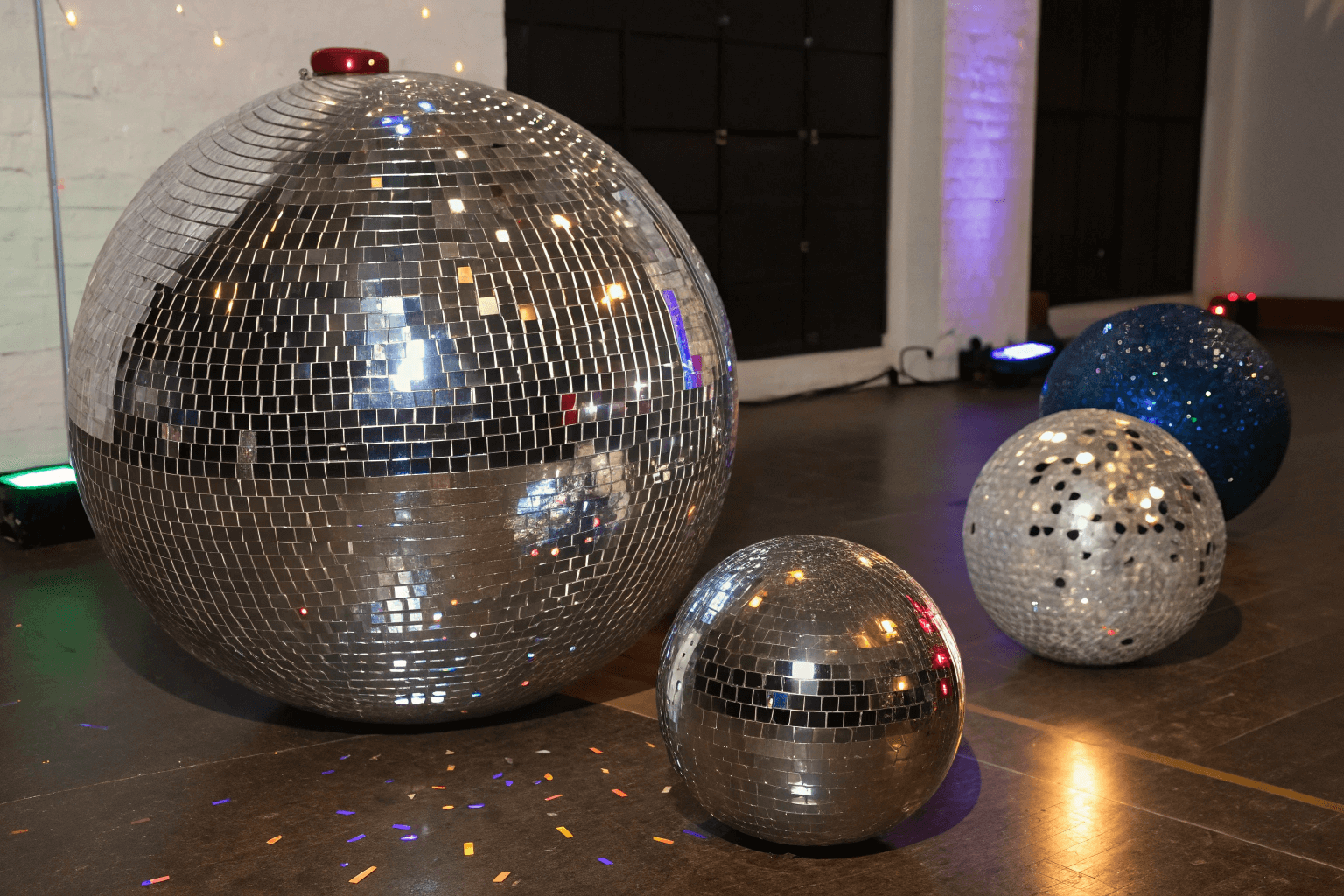
Source Commercial-Grade Mirror Balls, Factory Direct.
Calculating Tile Requirements (Sq. Ft. of a Sphere)
The surface area of a sphere is calculated using the formula A = 4πr², where r is the radius. For a 28-foot diameter sphere, this equals 2,464 square feet. This pure geometric area serves as the baseline for tile quantity, though real-world projects should add 10-15% for material waste.

The Core Geometric Formula and Its Application
The fundamental formula for a sphere’s surface area is A = 4πr², where A is the area and r is the radius. If you know the diameter (d) instead, you can use the equivalent formula A = πd², since the diameter is twice the radius (d = 2r). This calculation gives you the total curved exterior surface that needs tile coverage, which is the starting point for ordering materials and estimating costs.
Practical Calculation Examples and Waste Factor Considerations
For a sphere with a 10-foot radius, the surface area is 1,256 square feet (A = 4 * π * 10²). For a sphere with a 28-foot diameter, the area is 2,464 square feet (A = π * 28²). The formula provides the exact geometric area, but standard practice in refurbishment adds a 10-15% waste factor. This extra material accounts for tile cutting, pattern alignment, and potential defects during installation.
The surface area of a sphere, used for calculating tile needs on structures like tanks or domes, comes from the formula A = 4πr², where r is the radius in feet for an area in square feet. This gives the total curved surface to be covered. For practical use, you can convert a diameter to radius (r = d/2) and apply A = πd² to get direct square footage estimates for project bids.
Examples show the formula scales: a 28 ft diameter sphere needs 2,464 sq. ft., and a 10 ft radius sphere needs 1,256 sq. ft. These figures are benchmarks for tile quantity. The sources focus on pure geometry and do not include industry adjustments for waste or installation tolerances. In practice, a 10-15% contingency for cuts and overlaps is commonly added, though this is based on general experience rather than the cited references.
Hand-Tiling vs. Machine-Assisted Alignment
Machine-assisted alignment uses digital tools like laser trackers or navigation systems to achieve superior precision, reducing alignment errors by over 50% compared to hand methods. While hand-tiling relies on skilled craftsmanship, machine systems deliver OEM-spec consistency, lower rework rates, and are justified for high-volume or precision-critical projects despite a longer initial setup.

The Precision Gap: Quantifying Alignment Accuracy
The core difference between manual and machine methods is measurable in engineering data. Machine-assisted systems, such as those used in orthopedic surgery, achieve a femoral coronal alignment of 89.4° ± 2.2°, compared to 87.7° ± 2.1° for hand methods. This improvement is statistically significant (p=0.003).
The reduction in severe errors is even more pronounced. The rate of severe malalignment outliers—defined as being ≥3° off target—drops dramatically with machines. For tibial alignment, the outlier rate is 0% with machines versus 6.7% manually. For femoral alignment, it’s 10% versus 23.3%.
This level of precision is mirrored in industrial applications. In 3D wheel alignment, for example, machines achieve a repeatability of ±0.1°. This eliminates the technician-dependent variability inherent in manual methods that rely on strings or gauges, where errors can compound.
Operational Trade-offs: Speed, Skill, and Scale
The operational impact of each method reveals a nuanced trade-off between setup time and long-term efficiency. While machine setup averaged 88.1 minutes versus 83.4 minutes for hand methods, this marginal increase is offset by drastically reduced rework from alignment errors. The statistical difference in operative time is not significant (p=0.314).
Machine systems fundamentally change the skill requirement. They shorten the training curve for new technicians by providing a guided, repeatable process. In contrast, proficiency in hand-tiling is heavily dependent on years of artisan experience, introducing variability and risk.
The capital expenditure for machine assistance is justified by long-term gains. It boosts bay productivity and operational expense savings through higher consistency and less rework. The return on investment is most positive for high-volume resurfacing shops or projects that require permanent, stainless steel centerline references for consistent, large-scale work.
Grouting Options for Industrial/High-Impact Use
Industrial grouting requires materials that provide high compressive strength, non-shrink properties, and durability under dynamic loads. Cementitious precision grouts and epoxy grouts are the primary options, chosen based on factors like vibration, chemical exposure, and required bearing area.

Core Grout Types for High-Stress Applications
Cementitious precision grouts are the standard for most machinery bases, crane rails, and structural anchor bolts, offering high compressive strength and controlled expansion.
Epoxy grouts are specified for extreme conditions, such as areas with severe vibration, chemical spills, or thermal cycling, where superior bond strength and chemical resistance are critical.
The choice hinges on the specific load type: cementitious grouts handle high static and dynamic loads, while epoxy grouts excel where fatigue resistance and impermeability are paramount.
Technical Specifications and Performance Standards
Compressive strength is a key metric, with cementitious grouts like Five Star High Strength achieving 5,000 psi in 1 day and over 13,000 psi at 28 days.
Non-shrink performance is verified by standards like ASTM C 827 and ASTM C 1090, ensuring minimal height change (0.0-0.3%) for a consistent 95%+ effective bearing area under baseplates.
Flow characteristics, from 55% plastic to 140% flowable, determine placement method, enabling pumping into openings as small as 3 inches for full, void-free consolidation.
Material compliance with CRD-C621 and ASTM C1107 (Grade B or C) is essential for projects requiring certified non-shrink, high-strength performance in interior and exterior applications.
Post-Refurbishment Load Testing
Post-refurbishment load testing is a legally required safety check to confirm equipment can handle its rated capacity. It involves applying loads between 100% and 125% of the rated capacity in controlled static and dynamic tests, governed by OSHA and CMAA standards to ensure a built-in safety margin.

The Mandatory Testing Framework
This framework is governed by OSHA standards 1910.179(k)(2) for cranes and 1910.184 for slings, making it a legal requirement. The testing involves a load range from 100% to 125% of the equipment’s rated capacity.
Two key test types are performed. Static Load Testing requires holding 125% of the rated capacity for 10 minutes, with the equipment positioned 4 inches off the ground. Dynamic Load Testing involves operating all mechanisms at 110% of the rated capacity for 1 hour.
A critical safety rule dictates that the operational load limit must not exceed 80% of the maximum test load sustained. This creates a mandatory safety buffer. Test loads cannot exceed 125% of the rated capacity unless the original equipment manufacturer provides alternative written specifications.
Execution, Documentation, and Compliance
Modern testing methods use water-filled proof load bags with a capacity of 1-110 tonnes. This allows for gradual, controlled loading, which is superior to the sudden application of solid weights.
Advanced wireless monitoring systems log data at 200Hz and can handle over 120 simultaneous sensor connections for precise analysis during the test.
CMAA Specification 78 requires a written test report to be generated and maintained for the equipment’s entire service life. This report must be made available to authorized personnel.
After testing is complete, a qualified person must conduct a visual inspection to check for any damage, deformation, or defects that may have occurred.
Beyond the initial post-refurbishment test, OSHA mandates periodic re-testing at least every four years at 100% of the rated load. These periodic tests must be accompanied by thorough inspections.
Final Thoughts
Resurfacing large assets is a strategic financial decision, not just a repair job. The core principle is clear: if the total cost of refurbishment—including all future maintenance—stays below 50% of a new asset’s value, it typically offers a strong return on investment. This approach can save 40-70% over replacement while extending the equipment’s life for years. The decision hinges on a detailed analysis of the asset’s condition, its maintenance history, and the availability of parts, moving beyond a simple repair quote to a full lifecycle cost comparison.
Success depends on meticulous execution at every stage. From carefully stripping old adhesives without damaging the substrate to achieving the precise flatness required for large-format tiles, each technical step impacts the final durability and performance. Choosing the right grout for the operating environment and validating the work with mandatory load testing ensures the refurbished asset meets original specifications and safety standards. For unique or high-value items, this specialized process preserves the core investment, offering a cost-effective alternative to replacement when the foundational structure remains sound.
Frequently Asked Questions
Can you re-tile an entire disco ball?
The process of re-tiling a disco ball involves replacing its individual mirror facets. This is distinct from resurfacing a bowling ball, which uses abrasion. For a professional-grade refurbishment, the old adhesive must be removed without damaging the underlying sphere, new tiles are precisely cut and leveled, and a durable grout is applied. The feasibility and cost depend on the ball’s size, condition, and the desired tile material.
What is the cost to resurface a large disco ball?
Professional resurfacing costs for large disco balls are not standardized like bowling ball services. Pricing is project-specific, influenced by diameter, the extent of adhesive removal and surface preparation required, tile material (e.g., standard glass vs. premium mirrors), and labor intensity. For an accurate quote, a manufacturer like BDB would assess the ball’s condition and the client’s specifications directly.
How do you remove old glue from a mirror ball without causing damage?
Removing old adhesive requires careful mechanical and chemical methods to preserve the sphere’s integrity. Techniques include using plastic shims or scrapers for gentle prying and applying controlled amounts of solvents like acetone to soften the glue. The goal is to achieve a clean, level surface ready for new tile adhesion without scratching or warping the ball’s core structure.
When is re-tiling more cost-effective than buying a new disco ball?
Re-tiling is typically more ROI-positive for high-value, custom, or large-format disco balls where the core structure (the sphere and motor mount) remains sound. If a ball has sentimental, historical, or unique design value, refurbishment preserves that investment. For standard, mass-produced balls, replacement is often simpler and more economical unless specific tile specifications are required.
How many mirror tiles are needed for a 20-inch disco ball?
A 20-inch sphere has a surface area of approximately 1,256 square inches. Using the industry-standard 1×1 inch mirror tiles, like those specified for the Omega National MG-20 model, you would need about 1,256 tiles for full coverage. Some manufacturers use smaller tiles (e.g., 3/8-inch or 10mm) for a denser mosaic effect, which increases the total tile count proportionally.
Are there professional services for disco ball resurfacing?
Dedicated commercial services for disco ball resurfacing are not commonly advertised as standardized offerings. This type of refurbishment is usually handled by custom fabrication partners or specialty manufacturers. Companies like BDB, which operate as direct manufacturing partners, provide such bespoke refurbishment services by applying their precision tile-cutting, surface leveling, and adhesive expertise to restore or upgrade existing mirror balls.