

A single point of failure isn’t just a risk; it’s a liability. For rigging contractors and safety managers, a simple backup that shares components with the primary system doesn’t meet modern standards for true redundancy. This article explains the double-insurance protocol, where secondary safety cables must be physically and electrically independent to ensure continuous protection.

We’ll cover the core principles of implementing this separation, including the mandated 300 mm air-gap for cable trays and the requirement for independent anchorages in wire rope systems. You’ll also get actionable guidance on selecting the correct cable gauge—comparing the 500 lb breaking strength of a 1/16″ cable to the 2100 lb capacity of a 1/8″ cable—and how to calculate critical drop distances to keep your installations compliant and safe.
Why One Point of Failure is Not Enough
Relying on a single backup creates a shared point of failure. Modern safety standards require true redundancy, where primary and secondary systems are physically and electrically independent. This is achieved through mandated separation distances, fire-rated barriers, and independent anchorages to ensure one system remains operational if the other fails due to fire, mechanical damage, or structural collapse.

The Principle of True Redundancy in Safety Systems
A simple backup shares components or pathways with the primary system, creating a single point of failure. True redundancy requires completely independent systems. Standards like BS 8519:2020 mandate that primary and secondary supplies must be separated so a failure in one does not affect the other.
This principle applies universally, from electrical safety circuits in buildings to mechanical wire rope systems for suspended loads. The goal is to ensure continuous protection against diverse failure modes, including fire, cable tray collapse, anchor point failure, or accidental cutting.
Implementing Separation: Distances, Barriers, and Independent Anchorages
A 300 mm horizontal air-gap separation is a benchmark for cable trays, as specified in BS 5839-1:2020, providing distance-based independence. Where the 300 mm gap cannot be maintained, fire compartmentation with a minimum 120-minute fire-survival rating (using barriers like Durasteel® baffles) is required.
For wire rope systems, OSHA and ANSI standards require a secondary rope with an independent anchorage, separate from the primary rope’s rigging points. Cables for life-safety circuits, such as FP600 with metallic screened armour, must have a 120-minute fire resistance rating to maintain integrity during a fire.
These measurable specifications provide clear, actionable guidelines for rigging contractors and installers to eliminate shared failure points.
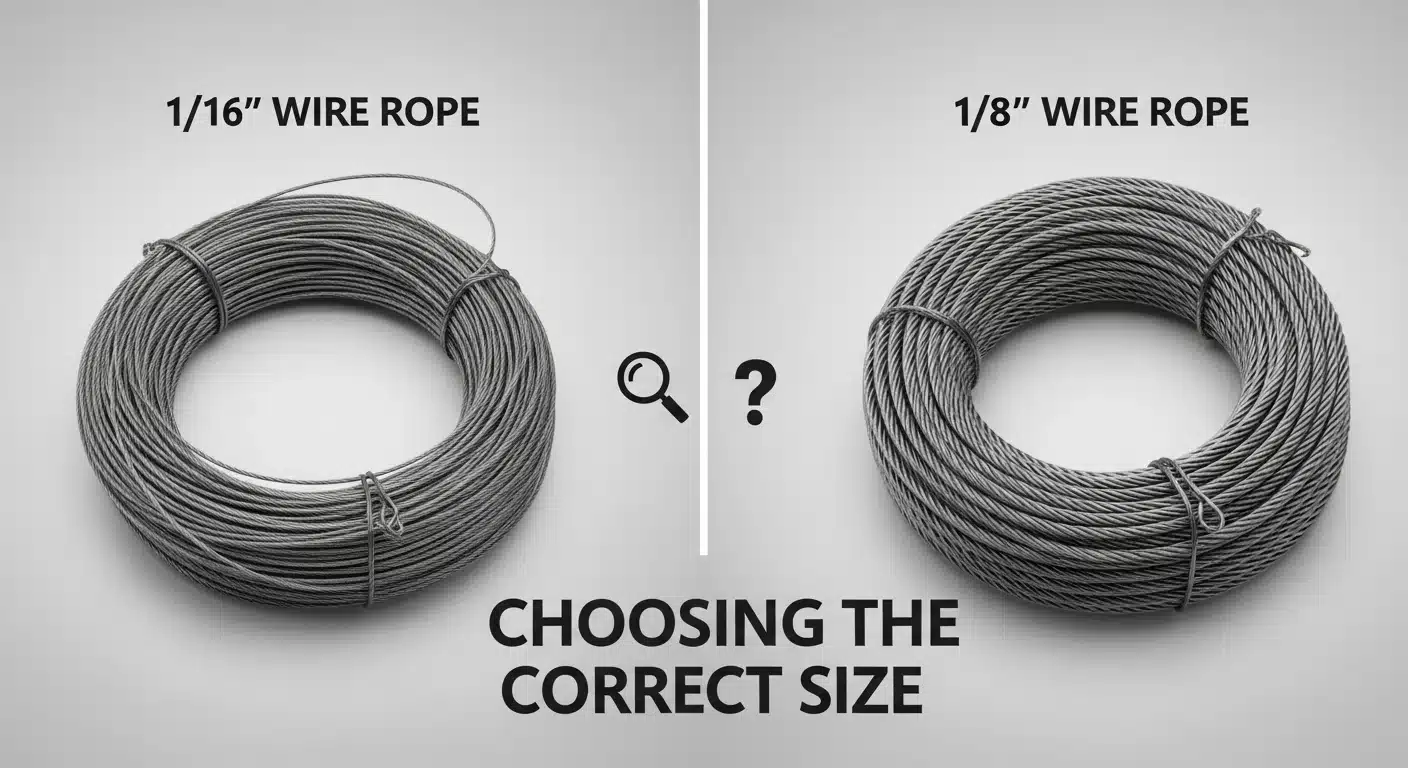
Selecting the Correct Wire Rope Gauge (1/16″ vs 1/8″)
The choice between 1/16″ and 1/8″ wire rope hinges on required breaking strength. A 1/16″ cable offers a minimum breaking strength of about 500 lbs, suitable for lighter loads. An 1/8″ cable provides roughly 2100 lbs of breaking strength, offering a four-fold increase in capacity for heavier rigging demands, which directly impacts the safe working load when applying standard safety factors.
| Specification | 1/16″ Wire Rope | 1/8″ Wire Rope |
|---|---|---|
| Diameter (Approx.) | 0.0625 in (16 SWG) | 0.125 in (10 SWG) |
| Min. Breaking Strength | 480-500 lbs (2.13-2.22 kN) | 1700-2100 lbs (7.56-9.34 kN) |
| Safe Working Load (5:1 Safety Factor) | 85-100 lbs | 370-420 lbs |
| Typical Weight per 1000 ft | 7.5-8.5 lbs | 28-35 lbs |
| Common Construction Standards | MIL-DTL-87161 (1×19), MIL-DTL-83420 (3×7, 7×19) | MIL-DTL-87161 (1×19), MIL-DTL-83420 (7×19), Industry 7×19 |
Core Specifications and Load Capacity
The 1/16″ wire rope has a diameter of approximately 0.0625 inches, which corresponds to 16 SWG. Its typical minimum breaking strength falls between 480 and 500 pounds, or 2.13 to 2.22 kilonewtons.
The 1/8″ wire rope has a diameter of approximately 0.125 inches, or 10 SWG. It provides a significantly higher minimum breaking strength, typically ranging from 1700 to 2100 pounds, which is 7.56 to 9.34 kilonewtons.
The strength increase from 1/16″ to 1/8″ is not linear. It scales with the cross-sectional area of the cable, resulting in roughly four times the breaking strength of the smaller gauge.
When applying a standard 5:1 safety factor, the safe working load for a 1/16″ cable is about 85 to 100 pounds. For a 1/8″ cable, the safe working load is approximately 370 to 420 pounds.
Construction Standards and Application Guidelines
Both gauges are manufactured to strict government specifications, including MIL-DTL-87161 for 1×19 construction and MIL-DTL-83420 for 3×7 and 7×19 constructions. This ensures traceability and reliability in performance.
The 1/16″ cable uses finer individual wires, typically between 0.006 and 0.010 inches in diameter. This construction offers superior flexibility, making it ideal for compact installations where space and weight are primary constraints, such as in certain aircraft-style rigging.
The 1/8″ cable is the standard for heavier rigging applications in events and construction. It commonly uses 7×19 or 1×19 constructions, which are designed to handle dynamic loads and provide a robust safety margin.
Selection should prioritize the application’s required minimum breaking strength and compliance with relevant standards, such as MIL-DTL-87161 or industry-specific specifications for elevator-grade 8×19 rope, rather than gauge alone.
Attachment Points: Primary vs. Secondary Loops
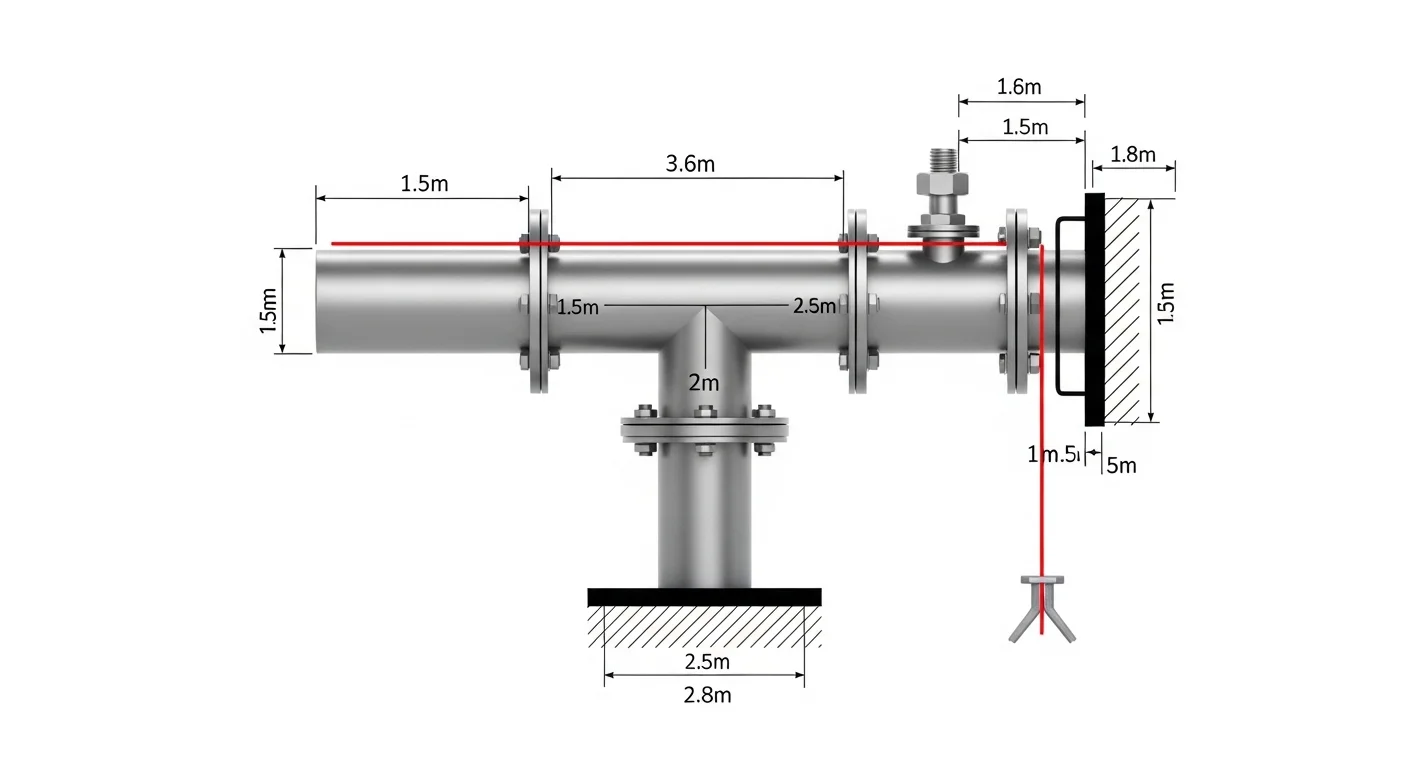
In a dual-loop safety system, the primary loop is the main load-bearing path, designed for constant, predictable stress. The secondary loop is a completely independent backup, sized and anchored separately to catch the load if the primary fails. Their connection at closely spaced tees is critical to prevent pressure interference and ensure the secondary activates only when needed.
| Parameter | Rule / Specification | Purpose |
|---|---|---|
| Tee Spacing (Center-to-Center) | Maximum 4x primary pipe diameter | Minimizes pressure drop, prevents unintended flow between loops |
| Straight Pipe at Tees | 8 pipe diameters upstream, 4 diameters downstream | Reduces turbulence at the interface |
| Common Piping Length | Maximum 1 foot, ≤ 2 “through” tees | Maintains system isolation and decoupling |
| Manifold Hose/Coupling | Min. 19 mm (0.75 in.) ID; 3-15 m (10-50 ft) length | Controls pressure loss, ensures adequate flow |
| Secondary Pump Head | 6 feet per 100 feet of piping | Ensures reliable pressure for backup system activation |
Defining the Roles: Primary Load Path vs. Secondary Backup
The primary loop is the designated path for the working load, engineered to handle constant or cyclic forces with a known safety factor.
The secondary loop is a fully redundant, independent system that remains passive under normal conditions, activating only upon a primary failure to arrest a fall or collapse.
Decoupling the loops prevents the secondary from sharing the load during normal operation, which preserves its integrity and ensures it is ready for an emergency.
This setup mirrors hydraulic primary/secondary piping, where the primary acts as a constant-pressure reference, allowing the secondary to operate independently without flow reversal.
Interface Design and Critical Spacing Rules
The connection between loops must use closely spaced tees, with a maximum center-to-center distance of 4 times the primary pipe’s diameter to minimize pressure drop and prevent unintended flow.
A minimum of 8 pipe diameters of straight pipe is required upstream of the first tee, and 4 diameters downstream of the second tee to reduce turbulence at the interface.
The total common piping between the tees should not exceed 1 foot, and no more than two ‘through’ tees should be used in this section to maintain system isolation.
For hose or flexible connections at manifolds, the minimum inner diameter is 19 mm (0.75 in.), with hose lengths kept between 3-15 meters (10-50 feet) to control pressure loss.
Source Professional-Grade Mirror Balls, Factory-Direct.

Using Thimbles and Ferrules for Secure Terminations
Thimbles and ferrules are essential components for creating secure wire rope eyes. The thimble protects the rope from abrasion and maintains its shape, while the ferrule is a metal sleeve pressed onto the rope to secure the termination. Together, they form a system governed by standards like EN 13411, which mandates specific efficiency ratings and material requirements to ensure the termination can safely handle the working load.

The Role and Standards for Thimble and Ferrule Systems
A thimble is a grooved metal insert placed inside a wire rope eye loop. Its primary function is to prevent the rope from crushing, abrading, or deforming under load, which preserves the rope’s strength and shape. A ferrule is a metal sleeve that is pressed or swaged onto the rope end to permanently secure the eye loop around the thimble, creating a durable termination.
The EN 13411 series of European standards is the primary framework governing these systems. It specifies minimum efficiency factors for different termination types. For example, ferrule-secured terminations with solid thimbles must achieve a minimum efficiency factor (KT) of 0.9. This means the termination retains 90% of the rope’s original breaking strength. In contrast, spliced terminations using thimbles have a lower required efficiency of 0.8 KT, or 80%. This difference highlights the superior strength and reliability of pressed ferrule systems.
These standards ensure terminations are predictable and safe. The efficiency factor directly impacts the calculated Working Load Limit (WLL) for the entire cable assembly, making correct component selection and installation critical for safety.
Technical Specifications and Installation Requirements
Material consistency is vital for safety. Solid thimbles must be manufactured from steel per EN 10025 or from cast steel, as specified in EN 13411-9:2021. This ensures the thimble has the necessary strength and durability. Commercially available diameters for solid thimbles range from 4mm to 50mm for mild steel and 2mm to 24mm for stainless steel, covering most secondary safety cable applications.
Proper installation is governed by precise dimensional tolerances. After pressing the ferrule, a critical clearance of approximately 1.5 times the nominal rope diameter must be maintained between the thimble base and the ferrule. This space allows for proper load distribution and prevents stress concentrations. For assemblies using a bolt through the thimble, the maximum permissible bolt clearance for type testing is 10% of the bore diameter.
Performance testing validates long-term reliability. In demanding applications like crane hoists, terminations must pass rigorous fatigue testing, enduring a minimum of 1 million load cycles to prove they won’t fail under repeated use. This performance is achievable because swaged (pressed) ferrule systems typically achieve 90-100% termination efficiency, significantly outperforming mechanical wire rope clips, which are generally rated at 80% efficiency.
Hiding the Safety Cable without Compromising Integrity
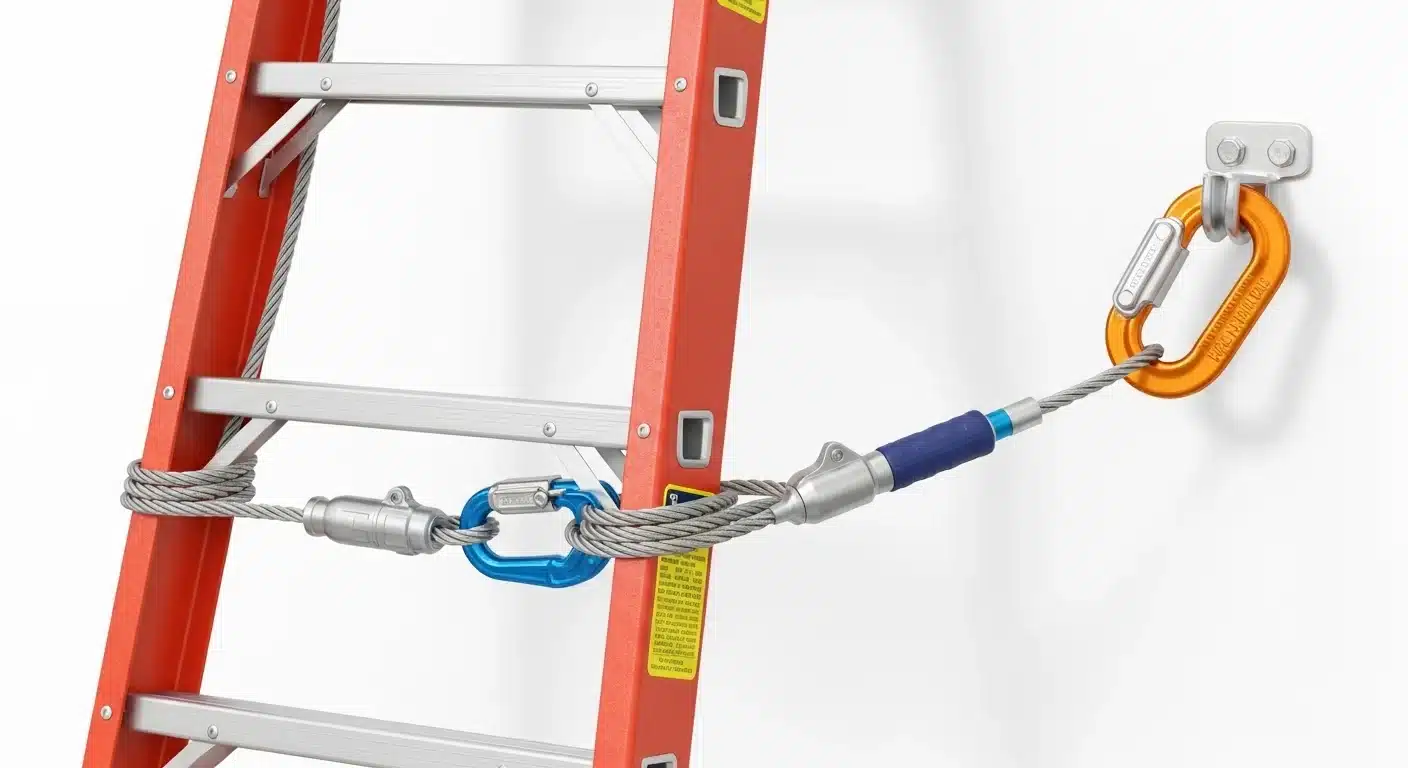
Hiding a safety cable involves routing it along the ladder’s path using specialized hardware like cable guides and brackets. These components keep the cable taut and aligned, preventing sag and exposure. The system’s integrity is preserved through high-strength cables, secure terminations like double-swaged fittings, and anchorage points rated for over 5,000 pounds, ensuring the concealed setup meets all required safety factors.
Routing and Hardware for Discreet Installation
To conceal the cable without creating snag points or visual clutter, specific components and methods are used. Cable Guides are installed every 25 feet to maintain precise alignment and prevent the cable from bowing or becoming visible.
Top and Bottom Brackets with integrated systems, such as rotating side plates and locking cams, create a low-profile, secure anchor point at the ladder’s ends. The cable is routed through a protective Cable Sleeve equipped with upper and lower rollers, which allows the climber’s lanyard to move smoothly while keeping the cable itself hidden within the ladder’s structure.
All connection points are sealed with weather-tight fittings. This protects the internal components from the elements and maintains a clean, uninterrupted exterior appearance, which is suitable for professional rigging and event setups.
Preserving Structural Integrity in a Concealed System
The core cable must be a high-strength 3/8” diameter 7×19 aircraft cable or an 8mm solid-core cable. Its minimum breaking strength far exceeds the 450 lbf installation load required for the system.
All terminations, such as eye-bolt connections, must be anchored to structural points rated for at least 5,000 lbf to handle potential fall forces. Adjustable cable hardware uses double-swaged fittings, providing a 2x safety factor to ensure connections remain secure under tension across a wide service temperature range from -40°F to 140°F.
The entire concealed system must be tested and tagged for compliance with ANSI/OSHA, CSA, and EU ladder safety standards. Visible system tags ensure traceability and verification of all safety ratings.
Calculating “Drop Distance” in Case of Primary Failure
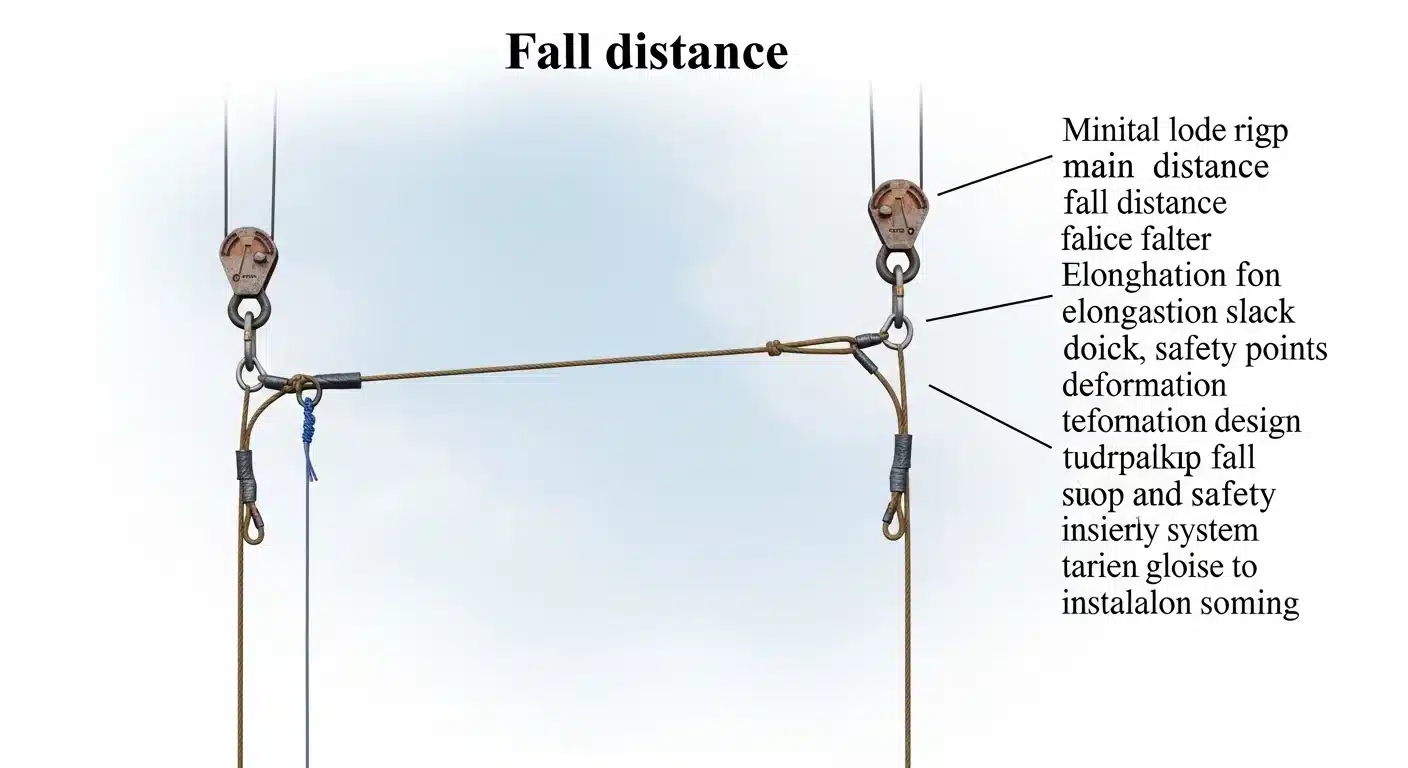
Drop distance is the calculated vertical travel of a load after a primary rigging failure, before the secondary safety cable arrests the fall. It is a function of cable stretch, attachment point slack, and system deformation. For overhead rigging, minimizing this distance is paramount to prevent catastrophic damage or injury, requiring precise engineering based on cable material, load weight, and installation geometry.
The Fundamentals of Drop Distance Calculation
Drop distance is not a fixed number but a calculated range based on system design and material properties.
The core purpose is to ensure the secondary system engages within a safe tolerance, preventing the load from striking the ground or other objects.
Key variables include the elastic stretch of the safety cable under load, any intentional or unintentional slack in the system, and deformation at attachment points.
For a typical steel cable, elastic stretch can be calculated using the modulus of elasticity, cable length, cross-sectional area, and the applied load.
Applying Engineering Principles and Best Practices
A standard calculation involves determining the cable’s elongation using the formula: (Load x Length) / (Cross-sectional Area x Modulus of Elasticity).
Best practice mandates adding a safety factor to the calculated stretch to account for dynamic loads, attachment point yield, and installation tolerances.
While specific numeric standards for secondary cable drop distance are not universally codified, the principle is governed by OSHA’s general duty clause and ANSI B30 standards, which require protection against falling loads.
The final engineered specification must ensure the total potential drop distance is less than the available clearance between the load and any obstruction below.
Compliance with OSHA and International Rigging Standards
For rigging in the U.S., compliance centers on OSHA standards like 29 CFR 1926.251 for inspections and 1926.753 for steel erection, alongside ASME B30 standards for equipment certification. Key rules include pre-shift inspections, using qualified riggers for critical tasks, and removing gear with specific defects like wire ropes with 12.5% broken wires. While practices align internationally, direct ISO equivalents for rigging were not identified in the research.

Core OSHA and ASME Standards for Rigging Safety
The foundation of safe rigging operations in the United States is built on specific, mandatory regulations from OSHA and detailed industry standards from ASME. These rules dictate how equipment must be inspected, rated, and operated by qualified personnel.
OSHA 29 CFR 1926.251 requires rigging equipment to be inspected prior to each shift and during use for safety. This standard forms the baseline for daily operational checks. For steel erection work, OSHA 29 CFR 1926.753 specifies that rigging capacity must follow rating charts and mandates that steel members be rigged at least 7 feet (2.1 m) apart to prevent contact.
The ASME B30 series provides the technical certification basis for equipment strength and safe use. Key volumes include B30.9 for slings, B30.10 for hooks, and B30.26 for shackles, links, rings, and rigging blocks. Equipment certified to these standards is validated for lifting applications.
Personnel qualifications are also strictly regulated. A qualified rigger is required for hoisting during assembly or disassembly of equipment and whenever workers are in the fall zone for hooking, unhooking, or guiding a load. This ensures critical tasks are performed by individuals with demonstrated knowledge and skill.
Inspection Criteria and International Alignment
U.S. standards provide precise, quantifiable failure criteria for rigging components, creating a clear line between serviceable and defective gear. This physics-based approach to validation shows alignment with global engineering principles, even in the absence of direct international rigging standards.
For wire rope, removal from service is mandatory if 12.5% of its wires are broken within one lay length. Other rejection criteria include evidence of chafing, kinking, bird-caging, corrosion, or heat damage. For shackles, the rated breaking strength must be greater than that of the attached components. When used with extra improved plow steel wire rope, shackles must have a minimum ultimate tensile strength of 120,000 PSI.
The research did not identify direct ISO or EN global standards specifically for rigging equipment and inspection. Therefore, for U.S. operations, the compliance focus remains squarely on OSHA and ASME. However, practices in jurisdictions like Oregon OSHA (Division 7/G) mirror federal rules with the same quantifiable criteria—such as the 7-foot spacing rule, 5-foot fall limits for guyline safety straps, and the precise wire rope rejection threshold. This indicates a widespread adoption of a validation approach based on measurable physics and engineering logic, which aligns with international best practices for structural safety.
Final Thoughts
Installing a secondary safety cable is not an optional extra; it’s a fundamental requirement for any responsible overhead rigging operation. The protocol hinges on a single, non-negotiable principle: true redundancy. This means creating a backup system that is physically and electrically independent from the primary, with its own anchorage points, routing, and termination hardware. Whether you’re selecting the correct wire rope gauge, designing attachment points, or calculating potential drop distances, every decision must reinforce this separation to eliminate shared points of failure.
The practical implication is that safety is built on measurable specifications, not guesswork. From the 300mm separation gap for cable trays to the 12:1 safety factor for a disco ball, each standard provides a clear, actionable target. Compliance with OSHA, ASME, and international norms like EN 13411 transforms abstract safety concepts into verifiable engineering practices. Ultimately, a correctly installed double-insurance protocol does more than just catch a falling load—it provides the certainty that the system will perform when it matters most, protecting both people and property from catastrophic failure.
Frequently Asked Questions
Do disco balls need safety cables?
Yes, securing disco balls with a secondary safety cable or chain is an industry standard for any overhead installation. This practice is required to prevent catastrophic failure and to comply with established rigging safety norms. The safety attachment must be rated to hold at least 12 times the weight of the mirror ball assembly.
How do you attach a safety wire to a mirror ball?
Attach the safety wire or chain to the dedicated safety eyelet on the mirror ball and the corresponding safety eyelet on the motor or mounting fixture. The safety cable should be slightly longer than the primary suspension to limit any potential drop to 20 centimeters or less. Always use a wire or chain rated for a minimum breaking strength of 12 times the total suspended weight.
What gauge wire should I use for an 8kg disco ball?
For an 8kg disco ball, you must use aircraft-grade wire or a heavy-duty safety cable rated for overhead rigging loads that far exceed the static weight. While specific gauges aren’t detailed in the provided standards, the cable must account for dynamic forces and meet the critical 12:1 safety factor, meaning it should have a minimum breaking strength of at least 96kg.
What is the best way to hide safety cables in decor?
Industry standards prioritize safety integrity over aesthetics. While specific decorative concealment methods aren’t covered in the core rigging standards, any method used must not compromise the cable’s strength, create abrasion points, or interfere with inspections. Solutions often involve coordinating with set design to route cables along structural elements or within decorative trusses, always ensuring the cable remains fully functional and accessible for inspection.
What rigging redundancy is required for public spaces?
Public venues and event spaces require secondary suspension for all flown loads. Standards like ANSI ES1.18-2022 mandate a backup system, such as a safety cable, that is independent of the primary rigging. This applies to structural points like rigging beams, which have specific load limits (e.g., 2000 lb point load), ensuring the secondary system can support the load if the primary fails.
What’s the difference between a safety cable and a primary chain?
The primary chain is the main load-bearing suspension designed for the working weight. A safety cable is a secondary, independent backup system. Chains typically have a much higher load capacity and are the standard for primary support. Safety cables, while strong, serve a different purpose: to catch the load if the primary chain fails, and they must be rated to handle the dynamic shock load of such an event.