

Shipping large, fragile spheres like disco balls or custom lighting presents a unique logistics challenge where the cost of damage or a miscalculated shipment can quickly erase your profit margin. The physics of packing, volumetric weight charges, and the choice between a suspension or padded crate base are not just theoretical—they directly impact your bottom line and project timelines.

This article breaks down the critical factors for optimizing these complex shipments. We’ll analyze how DIM factors from carriers like FedEx (139 in/lb) and UPS (166 in/lb) affect your freight costs, compare the structural engineering behind suspension and padded crate systems for different cargo types, and provide actionable guidance on palletization, insurance, and customs clearance using HS Code 9405.
The Fragile Logistics Challenge: Spheres vs. Space
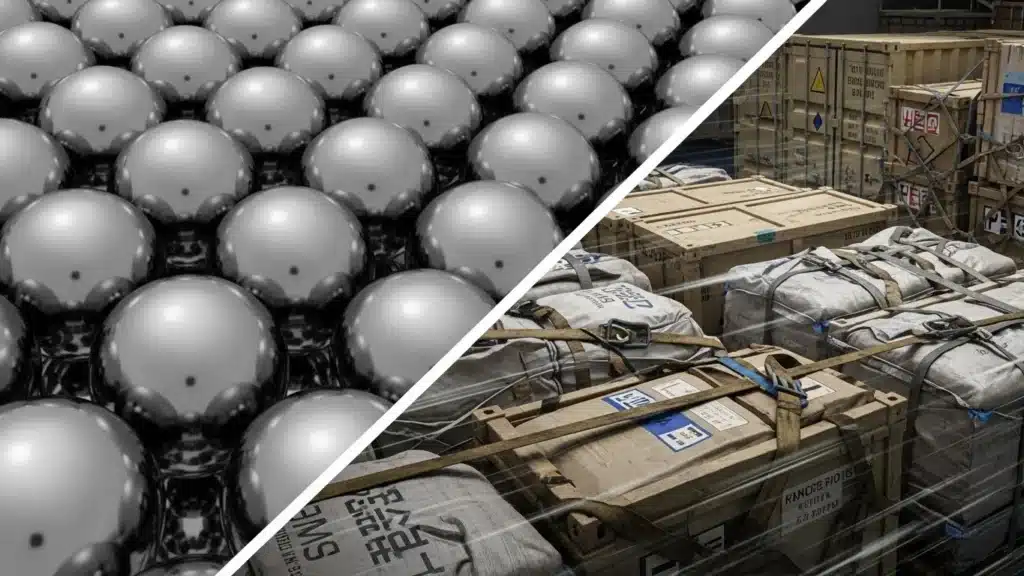
This challenge contrasts the predictable, dense packing of uniform spheres with the irregular voids and shear forces present in real-world cargo. It combines the physics of jamming and shear strain with modern IoT telematics to create a framework for minimizing damage and optimizing space in fragile logistics.
The Physics of Packing: From Ideal Spheres to Real-World Voids
In frictionless models, spheres reach a minimum jamming density (φ_J) where they lock in place, creating a stable, isotropic structure.
Real cargo is irregular, creating unpredictable void spaces (‘Space’) that allow items to shift, generating damaging shear forces (γ) during transit.
The ‘jamming plane’ concept shows that stable packing can occur through compression at a fixed density or through applied shear strain at higher densities, guiding load planning.
Bridging Theory with Practice: IoT Monitoring and Load Optimization
Devices like the Azure Sphere MT3620 MCU enable real-time edge monitoring of critical conditions like shock and vibration, which are proxies for shear forces within a load.
Telematics systems track location, temperature, and humidity, providing prescriptive data that allows for remote adjustments in cold chains, directly addressing timeliness for fragile goods.
By analyzing this sensor data alongside packing principles, logistics managers can optimize container loading to minimize void space and shear risk, reducing both waste and insurance claims.
Understanding Volumetric Weight (DIM Factor)
Volumetric weight is a pricing method used by carriers to charge for the space a package occupies, not just its actual weight. It’s calculated by dividing the package’s cubic volume by a carrier-specific DIM factor. For lightweight, bulky shipments, this often becomes the chargeable weight, directly affecting freight costs.
| Carrier / Service | DIM Factor (in/lb) | DIM Factor (cm/kg) |
|---|---|---|
| FedEx | 139 | 5000 |
| UPS Ground (Retail) | 139 | — |
| UPS Ground (Commercial) | 166 | — |
| USPS Priority Mail | 166 | — |
| DHL Express | — | 5000 |
What Volumetric Weight Is and Why It Matters
Volumetric weight prevents carriers from losing money on large, lightweight shipments that take up valuable cargo space. Carriers compare the actual weight and the calculated volumetric weight, then charge based on whichever is greater.
For items like mirror balls and large glass panels, the volumetric weight frequently determines the shipping cost due to their high volume-to-weight ratio. This pricing model incentivizes efficient packaging and accurate dimensional data from shippers.
DIM Factor Standards and Cost Calculations
The standard calculation is (Length × Width × Height) ÷ DIM Factor = Volumetric Weight. DIM factors vary: FedEx uses 139 (in/lb), UPS Ground (commercial) uses 166 (in/lb), and DHL Express uses 5000 (cm/kg).
A lower DIM factor results in a higher volumetric weight and cost. The difference between a factor of 139 and 166 can lead to a roughly 20% variation in shipping charges. Carriers like USPS apply DIM pricing once a package exceeds a specific cubic volume, such as 1,728 cubic inches.
High-volume B2B shippers can often negotiate more favorable DIM factors in contracts to optimize logistics costs.
Crate Engineering: Suspension vs. Padded Bases
Suspension systems use rigid, elevated skid bases and shock-absorbing materials to isolate cargo from shocks and vibrations, ideal for heavy equipment and palletized transport. Padded bases rely on direct cushioning materials like foam to absorb impacts, better suited for delicate items with less need for forklift mobility. The choice balances structural integrity against shock mitigation.

| Feature | Suspension System | Padded Base System |
|---|---|---|
| Core Structure | Rigid skid base (e.g., 4×4 lumber) creating an elevated frame. | Direct cushioning materials (foam, rubber) without a rigid elevated frame. |
| Primary Function | Structural integrity and load transfer for logistics handling. | Direct shock and vibration absorption for delicate items. |
| Forklift/Pallet Jack Access | Yes, provides ~3.5″ clearance. | Typically not designed for it. |
| Ideal Cargo | Heavy equipment, flat/leg/pedestal bases, palletized goods. | Delicate instruments, glass, vibration-sensitive assets. |
| Shock Mitigation Method | Isolates cargo via elevated structure; can be enhanced with vibration-damping materials. | Absorbs impact directly through cushioning materials that cradle the cargo. |
| Key Engineering Metric | Wood crushing strength (parallel to grain up to 6.0), frame resistance to racking. | PSI (weight/surface area) calculated against dynamic cushioning curves for foam selection. |
The Suspension System: Structural Integrity for Logistics
The suspension crate system is built around a skid-type base, typically constructed from 4x4x12 inch fir or pine lumber. The skids are beveled and secured with glue and 3-inch screws or nails to form a rigid, elevated frame.
This design lifts the crate about 3.5 inches off the ground, providing essential clearance for pallet jacks and forklift tines. This makes it the default choice for container shipping and warehouse handling where mechanical movement is standard.
The system’s strength comes from transferring load and impact stresses to engineered end frames and diagonal bracing or plywood sheathing. These components act as trusses, resisting crushing forces from slings and racking forces during transit.
For sensitive cargo, the suspension can be enhanced with vibration isolation. Materials like polyethylene foam and spring bolts are integrated, with their specifications calculated based on the cargo’s PSI (pounds per square inch) against dynamic cushioning curves.
This approach maximizes wood’s inherent strength properties, such as a maximum crushing strength parallel to the grain of up to 6.0. It is particularly suitable for equipment with flat, leg, or pedestal bases where loads are distributed.
Padded and Cushioned Bases: Direct Impact Protection
Padded crate bases prioritize direct shock absorption over structural framing for logistics. They rely on cushioning materials like polyurethane foam for light items, dense polyethylene foam blocks, or adhesive-backed PVC gaskets to fill voids and suspend components.
This method protects cargo by allowing it to “float” within the crate, dampening shocks and vibrations at the point of contact. However, it typically lacks the elevated, rigid structure needed for easy mechanical handling with forklifts.
This design is effective for delicate, high-value assets where vibration damping is a higher priority than repeated pallet transfers. Examples include sensitive glass sculptures or精密 instruments that cannot tolerate high-G impacts.
Engineering a padded base requires precise PSI calculations—dividing the cargo’s weight by its bearing surface area. This determines the correct foam density and thickness from dynamic cushioning curves to ensure adequate protection.
Even within a padded environment, securing the cargo is critical. Supplementary bracing like timber blocks, ratchet straps, or corrugated U-boards is often used to prevent movement of suspended elements like machine legs.
Source Commercial-Grade Mirror Balls, Factory-Direct.

Palletization for LCL (Less than Container Load)
Palletization in LCL shipping consolidates loose boxes onto a standard platform to prevent damage during mixed-consignee transport. While it safeguards cargo, it increases chargeable volume, requiring a strategic balance between protection and cost. Compliance with international material standards like ISPM 15 is mandatory.

The Core Functions: Damage Prevention and Cost Calculation
Palletization consolidates loose boxes onto a single platform. This protects your cargo from damage caused by neighboring shipments during the mixed-consignee transport typical of LCL shipping.
This protection comes with a direct impact on freight charges. Carriers calculate the cost using the full external dimensions of the loaded pallet, not just the footprint of the boxes. This often results in a higher chargeable volume.
The decision to palletize requires balancing the need for physical protection against the higher cost from this increased volumetric weight.
Technical Standards and Material Compliance
The standard U.S. pallet measures 48 inches by 40 inches and can typically support up to 4,600 pounds. These dimensions and capacity are key for planning your consolidation.
Weight thresholds guide the decision. Pieces over 70 kilograms must be placed on pallets or in fork-movable crates. Items between 30 and 70 kilograms also benefit from this type of support for safer handling.
For international shipments, material compliance is critical. Wooden pallets must meet ISPM 15 standards, meaning they must be heat-treated or fumigated and bear a valid IPPC stamp. Plastic or presswood pallets are exempt from this requirement.
Insurance Claims for High-Value Glass Assets
Filing a claim for high-value glass assets requires immediate action and detailed documentation. Standard policies often have limits, making specialized endorsements crucial for full coverage. The process hinges on professional appraisals and proof of value to support the claim against potential disputes.

Understanding Coverage Limits and Endorsements
Standard homeowners or business policies cover glass but impose specific limits, often leaving significant out-of-pocket costs after deductibles for custom or large items. For assets valued at or above $100,000, or for irreplaceable pieces, specialized coverage is essential.
Endorsements like Building Glass Coverage raise specific limits (e.g., to $5,000) to cover full replacement cost minus a deductible, which can be as low as $500. Without proper endorsements, a claim for a large bay window costing $2,000 might only yield $1,500 after a standard deductible, highlighting the coverage gap.
The Claims Process: Documentation and Valuation
Document damage within the first 24 hours using high-resolution photos and video with timestamps to create an immediate record. Compile a claim dossier including original purchase receipts, USPAP-compliant professional appraisals, authentication certificates, and full provenance records.
Valuation should be supported by a detailed condition report, replacement cost calculations, and market analysis using comparable sales or auction data. This rigorous documentation is vital to counter fraud detection systems, prevent insurer disputes, and ensure a payout based on fair market or replacement value.
Customs Clearance: Harmonized Codes (HS 9405)
HS Code 9405 is the global standard for classifying lamps, lighting fittings, and illuminated signs for customs. It is essential for determining import duties, ensuring smooth clearance, and avoiding shipping delays. For BDB, this code applies to disco balls and custom mirrored lighting elements, requiring precise documentation to match the product’s technical description.

What HS Code 9405 Covers and Why It Matters
HS Code 9405 is maintained by the World Customs Organization and used by over 170 countries for uniform tariff classification.
It specifically covers lamps and lighting fittings, including searchlights, spotlights, and illuminated signs or name-plates.
For BDB, this classification directly applies to commercial disco balls and custom mirrored lighting installations, categorizing them as ‘Other electric lamps and lighting fittings’ (typically under 9405.40).
Correct classification is non-negotiable; it determines the applicable duty rates, facilitates automated customs processing, and prevents costly delays or penalties at the border.
The code breaks down into precise sub-headings: 9405.10 for chandeliers, 9405.20 for table/floor lamps, 9405.30 for Christmas lighting, 9405.40 for other electric lamps, 9405.50 for non-electrical lamps, and 9405.60 for illuminated signs.
Trade data shows significant volume under this code, with over $937 million in US imports annually, primarily from China, Mexico, and Vietnam.
Accurate documentation must include the 10-digit HS code, a detailed commercial invoice specifying materials (e.g., ‘glass mirror facets on a motorized base’), value, and country of origin.
Partnerships with experienced freight forwarders are crucial to navigate destination-specific duty rates and ensure all technical descriptions align with the tariff classification to avoid disputes.
Unpacking SOP for Large Scale Projects
A Standard Operating Procedure for unpacking large-scale projects is a formalized, sequential plan. It defines the scope, technical specifications, and step-by-step workflows for handling, verifying, and commissioning high-value or complex shipments to prevent damage, ensure compliance, and meet project timelines.

Defining Scope and Technical Specifications
The first phase of an unpacking SOP establishes clear project boundaries and measurable performance criteria. This prevents misunderstandings and ensures all teams work from the same baseline before physical handling begins.
Explicitly list In-Scope and Out-of-Scope items to prevent scope creep, such as specific asset verification tasks versus cosmetic cleaning.
Quantify technical specifications including system latency for inventory checks, required uptime for commissioning tools, and app responsiveness for real-time data logging.
Define data protocols for storage, access controls during unpacking, secure transfer of verification records, and procedures for data deletion post-project.
Execution, Validation, and Contingency Procedures
This section translates the defined scope into actionable steps, incorporating quality gates and plans for unexpected issues to maintain operational continuity.
Follow a sequential procedure mirroring technical workflows: initial site calibration, physical unpacking and handling, sample preparation/analysis of components, and final data acquisition.
Implement a phased roll-out plan using feature flags for staged commissioning of complex systems, with defined milestones and metrics for each phase.
Integrate a detailed rollback plan to reduce liability, specifying steps for re-crating assets and troubleshooting protocols for common unpacking or commissioning failures.
For large-scale logistics projects, SOPs establish structured processes to manage complexity, starting with EPA-recommended sections that sequence technical operations from calibration to data reduction, ensuring reproducibility and quality control in freight handling or import workflows. This aligns with specification guidelines emphasizing staged development: initial requirements gathering refines into detailed quality, material, and testing criteria, preventing cost overruns for procurement teams by clarifying installation, maintenance, and documentation needs.
Technical validation integrates quantifiable attributes like latency and scalability into scope boundaries, explicitly delineating in/out elements and data protocols to mitigate risks such as scope creep or regulatory non-compliance (e.g., GDPR/CCPA), critical for reducing shipping costs through efficient error handling and resource allocation. Deployment and rollback plans further operationalize this, using phased roll-outs and metrics-driven milestones to support logistics managers in high-volume environments.
Tailored SOPs incorporate project-specific customizations, documenting dependencies and best practices to enhance efficiency, with AI or templates accelerating creation while maintaining alignment to industry standards for consistent outcomes in freight operations. No physics-based metrics (e.g., PSI, microns) or entity-specific standards (e.g., ASTM/ISO codes) were identified in results for unpacking processes.
Final Thoughts
Shipping large, fragile items like spheres is a complex task that requires a blend of science, engineering, and logistics strategy. It’s not just about putting something in a box. The physics of packing, the engineering of crates, and the financial rules of volumetric weight all interact. A successful shipment means understanding how to minimize damaging forces inside the container, choosing the right protective structure for the cargo, and accurately calculating the true cost of the space it occupies.
The real-world implication is that proactive planning is your best defense against damage and unexpected costs. From selecting the correct HS code for smooth customs clearance to having a detailed unpacking procedure, each step builds a system of control. This approach turns a high-risk shipment into a managed process, protecting your investment, meeting project timelines, and ensuring that fragile assets arrive ready for their intended purpose.
Frequently Asked Questions
How do you ship large disco balls internationally?
Large disco balls, typically 28 inches and above, require international freight via common carrier (truck or ocean) and must be professionally crated. Smaller sizes up to 22 inches may ship via UPS, subject to dimensional weight charges up to 95 lbs. All shipments require the correct HS code for customs, and electrical variants must comply with international safety standards.
What is the cost to crate a 48-inch disco ball?
A direct crating cost is not standardized, but a manufacturer’s fee of $175 per ball provides a reference point. A 48-inch ball typically ships in a 5′ x 5′ x 5′ crate with a total weight of around 300 lbs, including the ball and motor. For accurate pricing, obtain quotes from logistics providers, as costs vary based on materials, labor, and specific service requirements.
What are the breakage rates for mirror balls in transit?
There is no specific industry data for mirror balls, but a relevant benchmark comes from LTL (Less Than Truckload) glass shipments, where approximately 1 in 51 shipments (about 1.96%) experiences damage. The average claim value for such incidents is around $3,777.
What is the HS code for a mirror disco ball?
The correct HS code depends on the product’s composition and value. Mirror balls are often classified under 950590 as festive or carnival articles. For glass mirror balls specifically, the code 7013990090 may apply. Official U.S. rulings place glass disco balls under 9505.90.6000, attracting an 11.3% duty for items valued over $5.
When should I use LCL vs. FCL for bulk decor shipping?
Use FCL (Full Container Load) when your shipment volume exceeds 13-15 CBM. At this threshold, FCL typically reduces the cost per CBM by up to 30% compared to LCL (Less than Container Load). FCL also minimizes handling damage risk, can cut transit time by 3-7 days, and simplifies customs with unified documentation for the entire container.
How should I inspect a shipment for damage upon arrival?
Before signing the delivery receipt, inspect all sides of the crate or packaging for external damage. If damage is visible, write ‘DAMAGED’ on the receipt with a specific description (e.g., ‘crate corner crushed’). For suspected concealed damage, open the shipment with the driver present, document the findings on both copies of the paperwork, and formally request a carrier inspection within 5 business days to preserve your claim rights.