

Your window displays need to stop traffic, but your budget and space are limited. The solution isn’t a bigger budget, but a smarter application of physics. Small disco balls, from 2 to 6 inches, create a high-impact visual effect by leveraging the same optical principles of sparkle and reflection used in automotive paints and high-end coatings, quantified by standards like ASTM E1499.

This article breaks down how to engineer visual attraction with small-scale mirror balls. We’ll cover the science of sparkle, how to create depth with clusters of 2″, 4″, and 6″ balls, and the critical role of pinspot lighting. You’ll see how to apply sightline optimization by placing these focal points at the optimal 5-foot eye level, and learn from case studies where such displays achieved consumer satisfaction rates of 65.8% for color use.
The Science of Visual Attraction (The Sparkle)
Sparkle is the perception of bright, high-contrast points of light created by specular reflections from small metallic flakes or mirror facets under directional illumination. It is quantified using luminance imaging and psychophysical methods, with metrics like sparkle dot visibility percentiles correlating strongly with human visual assessment.

The Optical Physics of Sparkle
Sparkle is defined as bright points of light contrasted against a darker surround, originating from mirror-like reflections. The effect is produced by small, flat reflective surfaces like metallic flakes, effect pigments, or disco ball facets.
Directional illumination, such as a 45-degree light source, is essential to create the necessary high-contrast specular reflections. The phenomenon is not visible under diffuse, ambient lighting, which is why pinspot lighting is critical for disco ball displays.
Quantifying and Measuring Visual Sparkle
The ASTM E1499-2005 standard uses a magnitude estimation method, where observers rate sparkle from 0 to infinity against a reference sample with a value of 100. Instrumental measurement captures luminance factor images under controlled 45°:0° geometry with 1700 lx illuminance on the sample plane.
Data is processed into a sparkle dot visibility distribution; key percentiles like P95 indicate the brightest, most visible high-contrast spots. While commercial devices exist, their proprietary algorithms for sparkle intensity and area often correlate poorly with human perception for new materials like synthetic mica.
Sparkle in visual attraction arises from specular reflections off metallic flakes or effect pigments in coatings, creating high-contrast bright spots visible only under directional lighting (e.g., 45° incidence). CIE research validates quantification via luminance images processed for sparkle dot distributions, correlating optical metrics like average visibility and percentiles (e.g., P75, P95) with human psychophysical ratings from magnitude estimation (ASTM standard). High correlations (R² up to 0.93) hold for standard samples, but drop for those with skewed distributions like Luxan pigments due to extreme high-contrast outliers.
For visual merchandising (e.g., disco ball reflections), this physics supports small sparkle spots enhancing perceived dynamism, with engineering via pigment orientation controlling effect intensity. Limitations include proprietary commercial devices (e.g., multi-angle spectrophotometers) showing poor algorithm alignment with visual perception, especially for emerging synthetic mica flakes, prompting needs for standardized scales. Display contexts extend to anti-glare layers, measuring sparkle as σ/µ (standard deviation over mean) via difference imaging to isolate statistical modulations from pixel periodicity.
“Static Motion”: How Foot Traffic Animates Mirrors
Convex mirrors create ‘static motion’ by reflecting the movement of people passing by. Their wide-angle curvature captures a broad field of view, turning foot traffic into a live, animated scene within a static display. This effect adds energy and draws attention without any moving parts or power.

The Physics of Animated Reflection
The core optical principle relies on wide-angle convexity. Mirrors with fields of view from 90° to a full 360° capture the peripheral movement of passersby, creating a dynamic visual effect from what would otherwise be a static reflection.
This animation is driven by the parallax effect. As a viewer walks past the mirror, reflected objects appear to move at different speeds and trajectories, generating a compelling illusion of motion within the display itself.
The radius of the mirror’s convexity is a critical factor. A larger radius expands the viewable area but can distort the perceived speed of movement, especially beyond the optimal viewing distance. This distortion must be balanced to maintain the intended animated effect.
Ultimately, this ‘static motion’ principle is elegantly passive. It uses the ambient energy of foot traffic as its power source, completely eliminating the need for electrical mechanics, motors, or sensors.
Specifications for Commercial Animation
Mirror diameter directly dictates the animation’s effective range. For short-range indoor displays, units between 300mm and 600mm are typical, covering distances of 3 to 11 meters. For large storefront windows aiming to capture broader pedestrian flows, larger models from 800mm to 1200mm and beyond are necessary.
Proper installation is non-negotiable for a clear effect. Mounting on rigid, non-vibrating structures at a height of 2 to 2.5 meters ensures a stable reflection plane focused on foot traffic. Adjustable or flexible mounts can blur the animated image.
Durability is key in commercial settings. Materials like stainless steel offer high collision resistance, while PMMA optic (plexiglass) provides excellent scratch and shock resistance, maintaining optical clarity in high-traffic environments.
Environmental features ensure reliability. UV-resistant coatings prevent yellowing, anti-fog technology maintains clarity in humid conditions, and integrated drainage holes prevent water pooling in outdoor or transitional installations.
Creating Depth with Variable Sizes (2″, 4″, 6″)
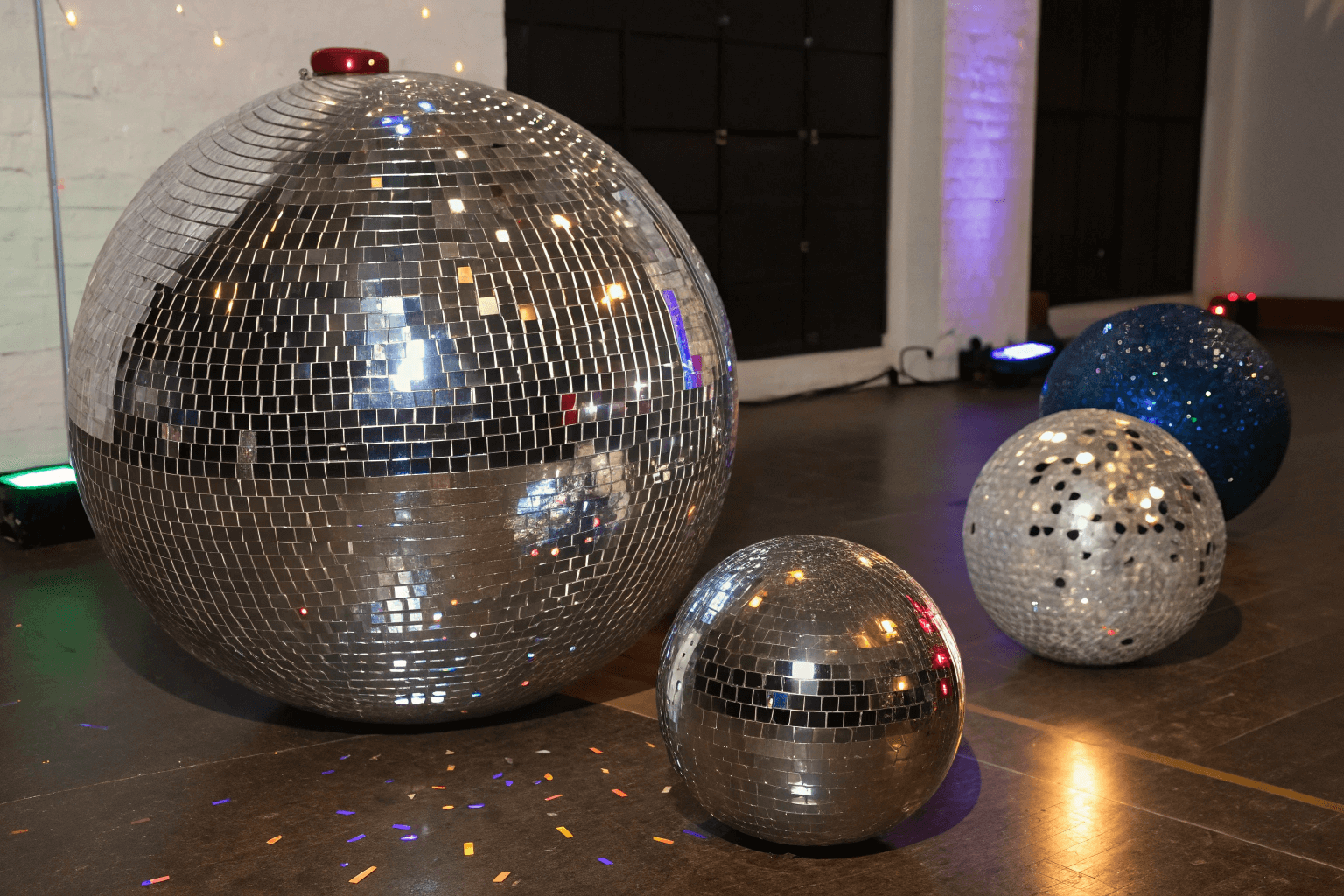
Using small disco balls from 2 to 6 inches in diameter allows visual merchandisers to build layered, dynamic displays. The different sizes reflect light at varying intensities and patterns, creating an illusion of depth that draws the eye into a window or fixture without overwhelming the limited space.
| Ball Size | Primary Application | Key Effect |
|---|---|---|
| 2″ – 2.35″ | Compact layered units (e.g., in a 4.6″ acrylic frame) | Tight, numerous beam patterns for textural contrast |
| 4″ | Mid-scale clustering in window displays | Balanced reflection to bridge visual hierarchy |
| 6″ | Focal point in small-volume displays (~320 cu in) | Broader, more diffuse light patterns |
| 12″ (Reference) | Standard room coverage with 2 pin spotlights | Demonstrates scalable dispersion principle |

The Visual Mechanics of Layered Reflection
A 2.35-inch mini ball paired with a 4.6-inch acrylic frame creates a compact, layered visual unit where light bounces between mirrored facets and transparent surfaces.
Clustering balls of different sizes (2″, 4″, 6″) mimics natural visual hierarchy, with smaller balls appearing farther away, tricking the eye into perceiving greater depth in a confined volume like a 320 cubic inch display.
The physics of reflection means smaller facets on a 2-inch ball produce tighter, more numerous beam patterns compared to the broader reflections from a 6-inch ball, adding textural contrast.
Technical Specifications for Targeted Application
For professional-grade visual effects, glass mirror tiles on a rigid core are preferred over inflatable variants for durability in static displays, with facet clarity being critical for sharp reflections.
In a standard setup, a 12-inch disco ball is recommended for room coverage with two pin spotlights; scaling down to 2-6 inch sizes concentrates this effect for precise, targeted illumination in window displays.
While no formal ASTM/ISO standards exist for disco balls, engineering focuses on mirror tile adhesion and core stability to ensure consistent 360-degree reflection without motorized rotation in these small-scale applications.
Source Commercial-Grade Mirror Balls, Factory-Direct.
Sightline Optimization: Drawing the Eye to Hero Products
Sightline optimization uses the natural 15 to 30-degree downward scan of the human eye to position hero products, like small disco balls, at touch or waist level. This placement in high-traffic hot zones creates clear focal points that increase engagement and conversion without complex engineering standards.
| Sightline Zone | Height Reference | Optimal Product Placement |
|---|---|---|
| Touch / Eye Level | Chest to eye height (~5 feet) | Hero products & bestsellers |
| Stretch Level | Above eye level | Seasonal & high-margin items |
| Stoop Level | Bottom shelves | Bulk & low-margin items |

The Ergonomic Science of the Shopper’s Gaze
Shoppers’ sightlines naturally gravitate 15 to 30 degrees below eye level, making the area from chest to waist height the primary visual scan zone.
The average adult eye level is about 5 feet (60 inches) high. Placing products slightly below this, at ‘touch level,’ aligns with the initial grab point for optimal visibility.
This ergonomic principle creates ‘hot zones’ in high-traffic areas where hero products receive the most visual attention, driving higher sales conversion for high-margin items.
Strategic Placement and Display Tactics for Maximum Impact
Use tiered shelving: position bestsellers at touch/eye level, bulk items lower at stoop level, and seasonal or high-margin items higher at stretch level to maximize visibility per square foot.
Create clear, unobstructed sightlines from key entry and exit points to frame focal displays, such as endcaps or 360-degree installations, for hero products.
Employ vertical merchandising to guide the eye upward for variety and use horizontal groupings at eye level to facilitate product comparison, standardizing displays with planograms for chain-wide consistency.
Lighting Small Balls: Pinspot vs. Ambient Wash
Pinspot lighting uses targeted, high-intensity beams to create dynamic, focused sparkle effects, ideal for drawing attention to specific display areas. Ambient wash provides even, internal illumination for soft, glowing patterns, perfect for creating a general atmosphere without external fixtures.

Pinspot Lighting: Creating Dynamic Focal Points
This technique uses targeted, high-intensity beams from ceiling-mounted or corner lights to hit the mirrored surfaces of small disco balls. The light reflects off the facets, producing thousands of moving dots across walls, ceilings, and floors for a dynamic, focused sparkle.
The effect is strategic. It’s ideal for creating a hero moment in a window display or highlighting a specific brand focal point in a retail environment. The visual impact is dramatically enhanced by using haze or fog, which makes the light beams themselves visible, creating a dramatic starburst effect around the ball.
This method is highly scalable. For large events, a common setup pairs a large central motorized ball (like a 24-inch model) with smaller static balls (8-inch to 12-inch) surrounding it, all lit by intelligent beam lights to create an immersive field of moving light.
Ambient Wash: Effortless, Integrated Glow
Ambient wash lighting provides even, glowing illumination from integrated or string LEDs within each ball. This creates soft, swirling light patterns directly from the display object itself, eliminating the need for external spotlights or complex setup.
This approach is commonly delivered via convenient, battery-powered strings. A typical configuration features 12 balls, each about 2 inches (5cm) in diameter, on an 8-foot (2.4m) strand powered by 3 AA batteries, offering maximum flexibility for hanging in displays.
For more control, multi-mode USB projectors are available. These units, often around 7.25 inches in size, include functions like slow color change, sound activation, twinkle, and dancing pattern effects, projected via a flexible arm for precise aiming. The priority here is ease of use and portability for visual merchandising, though some simpler LED strings may have a fixed color like bluish-white.
Seasonal Themes: Winter Frost and Summer Sparkle
Seasonal themes like Winter Frost and Summer Sparkle use specific color palettes, finishes, and light interactions to evoke a mood. Winter Frost leverages high-contrast, cool-toned reflective surfaces to mimic ice, while Summer Sparkle employs warmer, vibrant, and iridescent effects. These themes are executed through material choices and lighting to enhance visual merchandising.

Defining the Winter Frost Aesthetic
The Winter Frost aesthetic is built on a foundation of high-contrast, neutral-cool color palettes. These palettes feature slightly higher chroma, or saturation, than typical pastels, using colors like stark whites, silvers, and icy blues. These are often accented with deep reds or greens to create visual interest and depth.
A key element is the creation of “icy lights.” This effect is achieved by adding a small amount of high-chroma pigment to a white or near-white base, resulting in a sharp, reflective quality. This technique produces a more saturated and intense visual than softer pastel tones.
The theme can be further refined into specific winter subtypes, each with a distinct material base. A True Winter aesthetic uses a blinding white with a blueish or silvery cast for maximum reflectivity. Dark Winter employs a slightly ivory base, warmed with rich accent colors. Bright Winter utilizes a high-value, iridescent cream base that carries a subtle yellow warmth, creating a glassy, opaline transparency reminiscent of ice.
Textures are critical for completing the theme. Materials like crystal glassware, shimmering linens, and highly polished surfaces complement the reflective color palette. In practical applications, this can be executed with technical materials such as 12”x12” mesh-mounted polished porcelain or glass mosaic tiles. Patterns like Hexagon Large, Lantern, and Linear are specified for this purpose, offering a durable and repeatable system for creating high-impact displays.
Material and Lighting Strategies for Seasonal Execution
For the Winter Frost theme, the primary goal is to replicate the reflective, glassy quality of frost. This is achieved practically by using materials with polished finishes. Polished tiles or arranged mirror fragments create a high-contrast, saturated visual play when they interact with light, effectively mimicking the sparkle of ice crystals.
While specific data on Summer Sparkle is limited, the theme conceptually serves as a warm-weather contrast. It would employ warmer, more vibrant color palettes and likely use iridescent or warmer-toned reflective surfaces to create a lively and energetic sparkle effect, distinct from the cool clarity of Winter Frost.
Lighting is the critical component that activates these material strategies. Pinspot lighting can be used to create sharp, dramatic highlights on individual mirrored elements, simulating the effect of light catching on ice crystals or sparkling water. Conversely, ambient wash lighting provides a broader, diffused glow that enhances the overall atmosphere of the display.
These thematic executions are directly applicable to key markets. Retail visual merchandisers use these high-value, themed reflective ornaments to differentiate and elevate seasonal collections. Event professionals deploy the same principles at a larger scale, using strategic material and lighting placement to create fully immersive seasonal environments for guests.
Case Study: Global Fashion Brand Window Rollouts
Global fashion brands engineer window rollouts by balancing visual appeal, brand messaging, and interactive technology. Success is measured through consumer satisfaction metrics, with studies showing 65.8% satisfaction for color and 35% for lighting, analyzed using statistical tools like SPSS 21.0.

The VMWD Framework: Measuring Consumer Impact
The Visual Merchandising Window Display (VMWD) model is revised around four key factors: brand recognition, information transmission, visual appeal, and brand display.
Consumer satisfaction is measured empirically; for example, fast fashion displays achieve a 65.8% satisfaction rate for color use and 35% for lighting.
Data is collected using a 5-point Likert scale and analyzed with statistical software like SPSS 21.0, employing exploratory factor analysis with all loadings above 0.5.
Importance-Performance Analysis (IPA) is used to prioritize display elements that align with store image and directly influence purchase intent.
Technical Integration for Engagement and Security
Interactive technologies like augmented reality (AR) experiences and AI-enabled systems are integrated to enhance customer engagement and data management, particularly for sustainable brands.
Closed window display structures use backdrops or walls to create detailed scenes, hide cabling and lights, and control the physics of the display environment within a dedicated space.
Smart lighting systems, including LED strips and spotlights, provide precise illumination, while security is ensured with reinforced glass and specialized locking systems like Jahabow TDL systems, often integrated with alarms.
Final Thoughts
Small disco balls are more than just decorative ornaments; they are precise tools for visual merchandising. Their effectiveness is rooted in optical physics—the controlled sparkle from specular reflections and the dynamic animation created by foot traffic in convex mirrors. By applying principles like sightline optimization and strategic lighting, these compact objects can create layered depth, direct attention to hero products, and establish powerful seasonal themes, all within the constraints of a retail window or display fixture.
The real power of this approach lies in its scalability and accessibility. You don’t need a large budget or complex engineering to start. The principles of sparkle, static motion, and strategic placement work just as effectively with a cluster of 2-inch balls as they do in a global brand’s flagship window. By understanding the science behind the shine, any visual merchandiser can harness these small, reflective objects to create displays that are not only visually captivating but also strategically designed to engage customers and enhance the brand experience.
Frequently Asked Questions
How do you use small disco balls in retail windows?
Small disco balls, typically 5–15 cm in diameter, are hung from retail window ceilings using their built-in rings. They are paired with spotlights or rotating motors to reflect ambient light, creating dynamic shimmering patterns across product displays. This effect adds movement and visual interest to static windows.
What are the benefits of mini disco balls for visual merchandising?
Mini disco balls create colorful light effects and sparkle that attract shopper attention. They are versatile decorative elements that can enhance themed displays, parties, or events. Their compact size makes them suitable for focused applications within a larger window scene to draw the eye to specific products.
How do static small disco balls create light effects?
Static small disco balls create effects by having light projected onto them. Fixed-position RGB LED or laser projectors beam patterns onto the ball’s surface. The mirrored facets then reflect these patterns across the display area, simulating movement and color changes without the ball itself rotating, offering a simplified setup.
What is the best lighting for clusters of small mirror balls?
For optimal reflection from clusters, use focused spotlights. A common setup involves two spotlights positioned on either side. Look for lights with a beam width wider than the ball’s diameter and a brightness around 800 lumens with a warm 3000K color temperature to ensure even, sparkling coverage without harsh shadows.
What are key retail window display trends for 2026?
Trends focus on creating immersive experiences. This includes emotional, theatrical storytelling, sensory minimalism that uses texture and soft lighting, and integrating technology like digital signage or AR. Sustainable materials and modular designs that allow for quick, seasonal updates are also central to modern window strategies.
Why are shoppers drawn to shiny decor like disco balls?
Shiny decor taps into fundamental psychological responses. Reflective surfaces and sparkling lights are instinctive attention-grabbers. They stimulate visual interest and can evoke positive emotions, helping to create a pleasant and engaging mood in the retail environment that encourages dwell time and exploration.