

A decorative ball swinging unpredictably in an atrium isn’t just an aesthetic issue; it’s a sign of unmanaged airflow and a potential risk to your installation’s integrity. For facility managers, architects, and rigging specialists, this pendulum effect, often driven by high-velocity HVAC currents, can compromise safety and design intent.

This article breaks down the physics and practical solutions for stabilizing static rigs. We’ll analyze how HVAC outlets generating airflows of 2500-3500 fpm can initiate motion, compare the stability of dual-point versus single-point suspension systems, and detail how engineering strategies like internal counterweights and a minimum 1.2-meter base footprint are used to secure large installations in commercial spaces.
The Physics of the Pendulum Effect in Atriums
The pendulum effect describes the oscillatory motion of a suspended object, governed by gravity and its suspension length. In an atrium, this motion can be initiated by external forces like air currents. The period of swing is primarily determined by the length of the suspension cable and is largely unaffected by the swing angle or the mass of the object for small oscillations.

Fundamental Principles of Pendulum Motion
The restoring force for a pendulum is the tangential component of gravity, calculated as -Mg sin(θ), which pulls the bob back toward its equilibrium position.
Motion involves a continuous exchange between potential energy (PE = MgΔh) and kinetic energy (KE = ½ Iω²), where I is the moment of inertia and ω is the angular velocity.
For small angles (typically less than 15 degrees), the motion approximates simple harmonic motion, where the period is independent of the mass and the amplitude of the swing.
Key Equations and Practical Calculations
The period T for a simple pendulum is given by T = 2π √(L/g), where L is the suspension length and g is gravitational acceleration (approximately 9.81 m/s²).
The moment of inertia I for a physical pendulum can be derived from its period using I = (Mg R_cm³) / T², where R_cm is the distance from the pivot to the center of mass.
Experimental data shows the period is stable; for example, one lab measured g as 7.65 ± 0.378 m/s² using a pendulum, highlighting the method’s reliability for indirect measurement.
HVAC Outlets and High-Velocity Air Currents
High-velocity HVAC outlets deliver conditioned air at speeds between 2500 and 3500 feet per minute through small, flexible ducts. This creates focused, high-energy jets that can induce significant room air movement. For suspended installations, these concentrated air currents are a primary factor in causing unwanted pendulum motion and must be carefully mapped during the planning stage.
| Parameter | Specification / Value | Notes |
|---|---|---|
| Outlet Density (Min.) | 4 HE outlets or 8 x 2” outlets per ton | For Hi-Velocity HE-Z air handlers; ensures proper distribution and avoids insufficient BTUH per vent. |
| Air Velocity | 2500 – 3500 fpm (12.7 – 17.8 m/s) | Typical operating range; max velocity can reach 5000 fpm (25 m/s). |
| Duct Pressure | 125 Pa (0.5 in. w.c.) min. to 1000 Pa (4.0 in. w.c.) max. | Static pressure limits for flexible supply ducts. |
| Outlet Dimensions (Example) | Round: 127mm OD / 50mm ID Slotted: 180×12.5mm opening | Compact design concentrates airflow into a defined, high-energy stream. |
| Max Flexible Duct Length | 35 ft (10.7 m) | Critical for maintaining system pressure and performance. |
| Sound Levels | 52-58 dB(A) (NC 40-50) | The high-velocity jet is the primary source of air movement and noise in the occupied zone. |

How High-Velocity Outlets Create Air Currents
These systems use small-diameter ducts, typically 2 inches (50mm) in internal diameter, to force air out at velocities between 2500 and 3500 fpm.
The high-speed jet exiting the outlet entrains surrounding room air, creating a sustained current or ‘primary air envelope’ that can extend a significant distance from the vent. This envelope often maintains velocities above 150 fpm, which is sufficient to exert force on lightweight suspended objects.
Compact outlet designs, like 127mm round or 180×12.5mm slotted frames, concentrate the airflow into a defined stream, increasing its potential to exert force on objects in its path.
This design is efficient for space conditioning but intentionally creates localized zones of high airflow that must be considered for any ceiling-suspended element to prevent induced pendulum motion.
Critical Design Specifications for Mitigation
System capacity is defined by outlet density: a minimum of 4 high-efficiency (HE) outlets or eight 2-inch outlets are required per ton of cooling capacity to ensure proper air distribution and avoid under-performing vents that can create uneven or overly forceful jets.
Heating output per outlet is a key metric; examples show outputs around 3,146 BTUH, which must be recalculated against the specific thermal load of a space. An undersized system trying to meet a higher load may increase outlet velocity, exacerbating airflow issues.
Ductwork has strict limits: flexible supply ducts should not exceed 35 feet (10.7m) in length to maintain system pressure between 125 Pa (0.5 in. w.c.) and a maximum of 1000 Pa (4.0 in. w.c.). Exceeding this can reduce outlet velocity or increase system noise, but staying within limits ensures the designed jet force is predictable.
Airflow and noise are linked; these systems typically operate at sound levels of 52-58 dB(A) (NC 40-50), and the high-velocity jet itself is the primary source of air movement in the occupied zone. The throw and decay of this jet, as plotted in engineering guidelines, determine the zone of influence for suspended objects.
Dual-Point Rigging vs. Single-Point Suspension
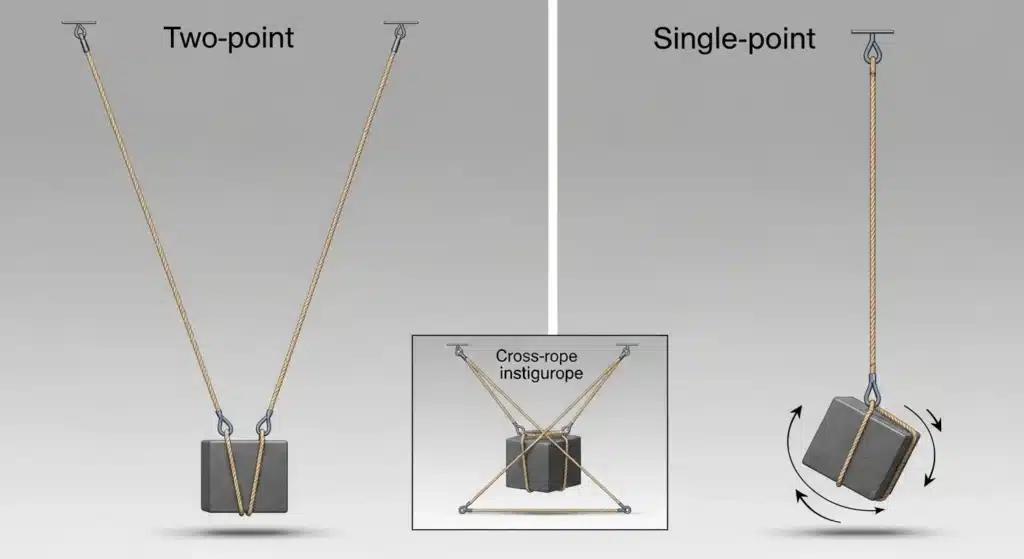
Dual-point rigging uses two attachment points to distribute a load’s weight, significantly improving stability and reducing pendulum swing. Single-point suspension relies on a single connection, which is simpler but more prone to tilting and rotation, requiring specific countermeasures like crossed rope configurations to maintain balance.
| System Type | Key Standard / Manual | Primary Technical Requirement |
|---|---|---|
| Single-Point Scaffold | Industry Safety Standards | Ropes with a minimum diameter of 5/8 inch (1.6 cm), reeved through four corner holes and crossed underneath to prevent slipping and tilting. |
| Two-Point Scaffold (Swing Stage) | WAC 296-874-30046 | Rigging must be designed by a qualified person, especially if suspension ropes are not vertical, with protection from chafing. |
| Dual-Point Helicopter Sling | FM 10-450-5 / MCRP 4-23E Vol III | Certified procedures for loads with proven static lift and flight characteristics; single-point certifications do not apply. |
| Single-Point Helicopter Sling | FM 55-450-4 | Separate certification for cargo nets, bags (e.g., A-22), and wheeled vehicles like the M274 Truck, with defined airspeed limits. |
Core Principles and Stability Comparison
Dual-point rigging connects a load at two distinct points, creating a more stable platform that resists rotation and pendulum motion induced by air currents or movement.
Single-point suspension attaches all weight to one central point. This simpler setup is inherently less stable, as any force can cause the load to swing or tilt out of level.
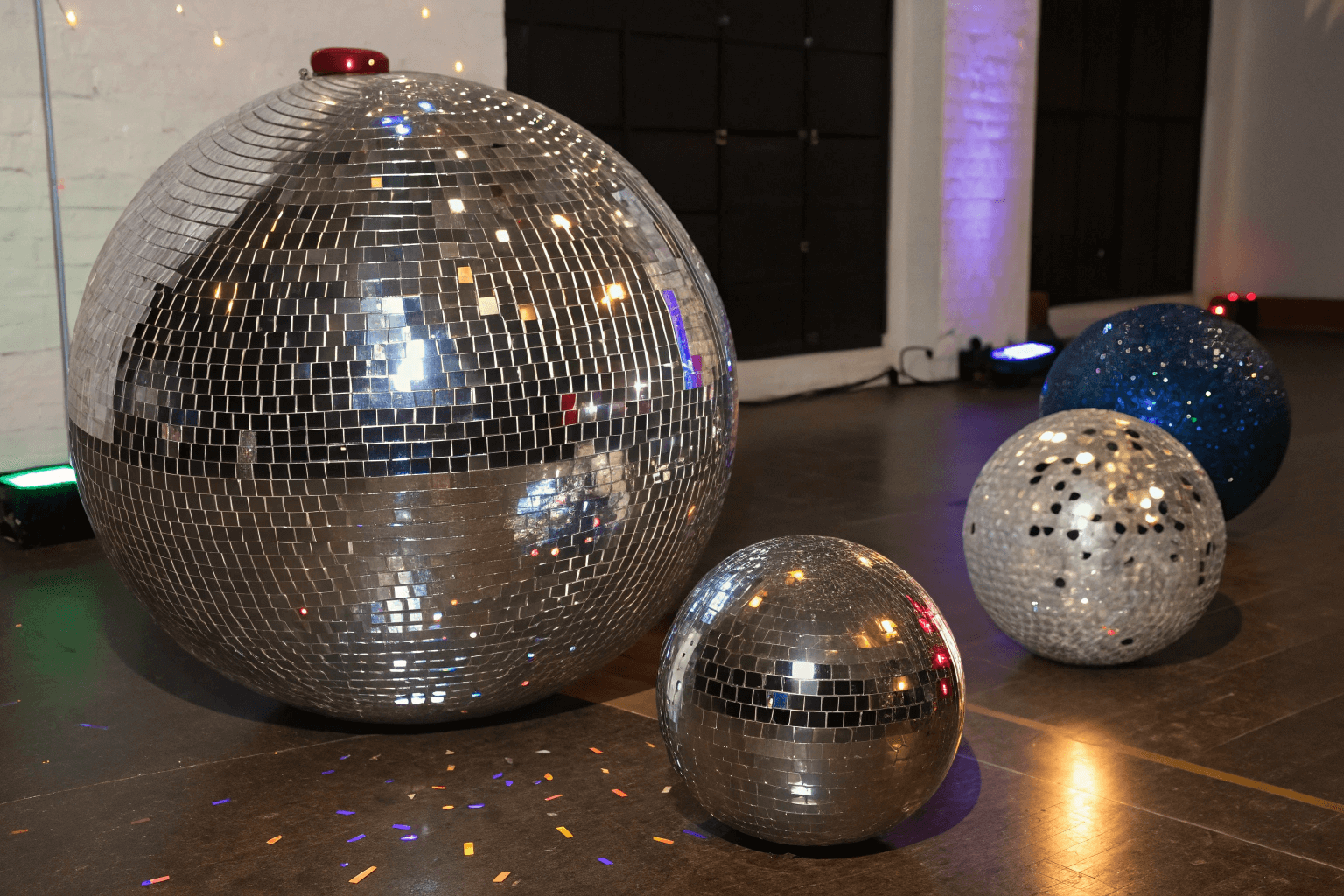
The enhanced stability of a dual-point system is critical in environments with variable airflow, such as atrium spaces, where it minimizes unwanted movement of decorative elements like large mirror balls.
Technical Specifications and Industry Standards
For single-point adjustable scaffolds, regulations mandate ropes with a minimum diameter of five-eighths inch (1.6 cm) to be reeved through corner holes and crossed underneath to prevent dangerous slipping.
Two-point adjustable scaffolds (swing stages) fall under specific codes like WAC 296-874-30046, requiring rigging designed by a qualified person, especially if suspension ropes are not perfectly vertical.
In aviation, dual-point helicopter sling loads follow certified procedures from manuals like FM 10-450-5, which are entirely separate from single-point certifications due to different hook spacing and flight dynamics.
Source Commercial-Grade Mirror Balls, Engineered for Professionals
Using Guy-Wires for Stabilization in Windy Zones
Guy-wires are tensioned cables that provide lateral support to tall, slender structures like poles and towers, preventing excessive deflection from wind loads. They work by anchoring the structure at multiple points to the ground, creating a stable triangulated system that resists bending and sway, which is critical for stabilizing suspended objects in windy atriums.

How Guy-Wires Counteract Wind Forces
Guy-wires provide lateral tension to directly counteract the deflection caused by wind pushing against a pole or suspended mass.
They transform a tall, flexible structure into a stable, triangulated system, preventing the pendulum-like sway that can occur in open atriums with high-velocity air currents.
Optimal attachment is at the hoop of a structure’s diagonal bracing to minimize deformation; attaching wires lower on the pole can actually increase movement under high winds.
This system is standard for structures over 20 feet tall in exposed locations and is equally applicable to interior installations stabilizing tall decorative or HVAC elements.
Technical Specifications and Installation Guidelines
Cables are typically galvanized steel with a 5.4 mm cross-section and a 7×7 steel core, rated for an ultimate tensile force of 30 kN.
For a 20-meter tower, installation uses four mounting levels (e.g., at 2.95 m, 5.80 m, 11.5 m, and 17.2 m) with galvanized steel collars.
Anchor distances are critical: lower guy levels (1-2) require anchors 6 meters from the base, while upper levels (3-4) need anchors 10 meters away.
Each wire requires a dedicated, robust anchor; for turbine applications, this means a 36-inch diameter steel-reinforced concrete anchor per cable.
Systems must accommodate ground slopes up to 10°, and professional tensioning is required to avoid overstrain, with regular checks for weather damage.
Impact of Ball Surface Area on Wind Resistance
Wind resistance is governed more by surface texture and the drag coefficient than by surface area alone. Rough surfaces, like a tennis ball’s nap, create turbulent airflow that can reduce drag at certain speeds compared to a smooth sphere of the same size.

Why Surface Texture Matters More Than Area
A smooth sphere has a drag coefficient of about 0.4, while a fuzzy tennis ball’s coefficient is higher, around 0.53.
Surface texture encourages a turbulent boundary layer, which can lead to a ‘drag crisis’ and lower resistance at high speeds compared to smooth surfaces.
For HVAC and design, a smaller object with a rough surface may experience similar or less drag than a larger smooth object in the same wind.
Engineering Data and Application for Suspended Objects
Research shows tennis balls maintain a consistent drag coefficient of 0.50-0.55 up to wind speeds of 63 m/s.
The drag crisis for rough spheres occurs at lower Reynolds numbers, meaning drag reduction happens sooner.
This principle informs the selection and rigging of decorative balls; a textured surface can be a strategic choice for managing pendulum motion in airflow.
Acoustic Resonance: Preventing “Chain Rattle”
Chain rattle is a mechanical noise caused by vibrations near a system’s natural resonance frequency, often triggered by airflow or structural interactions. Prevention focuses on shifting resonance frequencies through design, applying damping materials, and using electronic suppression to target specific low-frequency bands.

Understanding the Source of Chain Rattle
Chain rattle is a form of mechanical noise generated when vibrations, often from air turbulence or structural movement, excite a component at its natural resonance frequency.
In HVAC contexts, high-velocity airflow across chains or pendulums can create vortices that match the system’s resonant frequency, amplifying vibrations. This phenomenon is similar to speaker diaphragm movement or hoist chain noise, where energy concentrates in a narrow frequency band, causing audible rattling or ringing.
The key factors include the system’s natural frequency, the energy input from the excitation source like airflow, and the radiation efficiency of the vibrating parts.
Technical Strategies for Suppression and Damping
Active electronic suppressors can target low-frequency resonance bands under 200 Hz. These systems use microphone feedback to create destructive interference, achieving a 5-10 dB pressure reduction at the source. For stability, the microphone must be spaced close to the source, typically within three inches.
Applying constrained layer damping with viscoelastic materials alters resonance. A common rule specifies a damping layer thickness of one-third the surface thickness, paired with a constraining layer of 1.5 mm for structures between 1.5-3 mm thick.
Design modifications to increase stiffness or mass shift the resonance frequency outside the operational range. Using perforated panels or mesh guards can also reduce acoustic radiation efficiency, preventing energy from becoming audible noise.
For chain hoists specifically, selecting models with lower noise ratings directly reduces source energy. For example, a QT Hoist operates at 75.08 dB, compared to standard hoists which often exceed 85 dB, significantly lowering the potential for rattle.
Case Study: Stabilizing Balls in Open Mall Atriums
Stabilizing large decorative balls in atriums requires a multi-faceted approach. Engineers counter pendulum effects from HVAC drafts and pedestrian movement using internal steel frames and counterweights within a minimum 1.2m footprint. Compliance is ensured through fire-rated materials, specific anchoring to floor and ceiling points, and adherence to building codes governing atrium openings and fire separation.

Engineering for Stability in Dynamic Environments
The primary challenge is preventing sway from HVAC air currents and public interaction. This is addressed by designing internal steel frames with integrated counterweights to counteract pendulum effects. For props ranging from 2.5 to 4.5 meters tall, a minimum base footprint of 1.2 meters is critical for tipping stability.
Engineers validate these designs through rigorous CAD-based load testing and 3D weight simulations. Physical drop-test validation follows to ensure the structure meets all bearing and tipping standards. To facilitate installation in the constrained spaces of an active mall, construction is modular, typically using 3 to 6 sections, with each section kept under 2 meters for easier handling and assembly.
Compliance, Materials, and Installation Protocols
Material selection is driven by fire safety. Core materials like fire-rated PET, foam, and FRP must comply with UL94 and ASTM E84 flame spread standards. The installation is anchored using certified floor base plates and engineered ceiling suspension points to meet specific load-bearing requirements.
The project must adhere to strict building codes. For example, atrium openings are generally limited to 156 square feet unless the space is sprinklered, and adjacent spaces must be separated by 1-hour fire barrier walls. The installation process itself is optimized for speed and safety, designed to be completed in under 6 hours using a system of color-coded, QR-labeled modules that allow for tool-free assembly, minimizing disruption to the public.
Final Thoughts
Preventing unwanted motion in static rigs, like decorative balls in atriums, requires a practical approach that addresses the root causes. The physics of pendulum motion shows that once started, even small oscillations can persist. The primary trigger in modern buildings is often the high-velocity, concentrated air currents from HVAC systems. By understanding the specifications of these systems—like outlet velocity, placement, and duct pressure—you can map and avoid the zones most likely to induce swing.
The solution lies in combining proven mechanical strategies. Dual-point rigging offers inherent stability over a single point. For taller installations or high-flow areas, guy-wires provide direct lateral resistance. Even the object’s surface texture plays a role in managing airflow interaction. When these principles are applied together—informed by airflow analysis and backed by proper anchoring and compliant materials—you create a static installation that remains visually striking without becoming a moving, or noisy, distraction.
Frequently Asked Questions
Why is my disco ball swinging?
Disco balls swing due to the pendulum effect. Airflow disturbances, like HVAC currents, act on their lightweight, suspended structure. Large balls, which can be 4-5 meters in diameter and weigh several hundred kilograms, are particularly susceptible. The motion is amplified by their suspension system, often a terminating ring with multiple bores, which acts like a long pendulum arm.
How do you stop a hanging ball from moving?
The key is airflow management. Position the ball outside zones where HVAC airflow velocities exceed 0.5 m/s. For greater stability, place it in areas with turbulent flow below 0.2 m/s. This approach is based on motion control standards that limit acceleration-induced forces on suspended loads, ensuring the pendulum effect is minimized.
What is the wind load on a large disco ball?
There are no specific industry standards for calculating wind load on disco balls. However, the effective projected area for wind exposure is a primary factor. For example, a 100cm (40-inch) ball presents an area of about 0.78m². Larger installations require heavy-duty hardware and are explicitly rated for indoor use only, where wind is not a factor.
How does HVAC airflow affect hanging decor?
Hanging decor must be positioned to avoid disrupting HVAC system performance. Maintain a minimum clearance of 12 inches from the intake side of fan walls and 48 inches from the discharge side. This ensures a uniform velocity profile. Proper installation also involves limiting panel deflection to prevent airflow leakage, which can indirectly affect the stability of the decor.
How do you stabilize disco balls in large atriums?
No dedicated engineering guidelines exist for stabilizing disco balls in atriums against airflow. Standard practice involves applying principles from rigging and motion control, such as using dual-point suspension or guy-wires to dampen pendulum motion. The challenge is unique to each space’s specific airflow patterns and architectural features.
What is V-rigging for decorative spheres?
V-rigging refers to suspension methods that use multiple attachment points to create a stable, balanced hang. For lightweight spheres, this can involve hooks, fishing line, and swivels. For heavier or commercial-grade installations, professional rigging hardware like shackles and links is required, following safety standards to ensure the secure suspension of mirrored orbs and other decorative spheres.