

Your stage lighting is designed to withstand heat, but the props and decor around it often aren’t. When a high-intensity spotlight hits a decorative foam core or a mirror ball, the result isn’t just a dazzling effect—it can be a melted, warped, or delaminated failure that compromises your event’s safety and budget. The core issue is a fundamental mismatch between the intense thermal output of modern fixtures and the heat resistance of common materials.

This article breaks down the thermal reality behind these failures. We’ll compare the critical temperature thresholds of materials like EPS foam and FRP, explain how a sealed glass sphere can trap heat like a greenhouse, and provide the specific data you need for safe specification. You’ll see why FRP maintains structural integrity up to 120°C while EPS deforms well below 100°C, and learn how internal temperatures in a multi-layer glass enclosure can exceed 190°F (88°C).
The Thermal Reality of Modern Stage Lighting
Modern LED stage lights generate intense heat at the junction, requiring sophisticated thermal management to prevent failure. Without proper dissipation, components can exceed 80°C, triggering thermal runaway and dimming, while temperatures above 60°C can drastically shorten a fixture’s lifespan from 50,000 hours to just 1,000.

The Core Challenge: Heat Generation and Thermal Runaway
The primary threat to modern stage lighting is heat accumulation at the LED junction. When internal temperatures hit the thermal runaway threshold of 80°C, fixtures trigger an automatic protection mode, dimming output by 20% to prevent catastrophic overheating.
Heat accelerates component degradation exponentially. LED drivers and other critical parts age twice as fast when operating above 60°C. This thermal stress causes a severe drop in brightness and can collapse the fixture’s operational lifespan. Without effective heat management, a light rated for 50,000 hours can lose 20% of its brightness in just 1,000 hours of use.
Engineering Solutions for Heat Dissipation
Engineers combat heat with precise metrics and advanced materials. A key measurement is thermal resistance from the junction to the case (Rth J-C), standardized by the JEDEC JESD51-14 transient dual interface method. Optimal thermal interface materials are critical; for example, thermal grease can achieve an Rth J-C of 0.46 K/W, while thermal tape might result in 1.14 K/W.
Fixture design incorporates materials like die-cast aluminum bodies, graphene-coated heat pipes, and thermal pads to actively pull heat away from sensitive components. Thermal grease can reduce interface resistance by approximately five times compared to other materials.
Reliability is proven through rigorous LM-80-20 testing, which validates a 50,000+ hour lifespan under sustained heat stress while maintaining stable color output. For demanding environments, IP65-rated housings provide essential protection. This rating ensures the fixture is dust-tight and resistant to low-pressure water jets, making it suitable for outdoor stages and high-humidity venues where corrosion is a risk.
Melting Point Comparison: EPS vs. FRP
FRP (Fiber Reinforced Polymer) significantly outperforms EPS (Expanded Polystyrene) in heat resistance. While EPS can soften and deform at relatively low temperatures, FRP maintains structural integrity up to its glass transition temperature of 65–120 °C and retains significant strength even at 300–330 °C, making it the only viable material for high-intensity lighting.
| Material | Key Thermal Threshold | Performance Implication |
|---|---|---|
| EPS (Expanded Polystyrene) | Softens/deforms well below 100°C | Rapid loss of structural shape; unsuitable for sustained heat. |
| FRP (Fiber Reinforced Polymer) | Glass Transition (Tg): 65–120°C | Transitions from rigid to rubbery state; maintains form. |
| FRP Reinforcing Bars | 300–330°C | 50% reduction in elastic modulus; critical failure point. |
| FRP Laminates | 200–300°C | Onset of significant strength loss. |

Understanding Material Failure: Melting vs. Glass Transition
EPS and FRP fail under heat in fundamentally different ways. EPS is a thermoplastic; its polymer chains soften and slide past each other when heated. This causes it to lose its shape and structural integrity at temperatures well below 100°C, a process akin to melting.
FRP does not have a traditional melting point. Its critical thermal property is the Glass Transition Temperature (Tg). Below the Tg, the polymer resin matrix is in a rigid, glassy state. As temperature increases through the Tg range (typically 65°C to 120°C for construction-grade FRP), the resin becomes softer and more rubbery, but the embedded fiber reinforcement (glass, carbon, or basalt) continues to provide significant structural support. This distinction is key to understanding FRP’s superior performance in hot environments.
Critical Temperature Data and Performance Limits
The available data clearly defines FRP’s thermal limits. FRP reinforcing bars experience a 50% reduction in their elastic modulus—a critical measure of stiffness—at 300–330°C. For FRP laminates, significant strength loss begins between 200°C and 300°C. At extreme temperatures exceeding 400°C, FRP laminates can lose 68–94% of their tensile strength.
Notably, specific technical data on the thermal degradation point of EPS under the sustained, focused heat of stage lighting is absent from engineering literature, which itself highlights its unsuitability for specification in professional applications.
For context within operational ranges, at a maximum continuous service temperature of 60°C, FRP shows a predictable and manageable reduction in tensile strength: approximately 10% for Carbon FRP (CFRP), 20% for Glass FRP (GFRP), and 30% for Aramid FRP (AFRP). This demonstrates FRP’s ability to maintain usable performance under realistic thermal loads where EPS would have already failed.
Heat Sink Properties of Fiberglass Shells
Fiberglass shells act as a heat sink by absorbing and dissipating thermal energy from lighting fixtures. Their low thermal conductivity and high-temperature resistance prevent heat from damaging internal components, while their mechanical strength maintains structural integrity under thermal stress.

How Fiberglass Manages Heat in Lighting Fixtures
Fiberglass shells absorb radiant heat from high-intensity lamps, preventing direct transfer to sensitive internal electronics and motor assemblies.
The material’s low thermal conductivity, ranging from 0.58 W/(m·K), slows heat transfer, allowing the shell to act as a thermal buffer.
Its self-extinguishing UL 94 V-0 flammability rating ensures safety, preventing fire risk even when exposed to high operating temperatures.
Critical Performance Data and Operational Limits
The maximum continuous service temperature is 266°F (130°C), with a heat deflection temperature exceeding 500°F at 264 psi load.
Mechanical strength is maintained under heat, with tensile and compressive strength at 30,000 PSI and impact resistance of 25 ft-lbs/in.
The coefficient of thermal expansion is 4.4 × 10⁻⁶ in/in·°F, minimizing dimensional change and warping during temperature cycles common in venues.
Source Commercial-Grade Mirror Balls, Engineered for Professionals
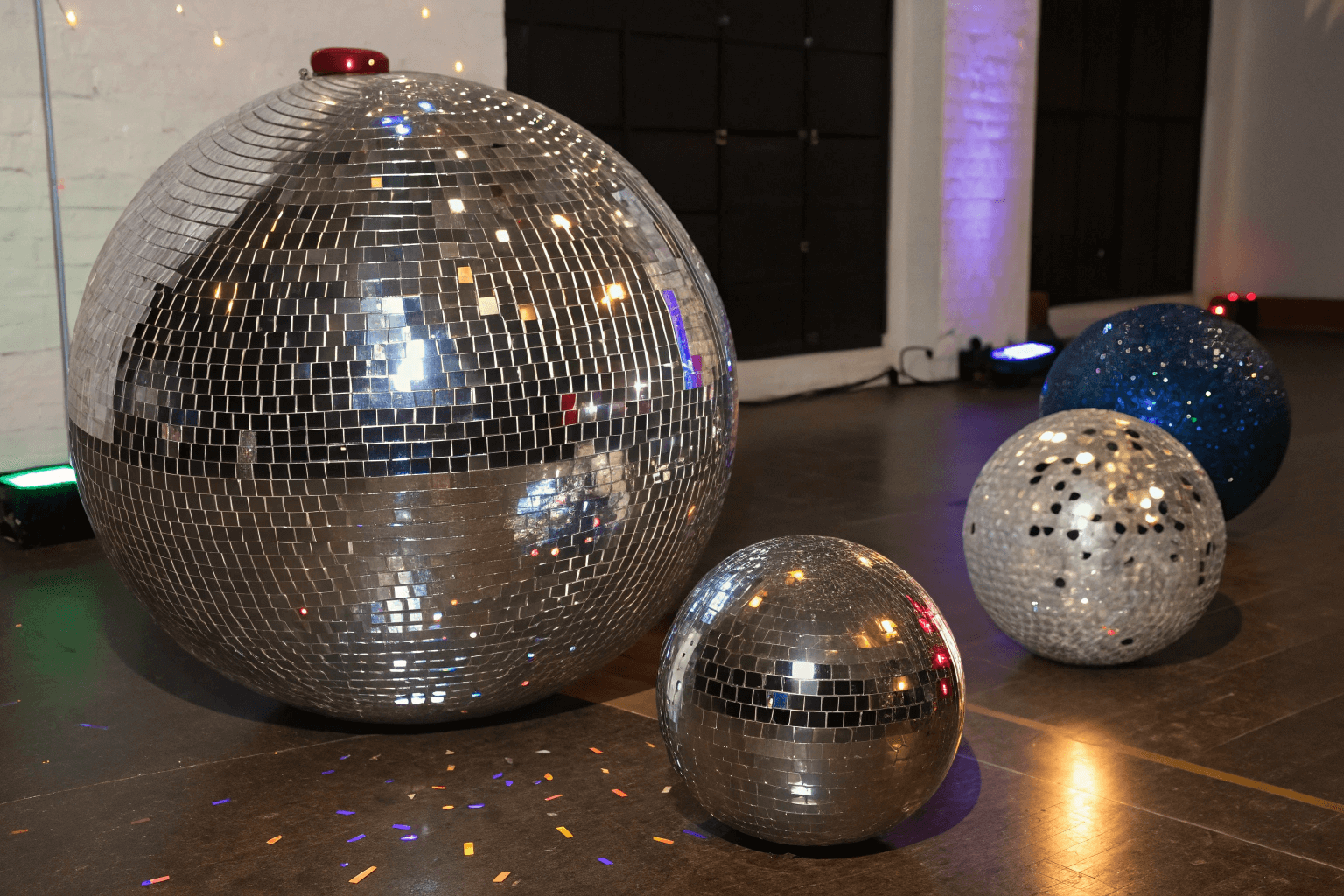
Case Study: Mirror Shedding in High-Intensity Clubs
Mirror shedding describes the delamination of the reflective coating from a glass or acrylic substrate, typically caused by the intense, sustained heat from modern stage lighting. In clubs, this creates a safety hazard and ruins the visual effect, representing a critical failure point for event professionals.

What Causes Mirror Shedding in a Club Environment?
Mirror shedding is the physical peeling or flaking of the thin metallic reflective layer from its base material.
The primary cause is thermal stress from high-intensity discharge (HID), LED, or laser fixtures operating for extended periods, often inches from the mirror surface.
Rapid temperature cycles, combined with airborne moisture and vibrations from sound systems, accelerate adhesive breakdown and coating failure.
This failure compromises the decorative element’s core function and poses a risk of falling debris onto performers or equipment.
Professional Risk Mitigation and Sourcing Solutions
Specify products with high-temperature adhesives and coatings rated for sustained exposure above 150°C, a common threshold for fixture proximity.
Partner with manufacturers who understand the thermal reality of live events and can provide failure analysis, not just basic product specs.
Implement a rigging checklist that includes verifying the heat rating of decorative elements relative to their planned distance from lighting arrays.
For large-scale or permanent installations, request material samples for in-house stress testing under simulated conditions before full production.
The “Greenhouse Effect” Inside Glass Spheres
The greenhouse effect in a sealed glass sphere is a radiative process. Visible light passes through the glass to heat an inner surface, but the infrared energy it emits is absorbed and re-radiated by the glass layers, trapping heat. This selective transparency can raise internal temperatures dramatically, with each added glass layer causing a stepwise increase in equilibrium temperature.

How Radiative Trapping Works in a Sealed Sphere
The core mechanism is selective transparency. Shortwave solar radiation, primarily visible light, passes through the glass to heat an inner core, such as a tungsten sphere. This heated core then emits longwave infrared radiation.
The glass absorbs this infrared energy and re-emits it, reducing the net outward energy flux. This creates a radiative forcing that elevates the temperature inside the enclosure. In a sealed sphere, convection is minimized, making this a purer model of radiative heat trapping compared to an open greenhouse.
Quantifying the Temperature Rise: Layers and U-Values
The temperature increase is quantifiable and significant. A single glass layer balancing at an emission of 240 W/m² can raise a surface temperature from 255 K to approximately 303 K (about 86°F). Adding layers amplifies this effect considerably.
Two glass layers can reach an equilibrium temperature of 338 K (149°F), and three layers can achieve 363 K (194°F). This stepwise increase demonstrates how multiple barriers to infrared radiation lead to substantial heat buildup.
Key material properties govern this process. For example, a 4 mm plain glass pane has a U-value of about 7 W/m²K. For context, building standards for well-insulated walls (U=0.23 W/m²K) and roofs (U=0.21 W/m²K) provide a baseline for comparing the thermal performance and heat resistance of different enclosures.
Recommended Safe Operating Temperatures
Safe operating temperatures for stage lighting are defined by component limits and safety standards. Standard LEDs function best between -40°C and 85°C ambient, while fixtures are UL-rated for specific ambient temperatures like 25°C, 40°C, or 65°C. In hazardous areas, T-ratings ensure surface temperatures stay below the ignition point of gases or dust.
| Category | Temperature Range / Rating | Key Application / Standard |
|---|---|---|
| Standard LED Components | -40°C to 85°C (-40°F to 185°F) ambient | Maintains performance and lifespan; exceeding accelerates degradation. |
| UL Fixture Classifications | 25°C (77°F), 40°C (104°F), 55°C (131°F), 65°C (149°F) | Maximum ambient temperature rating; select a fixture rated higher than your environment. |
| High-Heat Fixtures | Up to 100°C (212°F) with remote driver; up to 80°C (176°F) with attached driver | For extreme environments; requires robust thermal management. |
| Hazardous Area T-Ratings (UL 844 / NEC) | T1 (450°C) to T6 (85°C) maximum surface temperature | Ensures equipment surface temperature stays below the ignition point of specific gases or dust. |
| Safety Standards (e.g., IEC 62368-1) | Operator-accessible surfaces below 60°C (140°F) for continuous contact | Protects against burns and ensures safe handling. |

Understanding Component and Fixture Temperature Limits
Standard commercial LED components are designed to operate within an ambient temperature range of -40°C to 85°C (-40°F to 185°F). Exceeding this range accelerates degradation and reduces lifespan.
Fixture selection is guided by UL temperature classifications, which specify the maximum ambient temperature a fixture can withstand. Common ratings include 25°C (77°F), 40°C (104°F), 55°C (131°F), and 65°C (149°F). You must select a fixture with a rating higher than your expected ambient temperature.
For high-heat environments, specialized fixtures with remote drivers can handle ambient temperatures up to 100°C (212°F), while those with attached drivers are typically rated for up to 80°C (176°F).
Applying Standards for Safety and Compliance
In hazardous locations (with flammable gases or dust), the NEC and UL 844 use T-ratings (T1 to T6) to classify the maximum allowable surface temperature of equipment. For example, a T6 rating means the surface must not exceed 85°C (185°F).
General safety standards like IEC 62368-1 set limits for touch temperature in operator-accessible areas, typically requiring surfaces to remain below 60°C (140°F) during continuous contact.
Effective thermal management requires verifying a fixture’s IP rating (e.g., IP65 or higher) for harsh environments to prevent dust ingress that can trap heat and cause failure.
Protecting Your Rig from Light-Induced Warp
Protecting a rig from light-induced warp involves applying manufacturing engineering principles to manage thermal stress. The goal is to achieve uniform cooling and minimize temperature differentials across the structure, similar to high-precision injection molding or CNC machining, to prevent internal stresses that cause permanent deformation.

The Core Principle: Managing Thermal Stress Gradients
Warping occurs when different parts of a structure heat and cool at different rates, creating internal stress. This is analogous to issues in injection molding where thick and thin sections cool unevenly.
The primary engineering goal is to maintain a minimal temperature differential (delta-T) across the entire part. In high-precision contexts, a target of less than 12°C is critical to prevent edge deviations exceeding 0.05 mm.
Design symmetry is crucial. Asymmetric geometry or varying wall thickness creates natural hotspots and cool zones, leading to directional warp. Using ribs or gussets for stiffness is preferred over thick, uneven walls.
Practical Strategies for Rig Design and On-Site Management
Material and Construction: Opt for materials with low thermal expansion or those that promote even heat dissipation. In reinforced materials, control fiber orientation (e.g., uniform glass fiber alignment) to prevent anisotropic shrinkage.
Process and Control: Implement balanced ‘cooling’ strategies. For a rig, this means ensuring even airflow around the structure and avoiding placing multiple high-intensity lights on one side only. Consider stress-relief clamping during assembly.
Precision Standards: Reference high-tolerance benchmarks. For critical components, warp should be limited to 0.1% of the length (or 0.25-0.5 mm max), similar to Class 3/4 standards for printed circuit boards (IPC).
Final Thoughts
The risk of high-heat stage lighting melting foam cores is real, but it’s a predictable engineering challenge, not an unavoidable disaster. The key lies in understanding the thermal limits of your materials. EPS foam, with its low softening point, is clearly unsuitable for proximity to high-intensity fixtures. In contrast, materials like FRP and fiberglass are engineered to withstand the thermal stress of modern lighting, maintaining structural integrity at temperatures where EPS would fail completely.
For event professionals, this means moving beyond basic aesthetics to consider the thermal reality of a venue. Specifying the right materials, understanding fixture temperature ratings, and managing heat dissipation through design are no longer optional—they’re essential for safety, reliability, and protecting your investment. By applying these principles, you can ensure your rig delivers spectacular visuals without becoming a casualty of its own heat.
Frequently Asked Questions
Can stage lights melt a disco ball?
No, stage lights cannot melt a disco ball under standard professional use. Disco balls are constructed from heat-resistant polycarbonate or glass/polystyrene mirrors with melting points exceeding 150°C (302°F). Typical stage lights, including LED or halogen fixtures, maintain focused beam surface temperatures below 100°C at standard operating distances of 1-5 meters.
Why are my mirror tiles falling off?
Mirror tiles fall off primarily due to using incompatible cement-based adhesive mortars, which cause oxidation and degradation of the mirror’s silvered backing. Industry standards require epoxy-based adhesives like LATAPOXY® 300 to prevent this chemical reaction. Secure bonding requires a structurally sound substrate such as cement board, concrete, or drywall; plywood should be avoided.
Are fiberglass disco balls heat resistant?
Specific technical data on the heat resistance of fiberglass disco balls is not available in the provided research. While fiberglass composites are known for thermal stability, reliable specifications such as temperature thresholds, fire testing certifications (UL, NFPA), or relevant ASTM standards for disco ball applications would be needed from manufacturer datasheets to provide a definitive, data-backed answer for professional use.
What is a safe distance for pinspots from mirrors?
A specific, standardized safe distance for pinspots from mirror balls to prevent heat damage is not established in the available technical documentation. For optimal beam focus, pinspots are typically mounted 10–15 feet above a target. However, determining a thermal safety distance requires cross-referencing the pinspot’s thermal output with the mirror ball material’s degradation temperature, data which is not provided in current industry specifications.
Do LED lights melt styrofoam?
No, LED lights do not melt styrofoam (expanded polystyrene or EPS). The surface temperature of operational LED fixtures typically ranges from 27-49°C (80-120°F). In contrast, EPS begins to soften at a significantly higher temperature range of 90-105°C (194-221°F), which is well above the heat output of standard LED lighting.
At what temperature do disco balls fail?
Disco balls are at risk of operational failure if ambient temperatures exceed 30°C (86°F). This limit is specified as the safe operating temperature in multiple manufacturer user manuals. Exceeding this ambient temperature can compromise adhesive integrity, structural components, and the reflective finish, leading to potential failure.