

When you’re suspending a multi-ball array, the weight of the individual spheres is just the beginning. The real challenge is calculating the total static load on your rigging points, a figure that must account for the hardware, the chain, and the combined weight of the entire cluster to prevent structural failure.

This article breaks down the critical calculations for safe installation. We’ll cover how to determine the total array load per standards like NASA-STD-8719.9C, explain the 150% safe overload limit for load-bearing elements, and show you how to factor in the weight of rigging chains, which can add over 14 pounds per foot in high-ceiling applications.
Beyond Individual Weight: Total Array Load
Total array load is the combined weight of all items, rigging hardware, and attachments in a system. It must be calculated against the rated capacity of all load-bearing elements, ensuring it stays within safe overload limits (typically 150% of full scale) to prevent structural failure. This calculation is critical for planning safe installations in events, construction, and engineering.
| Metric | Definition & Purpose | Example / Standard |
|---|---|---|
| Rated Capacity (Emax) | The maximum load a device is designed to measure reliably. | Up to 250,000 lb for Rice Lake RL72020 load cell. |
| Safe Overload | The maximum load (typically 150% of full scale) a system can handle without permanent damage. | A load cell can handle 1.5x its rated capacity. |
| Breaking Overload | The load (typically 300% of full scale) that causes catastrophic failure. | The point of structural failure for a load cell. |
| Combined Error | The total measurement error from non-linearity, hysteresis, and repeatability. | ≤0.03% FSO, calculated via root sum square: √(Non-Linearity² + Hysteresis² + Repeatability²). |
| Total Load (NASA Definition) | The aggregate force including the item weight plus all rigging hardware. | Includes slings, below-the-hook devices, and the load block per NASA-STD-8719.9C. |

What Constitutes a Total Array Load?
The total array load is the sum of all forces the system must support. This includes the weight of every primary item plus the weight of all rigging hardware, slings, below-the-hook lifting devices, and the load block itself. Standards like NASA-STD-8719.9C formally define this aggregate calculation to ensure nothing is overlooked.
This total represents the aggregate force that the entire structural array or measurement system must be rated to handle. For systems using multiple load cells, it’s the combined load that determines the required system capacity and safety margins. Focusing only on the weight of individual speakers, truss sections, or other components is insufficient and dangerous.
This concept is directly applicable to rigging for event production, architectural installations, and any engineering scenario where multiple loads are suspended or supported as a single, interconnected system. Accurate calculation prevents overloading any single point of failure.
Standards and Calculations for System Capacity
Engineers verify a system’s capacity against its total array load using specific technical specifications and safety factors. Load cells and other devices have a maximum rated capacity (Emax), such as the Rice Lake RL72020, which is rated for up to 250,000 lb. The safe overload limit—typically 150% of the full-scale rated capacity—defines the maximum load the system can handle without damage, providing a critical safety buffer.
Precision under load is verified by calculating a Combined Error, often specified as ≤0.03% of Full Scale Output (FSO). This error is derived by combining non-linearity, hysteresis, and repeatability errors using a root sum square method (√(Non-Linearity² + Hysteresis² + Repeatability²)).
Compliance with standards like NIST Handbook 44 and OIML/NTEP governs other critical metrics. The Y-Value (Emax / Vmin ratio) determines the device’s resolution, where a higher number indicates better precision. The nmax value defines the number of verification intervals, dictating the granularity of measurements. These standards ensure device accuracy and reliability when supporting the total calculated load.
Calculating Weight per Linear Foot of Truss
Weight per linear foot (plf) for a truss is calculated by summing the dead loads of all its components—like chords, webs, and plates—and converting that total to a pounds-per-foot value. This accounts for the truss spacing and any additional loads, such as sheathing or attached walls, to determine the force exerted on each support point.

The Core Concept: From Distributed Load to Linear Force
This calculation translates a surface load, measured in pounds per square foot (psf), into a linear load (plf). The resulting plf value represents the force that structural elements like beams, joists, or rigging points must support along their length.
Converting psf to plf is a foundational step for determining the reactions at support points. These reaction forces are critical for selecting the correct hardware and ensuring the overall structural integrity of the assembly.
For a complete load analysis, you must include all contributing dead loads. A common example is an 8-foot tall stud wall, which has an approximate dead load of 85 plf. This load must be added to the truss reactions at the support points.
Industry standards provide guidance on which loads require formal calculation. For instance, ANSI/TPI 1-2014 states that partition loads of 60 plf or less may be ignored in design, helping to streamline the calculation process.
Practical Calculation and Key Data Points
For a wood roof truss spaced 24 inches on-center, component weights are typically provided in psf. A 2×12 top chord contributes about 2.2 psf, while 2×4 webs and plates add roughly 0.8 psf.
To find the total weight per linear foot, sum the psf values for all components. Then, multiply this total by the truss spacing (e.g., 2 feet) to get the load carried per linear foot of the building’s length.
Steel construction uses similar principles. The self-weight of steel joist girders can range from 15 to 200 plf. Their design loads are much higher; for example, K-Series joists with Allowable Stress Design (ASD) can carry loads from 178 to 1068 plf.
A standard roof reaction calculation illustrates the final load on a support. For a 40 psf total load, the reaction is (40 psf) x (Span/2) x (2 ft spacing) = 1200 lbs. Adding the 85 plf from an adjacent wall creates a significant concentrated point load that must be addressed in the connection design.
The Impact of Chain Weight on High-Ceiling Rigs
In high-ceiling rigs, the chain’s own weight adds directly to the total suspended load, increasing stress on overhead structures. Engineers must account for this by calculating the total chain weight based on its grade, length, and diameter, and then add it to the payload weight to determine the true system load.

Why Chain Weight Becomes a Critical Load Factor
The total system load includes both the lifted payload and the weight of all rigging hardware, including the chain. This is a fundamental principle in load calculation.
In high-ceiling applications, long chain lengths mean the chain’s self-weight can be a substantial portion of the total load. This added weight increases the stress on ceiling anchors and the building structure itself. Failing to account for it can lead to exceeding the Working Load Limit (WLL) of the hardware or the structural capacity of the building.
The standard 4:1 safety factor for lifting applies to this total load, which includes the chain weight. This means the hardware’s breaking strength must be four times the combined weight of the payload and the rigging chain.
Calculating Chain Weight and Selecting the Right Grade
Chain weight per foot varies by link diameter and grade. For example, Grade 80 chain weighs between 0.44 and 14.20 pounds per foot, depending on diameters ranging from 7/32″ to 1-1/4″.
To calculate the total chain weight, multiply the weight per foot by the total length of chain in the rig. This value is then added to the payload weight for final load calculations. Selecting a higher-grade chain like Grade 100 or 120 provides a better strength-to-weight ratio.
Grade 120 chain, with its distinctive square-profile link design, offers up to a 50% higher Working Load Limit than equivalent Grade 80 chain while remaining lighter per foot. This minimizes the hardware’s contribution to the total load, which is crucial for weight-sensitive, high-ceiling rigs in industries like aerospace and heavy fabrication.
Source Commercial-Grade Mirror Balls, Direct from the Factory

Center of Gravity in Irregular Cluster Groups
The center of gravity for an irregular cluster is found by breaking it into simple geometric shapes, calculating the weighted average of their individual centroids. This point is where the total weight effectively acts, and its accurate location is essential for balanced load distribution and safe structural design.

The Composite Body Method for Finding the CoG
The center of gravity (CoG) is the single point where the total weight of an object or cluster can be considered to act for analysis.
For uniform density materials, the CoG is identical to the geometric centroid, simplifying the calculation.
The standard method involves decomposing the irregular shape into basic components like rectangles, triangles, and cylinders.
The overall CoG coordinates (x̄, ȳ, z̄) are calculated using weighted average formulas: x̄ = Σ(A_i * x̄_i) / ΣA_i for areas, or Σ(V_i * z̄_i) / ΣV_i for volumes.
Voids or cutouts, such as holes in a steel channel, are treated as components with negative area or volume in the summation.
Practical Application and Calculation Example
A practical example involves an L-shaped plane figure with dimensions like 8 ft and 18 ft. The area is split into two rectangles, their individual areas and centroid locations are tabulated, and moments are summed to find the composite centroid.
This calculation is fundamental for load balancing in structural designs like building frames, crane lifts, and theatrical rigging to ensure stability under self-weight and external forces like wind.
For non-uniform density, the calculation shifts from using area/volume to directly integrating weight distribution, though the composite method principle remains.
In professional practice, CAD software (e.g., SolidWorks) automates 3D centroid extraction from digital models, but understanding the manual method is crucial for verification and problem-solving on-site.
Accurate CoG location informs decisions on rigging points, load distribution on truss, and compliance with hardware Working Load Limits (WLL) to prevent tipping or structural failure.
Understanding WLL (Working Load Limit) for Hardware
The Working Load Limit (WLL) is the maximum safe load a piece of hardware like a chain, shackle, or hook can handle under normal conditions. It is not a breaking point but a calculated safe limit, derived by dividing the hardware’s Minimum Breaking Load by a safety factor, typically 4:1 to 6:1 for lifting equipment. This ensures the system can withstand dynamic forces, wear, and shock without failure.

What WLL Means and How It’s Calculated
The Working Load Limit is the maximum safe operational load. In standards like BS EN 13000:2004 for crane hooks, this definition explicitly excludes the hardware’s own mass.
Engineers calculate WLL by dividing the hardware’s Minimum Breaking Load (MBL) by a designated safety factor. For overhead lifting chains, this factor is typically 4:1, while other rigging devices may use a factor up to 6:1.
A ratchet strap with a 15,000 lbs breaking strength, for example, would have a WLL of 5,000 lbs when a 3:1 safety factor is applied.
This safety factor is not arbitrary. It accounts for dynamic loads, shock, material fatigue, corrosion, and wear over the hardware’s entire service life.
Manufacturers set the final WLL after proof load testing, and it must be permanently marked on the hardware. Any decision to derate this limit requires a qualified engineering assessment.
Chain Grades, Markings, and Practical Application
Chain grades directly indicate WLL capacity. For example, a 6mm G30 chain has a WLL of 249 kg, while an 8mm G70 Transport chain is rated for 1,814 kg. For lifting, a 10mm G80 chain has a 3,200 kg WLL, and a G100 chain of the same diameter is rated for 4,000 kg.
G80 and G100 chains are made from heat-treated alloy steel containing elements like Nickel, Chromium, and Molybdenum. They are marked with ‘8’/’80’ or ’10’/’100′ respectively to comply with standards like EN 818-2/4 for overhead lifting.
Markings like ‘8-1/2t’ indicate a WLL of 8.5 metric tonnes, or approximately 8,500 kg. The lowercase ‘t’ typically denotes metric tonnes (1,000 kg).
OSHA regulation 1926.251 mandates that alloy steel chain slings must not be loaded beyond their marked WLL.
In any rigging assembly, the system’s safe WLL is determined by the lowest-rated component, whether it’s a shackle, a chain link, or a hook. It’s critical to note that G70 chains, often identified by yellow chrome plating, are designed for transport and tie-down and are not rated for overhead lifting due to their lower resistance to shock loads.
Creating a Load Map for Structural Engineers
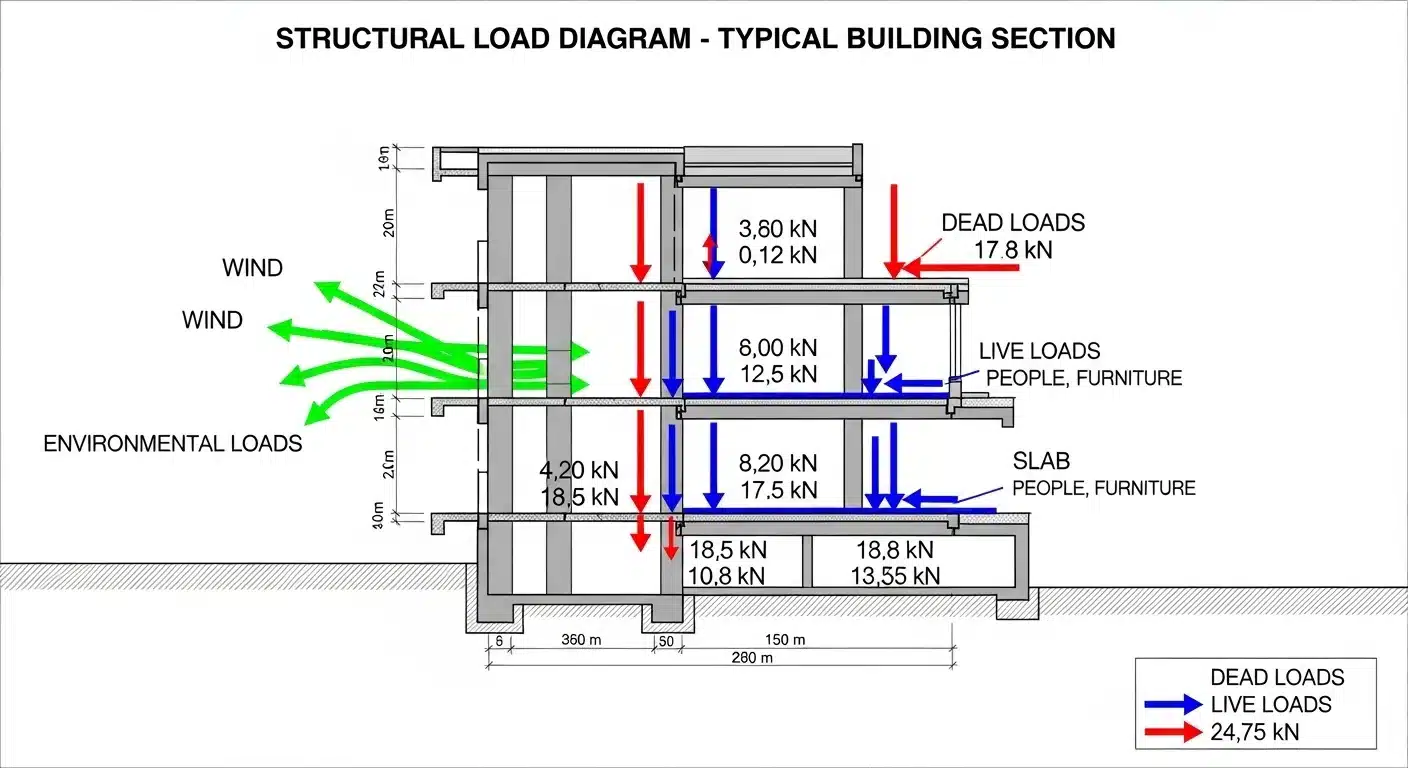
A load map is a detailed document that identifies, quantifies, and visualizes all forces on a structure, including dead, live, and environmental loads. It follows the load path from point of application to the foundation, using standards like ASCE 7-22 and specific load combination methods to ensure structural integrity.
| Load Type | Description | Key Standard/Example |
|---|---|---|
| Dead Load | Permanent weight of the structure and fixed components. | ASCE 7-22. Example: 0.25m concrete slab = 6.0 kN/m². |
| Live Load | Variable loads from occupancy, furniture, and use. | ASCE 7-22 prescribes minimum values. |
| Environmental Load | Forces from wind, snow, seismic activity, rain, and flood. | ASCE 7-22 defines hazard-specific loads. |
| Design Method | Framework for combining loads with safety factors. | LRFD (Load and Resistance Factor Design) or ASD (Allowable Strength Design). |
The Core Components of a Professional Load Map
A load map documents the complete load path. This means tracing every force from its point of application, through the structural members and connections, all the way down to the foundation. This visual and technical documentation is foundational for analysis and communication.
The entire process is governed by the ASCE 7-22 standard. This is the nationally adopted code that prescribes minimum design loads for all hazards, including dead, live, soil, flood, tsunami, snow, rain, atmospheric ice, seismic, and wind loads.
Loads are systematically classified into four primary groups. These are dead loads (the permanent weight of the structure itself), live loads (from occupancy and use), impact loads, and environmental loads (like wind and seismic forces).
Engineers first calculate the nominal load for each type. Once these individual loads are quantified, they are combined using specific factors from one of two primary design methodologies: Load and Resistance Factor Design (LRFD) or Allowable Strength Design (ASD).
Step-by-Step Calculation and Documentation Workflow
The workflow typically starts with dead load calculation. For instance, a 0.25-meter thick concrete slab, with a unit weight of 24 kN/m³, results in a dead load of 6.0 kN/m² (0.25m × 24 kN/m³). This establishes the base permanent load on the structure.
For seismic design, a specific calculation determines the seismic weight (W). The formula is W = Total Dead Load + (0.25 × Total Live Load). This weighted mass is crucial for analyzing the structure’s response to earthquake forces.
Buildings are designed for reasonable load combinations, not for all loads hitting their maximum simultaneously. ASCE 7 defines specific combinations to evaluate, and engineers must determine which combination produces the most unfavorable effect on each structural element.
This analysis and documentation are supported by specialized software. Common tools for modeling load distribution and analyzing the load path include SAP2000, ETABS, STAAD-Pro, RISA, and MBS. These programs help automate calculations and visualize results.
Using Load Cells for Heavy Statement Pieces
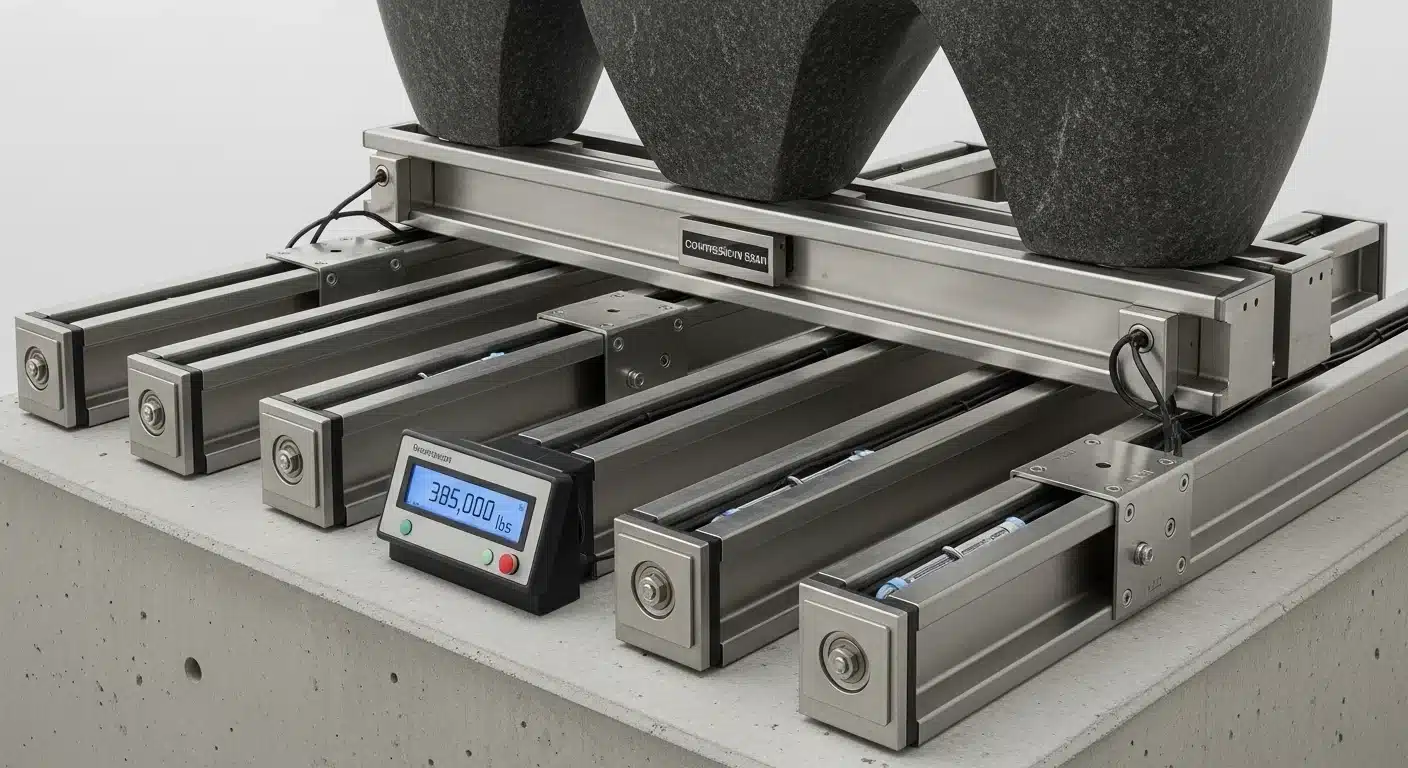
Load cells for heavy statement pieces are specialized sensors, often compression or shear beam types made from durable 17-4 PH stainless steel, that measure immense static loads up to 400,000 lbs. Their integration allows for precise structural monitoring, ensuring safety and stability by verifying calculated loads against real-world data.
Selecting the Right Load Cell for Static Installations
For large static elements like sculptures or architectural features, prioritize high-capacity compression (CLC Series) or shear beam types. These sensors offer capacities from 2,000 lbs to 400,000 lbs, providing the necessary range for massive installations.
Material selection is critical for long-term durability under sustained load. Heat-treated 17-4 PH stainless steel is the key material for these applications, offering superior strength and resistance to creep. Avoid using 2023 aluminum alloy for heavy-duty installations due to its risk of permanent deformation over time.
Low-profile designs, such as those with a 2-inch diameter, are essential for integration. They allow the load cell to be installed within the structural base of the piece without altering its aesthetic profile or increasing its footprint.
To account for dynamic forces in semi-static applications, a common engineering practice is to apply a safety margin by doubling the normal rated capacity of the load cell. This ensures the sensor can handle unexpected loads without compromising accuracy or safety.
Technical Integration and Compliance Standards
Proper installation is vital for accurate measurement. Use convex loading surfaces or through-hole donut cells (THA/THB Series) to ensure precise, axial force distribution and minimize damaging side forces. Even a minor 5-degree angular misalignment can introduce a 0.4% measurement error.
These load cells typically output a 2 mV/V signal from an internal strain gauge Wheatstone bridge. This low-level signal requires a signal conditioner, like the TM0-1 amplifier, to convert it into a robust, high-speed data stream suitable for real-time monitoring systems.
When selecting a sensor, verify its Full Scale Output (FSO) linearity specification, such as ±0.15%. This metric defines the sensor’s accuracy across its entire measurement range and is crucial for reliable data in both tension and compression applications.
Compliance with recognized standards like ISO 7500/1 or EN10002-2 validates the static load calculations and hardware selection. This formal validation is often required for structural engineering sign-off, ensuring the installation meets industry safety and performance benchmarks.
Final Thoughts
Calculating loads for multi-ball arrays or any complex structural cluster is more than just adding up individual weights. It’s a systematic process that accounts for the total array load, including all rigging hardware, and then distributes that force correctly. You must consider the weight per linear foot of supporting structures, the added weight of long chains in high-ceiling rigs, and the precise location of the cluster’s center of gravity. Every piece of hardware, from shackles to load cells, has a defined Working Load Limit that must not be exceeded by the calculated forces.
The goal is to create a clear load map that traces every force from the point of application down to the foundation. By following established standards and using the correct calculations for total load, linear force, and hardware limits, you ensure the installation is safe, stable, and compliant. Whether for an event, an architectural feature, or an industrial application, this rigorous approach to static load math is what prevents overloading and structural failure.
Frequently Asked Questions
How do you calculate the rigging load for decorative elements like mirror balls?
The rigging load is calculated using a factored load formula: P = p × KOS × Kv. Here, ‘p’ is the unfactored weight of the decor element. ‘KOS’ is an optional safety factor, and ‘Kv’ is a dynamic acceleration factor. For slings, the force is adjusted by the load angle factor; for example, a 96-inch sling at an 83-inch height has a factor of 1.157, turning a 500 lb share into 578.5 lbs per leg. A minimum 60° sling angle to the panel surface is required. The total rigging capacity must exceed the summed sling forces, adhering to standards like OSHA 1926.753(e)(2). A 5:1 design factor is standard, meaning the rigging’s ultimate breaking strength must be five times its working load limit.
What is the Working Load Limit (WLL) in rigging?
The Working Load Limit (WLL) is the maximum weight or force that rigging or lifting equipment is rated to handle safely under normal conditions. It’s determined by dividing the equipment’s minimum breaking strength by a designated safety factor. Common safety factors range from 4:1 to 6:1, with a minimum of 5:1 being a frequent industry standard. For example, equipment with a 10,000 lb breaking strength would have a 2,000 lb WLL with a 5:1 factor. These standards are set by organizations like OSHA and ASME, as well as equipment manufacturers.
How much does a professional 50-ball disco cluster weigh?
A professional cluster of 50 disco balls, typically using 50cm diameter balls which are standard for such lighting effects, has a total weight between 4.7kg and 6.4kg. This range is based on specifications from multiple manufacturers, with 6.4kg representing the upper end for a cluster of this size and professional grade.
What is the total weight of a 24-inch ball with its chain?
There is no established industry standard for the total weight of a heavy 24-inch industrial ball with an attached chain for structural rigging. Available data primarily covers lightweight jewelry or decorative ball chains. For instance, a 24-inch length of 3.2mm stainless steel ball chain weighs approximately 10.2 grams. For accurate load calculations on a heavy statement piece, the specific weight of the custom ball and its hardware must be measured directly or obtained from the manufacturer.
What are the load distribution requirements for installing ceiling clouds?
Industry standards for static loads on ceiling clouds, such as those used in acoustic treatments, specify bracing at regular intervals. Support should be placed at 4 feet on-center (o.c.) and within 24 inches of each corner or perimeter. These components must be restrained per building codes to handle distributed loads, which can be equivalent to 100 pounds per square foot (psf) or point loads of 2,000 pounds, as referenced in standards like ASCE 7-22 for access floors and similar structures.
What is the safety factor for cluster rigging?
The standard safety factor for general rigging hardware, including cluster rigging for decor or audio, is a minimum of 5:1. This is mandated by regulations such as OSHA 29 CFR 1926.1431(g)(3). For specific applications like rotation-resistant slings, the factor increases to 10:1. Audio cluster rigging, such as for speaker arrays, often follows a minimum 4:1 safety factor per regulations like DGUV 17 (BGV-C1).