

Choosing the wrong materials for decorative elements like ceiling panels or mirrored installations can lead to failed fire inspections, costly project delays, and significant safety risks. Fire marshals are specifically trained to identify how these features can obstruct sprinkler spray patterns, trap heat, and delay detection—issues that are not always obvious during initial design.

This guide clarifies the critical fire retardant standards for venues, explaining the key differences between material-focused tests like UL 94 V-0 and building-focused standards like DIN 4102 B1. You’ll learn why materials must meet specific criteria, such as a Flame Spread Index below 25 per ASTM E84 for ceiling tiles, and how to navigate the mandatory documentation process for site submittals to ensure a smooth approval.
Why Fire Marshals Target Ceiling Decor
Fire Marshals focus on ceiling decor because it can obstruct sprinkler spray patterns, trap heat, and delay fire detection. Compliance with NFPA 13 and ASTM standards is mandatory to ensure sprinklers activate correctly and prevent fire spread in concealed spaces.

How Decor Disrupts Sprinkler Performance and Fire Dynamics
Ceiling obstructions like beams, light fixtures, and decorative panels can block a sprinkler’s water spray pattern, preventing it from reaching the fire source effectively.
NFPA 13 requires detailed documentation of all ceiling features—including heights, slopes, and fixture depths—to calculate proper water distribution and ensure activation.
Decor can create hidden voids or pockets that trap heat and smoke, delaying sprinkler head activation and allowing a fire to grow unchecked.
Materials must allow for a ‘drop-away’ design in a fire to expose concealed sprinklers; non-compliant materials risk creating a fire barrier that traps heat.
Specific Code Requirements and Enforcement Protocols
Ceiling tiles and panels must achieve a Class A Fire Rating per ASTM E84/UL 723, with a Flame Spread Index below 25 and Smoke Developed Index below 450.
Mandatory clearance zones: Maintain an 18-inch (457 mm) to 24-inch (610 mm) space between storage and the ceiling in sprinklered areas to ensure heat reaches sprinkler heads.
Fire Marshals enforce compliance through local plan reviews, referencing state codes like the California State Fire Marshal Listing (e.g., No. 2200-1622:100), with final on-site approval required.
For sloped or beamed ceilings, hydraulic calculations require a minimum water density of 0.495 GPM per square foot over a design area of 2,000 square feet, which obstructions can compromise.
Understanding UL94-V0 vs. DIN 4102 B1
UL 94 V-0 is a North American standard for plastics, focusing on self-extinguishing within 10 seconds and preventing flaming drips. DIN 4102 B1 is a German building material standard that assesses flame spread, residual length, and smoke temperature. While materials like PVC can meet both, the tests and intended applications differ significantly.

| Standard | Primary Focus | Key Performance Criteria |
|---|---|---|
| UL 94 V-0 | Material flammability for plastic components | Self-extinguish within 10 seconds; no flaming drips; specimen size 127 mm x 12.7 mm. |
| DIN 4102 B1 | Fire behavior of building materials | Residual length ≥150 mm; smoke temperature ≤200°C; damaged area ≤250 mm. |
Core Concepts and Testing Methods
UL 94 V-0 is a material flammability standard from Underwriters Laboratories, primarily for plastic components in electronics and enclosures.
Its vertical burn test applies a 20mm flame twice for 10 seconds each, requiring self-extinguishing within 10 seconds after each application.
A critical pass/fail criterion is the prohibition of flaming drips that could ignite materials below.
DIN 4102 B1 is a German standard for building materials, being phased out for EN 13501-1, focusing on a product’s contribution to fire within a structure.
Its vertical test evaluates flame spread, requiring a residual specimen length of at least 150 mm and limiting smoke temperature to 200°C or below.
For textiles under 5mm thick, it mandates an afterflame time of less than 5 seconds and prohibits burning droplets.
Key Data, Material Applications, and Compliance
UL 94 V-0 ratings are thickness-dependent; a material rated V-0 at 3.0 mm may only achieve V-1 at 2.0 mm, affecting compliance for thinner sections.
The standard’s test specimen size is 5 inches (127 mm) long by 0.5 inch (12.7 mm) wide, and it is not applicable for parts over 13 mm thick or areas larger than 1 square meter.
DIN 4102 B1 criteria also include a maximum damaged area (length + width) not exceeding 250 mm, similar to the French NF-P92-503-M1 standard.
Materials like specific PVC grades (e.g., Trovidur® EPC grey) can achieve both UL 94 V-0 (at 4 mm thickness) and DIN 4102 B1, with a yield stress of 52 MPa.
Architects and safety officers use UL 94 for component-level safety (e.g., EV battery housings) and DIN 4102 B1 (or its successor) for compliance with EU building codes.
Verifying thickness-specific certification is essential, as a material’s passing rating for one thickness does not guarantee compliance at another.
The Flammability of Adhesives and Cores
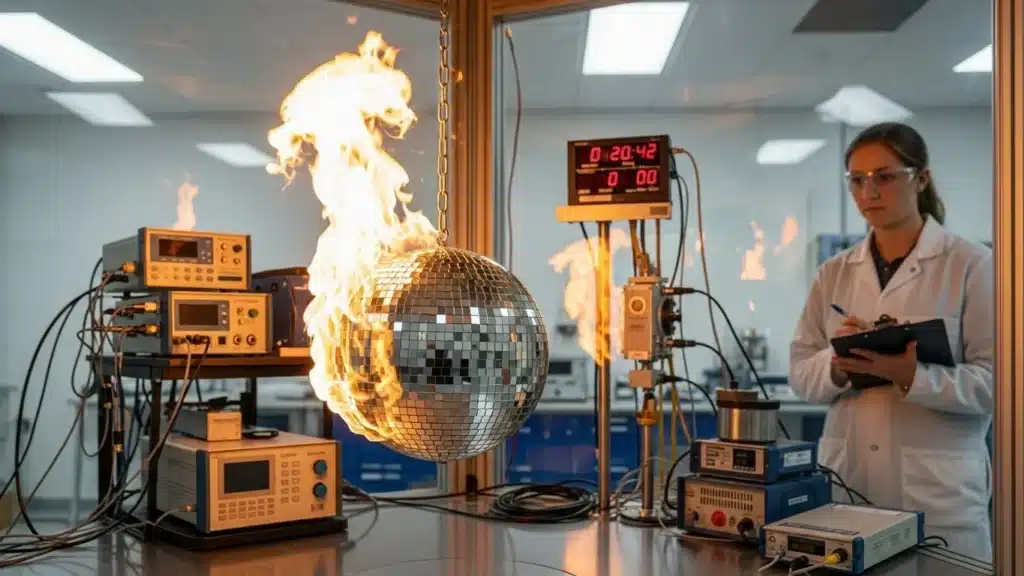
Adhesives and core materials are evaluated under standards like UL 94 and NFPA 701, which measure self-extinguishing times, burn rates, and flame spread. These ratings are critical for ensuring decorative elements, such as mirrored panels or disco balls, meet building and fire code requirements for interior finishes.
Core Flammability Standards and Test Methods
UL 94 is the dominant standard for plastics and adhesives, with vertical (V-0, V-1, V-2) and horizontal (HB) burn tests that apply a flame for 10-30 seconds to measure self-extinguishment and propagation.
The UL 94 V-0 rating is the highest vertical class, requiring specimens to self-extinguish within 10 seconds with no flaming drips.
For surface flammability, the UL 94 5VA test uses five applications of a 5-second flame; a material passes if it self-extinguishes within 60 seconds total and does not develop a hole.
In aerospace and building panels, standards like FAA 14 CFR 25.853(a) and NFPA 701 apply, assessing vertical burn length, heat release, and flame spread index (e.g., NFPA Class I requires a flame spread index of 0-25).
Material-Specific Data and Qualification Pathways
Specific adhesive formulations, like Core Adhesive SB-100, have a flash point of -17.0°C and a volatile content of 74.8%, indicating high flammability risk during handling despite potential finished product ratings.
For composite cores, such as phenolic aramid honeycomb (e.g., Nomex), data from tested densities and cell sizes is often used to qualify intermediate, untested specifications, reducing the need for retesting.
Adhesives used in pre-qualified panel systems, like certain epoxy bonds for honeycomb, may not require separate testing if the base assembly passes the relevant vertical burn length and drip tests.
The automotive benchmark FMVSS 302 (ISO 3795) sets a burn rate limit specifically for the top 13 mm of materials, which differs from the component-focused approach of UL 94.
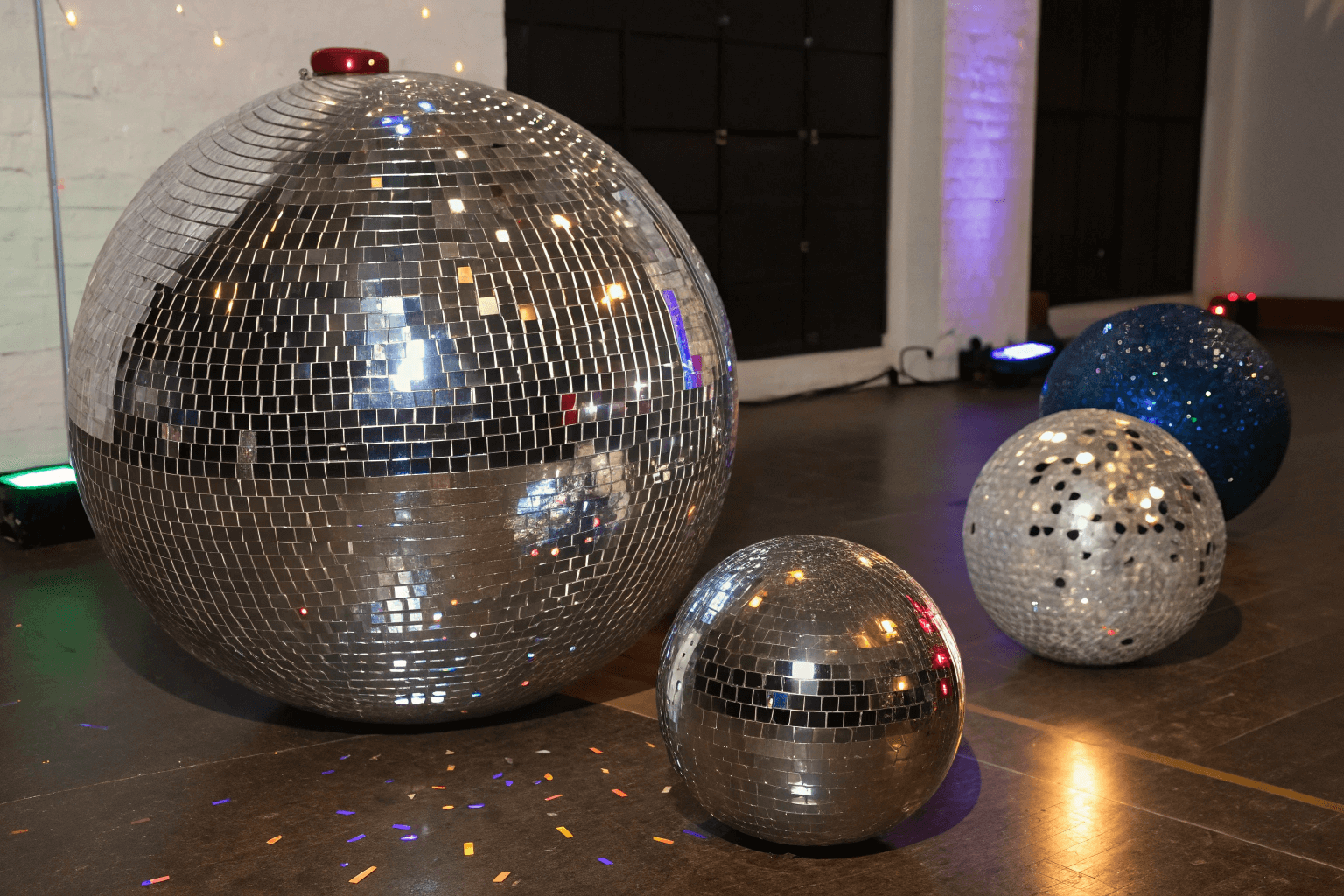
Source Commercial-Grade Mirror Balls, Not Party Favors
Reflected Light Concentration Risks
In a fire, the intense radiance from flames can be thousands of times brighter than light reflected from safety targets like exit signs. This degrades contrast, making detection or visibility for egress difficult. Standards like NFPA 101 mandate minimum illumination levels and uniformity to ensure paths remain visible, while technical solutions like spectral filtering can isolate critical signals from the fire’s glare.

The Physics of Signal Overwhelm in Fires
During structural fire tests, the radiance emitted directly by flames can reach 2997 W/m²·sr within the visible spectrum. This immense output completely overshadows the light reflected from safety targets.
For example, an LED-illuminated target on a matte white painted surface reflects only about 16 W/m²·sr at a 450 nm wavelength. This creates a stark signal-to-noise ratio of roughly 1 to 190 when compared to the flame’s emission, making the target effectively invisible to imaging systems in fires larger than 275 kW without intervention.
The core risk is not just general brightness, but the specific spectral concentration of the flame’s light. Flame emissions are particularly strong in the red band of the spectrum, which can swamp other light sources and critically degrade the performance of safety systems that rely on visual contrast.
Compliance Standards and Technical Mitigations
Building codes establish clear requirements to counteract these risks. NFPA 101, the Life Safety Code, mandates that emergency egress illumination must start at an average of 1 foot-candle (10.8 lux) at floor level. This illumination is allowed to decline in a controlled manner, and the standard enforces a maximum-to-minimum uniformity ratio of 40:1 to prevent dark spots along escape routes.
For exit signs, the ANSI/UL 924 standard governs internally illuminated units, ensuring they provide sufficient luminance and a minimum contrast ratio of 0.5 to remain legible under adverse conditions, including smoke and competing light.
From an engineering perspective, a powerful technical mitigation involves pairing narrowband illumination with spectral bandpass filters. This approach can reverse the signal overwhelm. By illuminating a target with a specific wavelength of light and using a filter that only allows that same wavelength to pass to a sensor or camera, the reflected target signal can be boosted to twice the level of the flame’s emission while suppressing the flame’s broad-spectrum “noise” by over a million times.
This technique enables the reliable imaging of safety targets even in extreme conditions—such as fires up to 1000 kW and target surface temperatures exceeding 700°C. This capability is a key factor for architects and engineers when specifying advanced safety systems, such as those using photoluminescent materials or active filtered illumination, to ensure resilience against optical interference from a fire.
Providing Certificates for Site Submittals
Providing certificates for site submittals involves preparing and submitting detailed technical documentation to fire marshals or building authorities for approval before inspections and occupancy. This process is mandatory for new construction and major alterations, requiring documents like property layouts, fire escape plans, and system specifications. Compliance with standards like NFPA is verified during inspections, and failure to submit proper certificates can result in significant fines, project delays, or legal action.

| Certificate / System | Key Requirements | Compliance & Notes |
|---|---|---|
| Fire Safety Certificate (FSC) | Property layout, fire escape plans, firefighting equipment details, occupancy certificate. | Valid for 1-3 years. Required for new construction and material alterations. Non-compliance fines range from $500 to $10,000. |
| Fire Sprinkler Systems | Design by NICET Level III/IV or registered engineer; NFPA Test Certificate for Aboveground Piping after witnessed testing. | Per Ohio Building Code 106.2.1 and ORC 3781.105. Certified oversight may be required for underground lines. |
| ERCES (Emergency Responder Radio) | Fire alarm system plan showing connection; building permit for penetrations through fire-rated assemblies. | Ensures radio coverage for first responders. Must be integrated with the building’s fire alarm system. |
| Fire Alarm Plan Submittals | Required for new systems, additions, or changes. | Enforced per local codes like Delaware State Fire Marshal and Virginia’s SFPC post-certificate of occupancy. |
The Core Process for Fire Safety Certificate Submission
A Fire Safety Certificate (FSC) is a legal requirement for new construction and material alterations to buildings such as data centers, hotels, and shopping centers. These certificates typically expire after 1 to 3 years and must be renewed.
The process begins with a comprehensive fire safety assessment. Following this, a formal application is submitted to the local fire department. Required documents include detailed property layouts, fire escape plans, specifications for all firefighting equipment, and an occupancy certificate.
Authorities conduct on-site inspections to verify compliance with codes like NFPA. Any deficiencies identified must be corrected before the FSC is issued. This certificate is not just a formality; it is essential for legal operation, insurance validation, and ensuring occupant safety.
Technical Documentation and System-Specific Submittals
For fire sprinkler systems, submittals are highly technical. The system design must be certified by a NICET Level III/IV technician or a registered professional engineer. After installation, an acceptance test is performed, which must be witnessed by a fire prevention bureau representative. Upon passing, an NFPA Test Certificate for Aboveground Piping is issued to document compliance.
Submittals for Emergency Responder Radio Coverage Systems (ERCES) must include a fire alarm system plan that clearly shows how the ERCES connects to the building’s primary fire alarm system. If antenna installation requires penetrating fire-rated walls or floors, a separate building permit for those penetrations is mandatory to maintain the assembly’s fire-resistance rating.
Fire alarm plan submittals are required for any new system or modification. It’s critical to follow local amendments; for example, in Virginia, the Statewide Fire Prevention Code (SFPC) is enforced after a certificate of occupancy is issued, making post-approval compliance checks standard.
Smoke Emission Data for Enclosed Spaces
For enclosed spaces, managing smoke risk centers on engineering controls and containment, not just material data. Key standards define specific ventilation rates and pressure differentials to prevent smoke spread and protect occupants, which is critical for spaces where decorative elements like mirror balls are installed.

The Role of Ventilation and Containment Standards
Engineering standards prioritize active containment over passive material data to manage risk in occupied spaces. This approach focuses on controlling the environment to prevent hazards from spreading.
Key metrics include air velocity, measured in feet per minute or meters per second, and pressure differentials, measured in Pascals. These measurements are the foundation of effective containment design.
These controls are engineered to capture and exhaust contaminants at their source. This prevents the migration of smoke or other hazardous particles to other areas, ensuring occupant safety.
Key Engineering Metrics and Their Applications
EPA Method 204 for permanent total enclosures requires a minimum face velocity of 200 fpm, with 500 fpm serving as a critical verification threshold for airflow methods.
CDC standards for tuberculosis isolation rooms mandate a negative pressure differential of 0.25 Pa and an exhaust rate that exceeds the supply by 50 cfm to ensure airborne contaminants are contained.
Laboratory ventilation design targets an air velocity of 100 fpm (0.51 m/s) at openings to ensure consistent containment of chemical or biological agents.
Specialized applications, like designated smoking rooms, use higher negative pressure differentials in the range of -5 to -7 Pa to achieve exhaust efficiency of at least 90%.
Retrofitting Non-Compliant Legacy Balls
Retrofitting legacy fire safety balls involves applying model building codes like NFPA 101 and IBC for sprinkler systems, and product standards like API 607 for ball valves. Solutions include installing certified fire-safe valves with thermal shutoff links and automatic fire extinguisher balls that require no maintenance for five years.
Code-Driven Retrofits for Building Systems
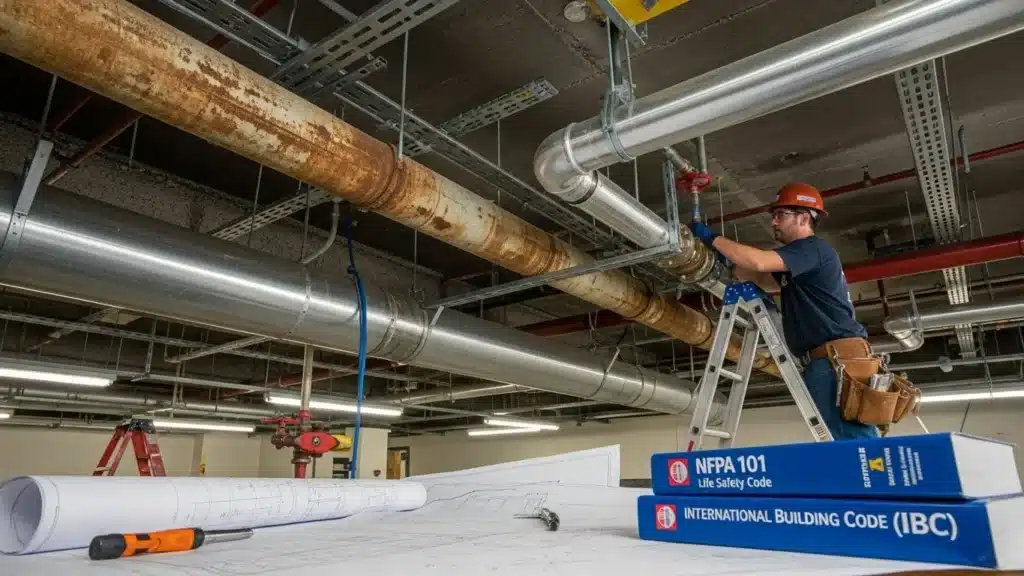
Upgrading automatic sprinklers and other life safety systems in existing buildings is mandated by model codes. Standards like NFPA 1, NFPA 101 Life Safety Code, the International Building Code (IBC), and the International Existing Building Code (IEBC) require retrofits based on a building’s occupancy type, height, and specific hazards.
Common triggers for these mandatory upgrades include high-rise buildings, facilities with evacuation plans deemed impractical, and existing mercantile occupancies. These ANSI-recognized standards are consensus-based and provide minimum safety requirements. They are frequently updated in response to major fire incidents to prevent similar tragedies, often implemented through a combination of code provisions and local ordinances.
Product-Specific Solutions: Valves and Extinguisher Balls
For ball valves in systems handling flammable liquids, the API 607 certification is the benchmark for fire-safe design. Compliant valves, such as full-port 3-piece or flanged models, are constructed from stainless or carbon steel and incorporate U.L.-listed thermal links. These links activate at temperatures between 165°F and 500°F to automatically shut off the valve and contain a fire. Related standards like NFPA 58, OSHA 1910.106, and Factory Mutual Class 7440 also apply to these fire-safe valve retrofits.
Automatic fire extinguisher balls provide a straightforward retrofit solution for areas requiring immediate fire suppression. Models like the Terminate-TFO-1.2-Z are designed for A, B, C, E, and F class fires. With a 150 mm diameter, they activate in under 3 seconds to protect an area under 3 square meters. A key advantage is their 5-year, maintenance-free shelf life. Installation is simple, typically using M4 screw brackets on walls or ceilings, and they carry certifications such as CE and ISO 9001:2015.
Final Thoughts
Navigating fire safety for venues is a detailed process that goes beyond just choosing materials. It requires a clear understanding of how building codes, material standards, and installation practices work together. The key is to see compliance not as a single checklist, but as an integrated system where every element—from the flammability of a decorative panel to the placement of a sprinkler head—affects overall safety.
The most effective approach starts early in the design phase. By planning for proper documentation, selecting materials with the correct certifications for their specific application and thickness, and ensuring installations don’t interfere with life safety systems, venues can avoid costly retrofits and delays. Ultimately, this proactive focus on integrated compliance creates spaces that are not only visually impressive but are fundamentally safer for everyone inside.
Frequently Asked Questions
Are disco balls fire-rated?
No, disco balls are not fire-rated. There are no industry standards or certifications that confirm a fire-rating for these decorative items. Safety concerns typically focus on electrical hazards from components like motors or wiring, rather than a product-wide fire safety classification.
What is the B1 fire standard for decor?
The B1 standard, defined by the German DIN 4102-1, classifies building materials as flame-retardant. Materials like certain textiles, wall coverings, and displays must be difficult to ignite, self-extinguish, and achieve a mean remaining length of over 15 cm in a specific fire tunnel test. It’s a key benchmark for decor in regulated spaces.
Can disco ball reflections start a fire?
There are no documented cases or established standards indicating that reflections from a traditional disco ball can ignite a fire. The primary fire risks associated with these products stem from electrical faults, such as arcing or overheating, not from concentrated light.
Do I need a fire certificate for hotel lobbies?
There is no single ‘fire certificate’ universally mandated for hotel lobbies. Compliance is achieved through installed systems like sprinklers, fire alarms, and clear exit paths as required by codes like the International Fire Code (IFC). Local authorities may require certification for individual safety systems, such as fire alarm panels.
Are fiberglass cores fireproof?
Fiberglass cores are not fireproof but are fire-resistant and non-combustible. They meet standards like ASTM E84 Class A, with a flame spread index of 25 or less and smoke development of 450 or less. They can withstand temperatures up to 1000°C (1832°F) without burning, though overall performance can be affected by other materials used in construction.
What is the safety distance from high-heat stage lights?
Industry guidelines recommend maintaining a minimum distance of 0.5 meters between high-heat stage lights and combustible materials like curtains. A greater distance of 1.5 meters from the front of the lamp is advised to account for heat radiation, airflow, and potential movement during an event.