

Hanging a disco ball or any overhead decor in a public venue isn’t just about aesthetics—it’s a critical safety and liability decision. A single rigging failure can lead to catastrophic injury, property damage, and severe legal consequences for venue owners, producers, and contractors. The responsibility is a legally segmented chain, where the venue must provide safe infrastructure and the contractor must execute an engineered design that respects strict working load limits and dynamic forces like wind.

This article breaks down the essential engineering and compliance requirements for safe static hanging. We’ll cover the distinct duties of venue owners and rigging contractors, explain why a static load calculation is insufficient and must account for lateral wind pressure governed by standards like ANSI E1.21, and detail the approved hardware—such as ASME B30.26-compliant shackles and swivels—that forms a reliable load path. You’ll learn why a secondary safety line is non-negotiable, how to correctly anchor into concrete versus a drop ceiling, and what the mandatory annual inspection checklist entails to ensure your systems meet codes like ANSI E1.47.
The Responsibility of Overhead Rigging
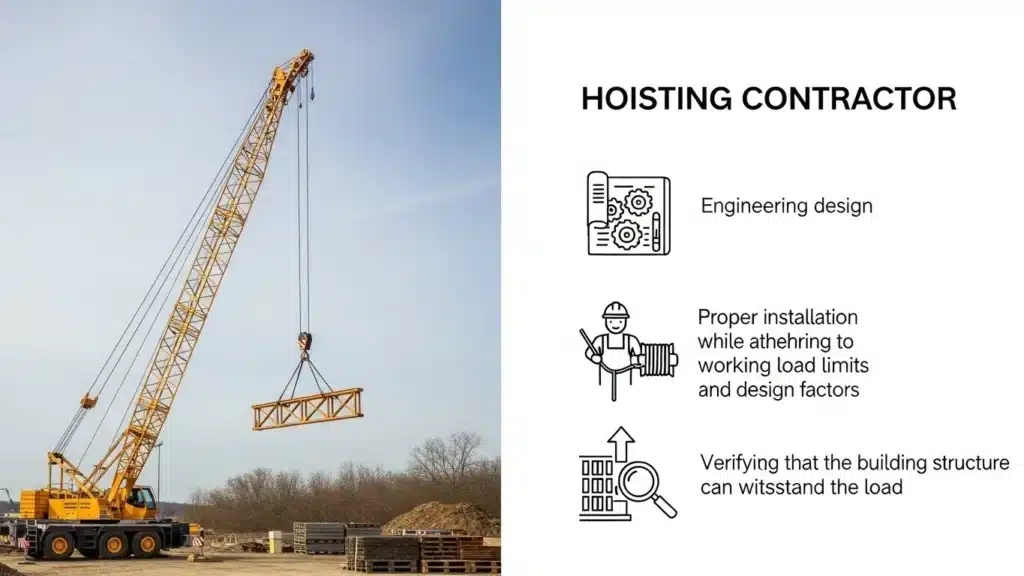
Responsibility for overhead rigging is a legally segmented chain. The venue owner or producer is responsible for providing safe infrastructure, correct equipment specifications, and ensuring qualified personnel. The rigging contractor is responsible for the engineered design, proper installation respecting working load limits and design factors, and confirming the building structure can support the load.
The Venue Owner or Producer’s Duties
The venue owner or producer holds the foundational responsibility for establishing a safe rigging environment. They must provide the correct rigging equipment along with all manufacturer documentation and safety specifications. A core duty is ensuring the working load limit (WLL) of the system is never exceeded during any operation.
This role also requires implementing and enforcing a formal schedule for regular inspections and preventative maintenance of all rigging hardware. The venue or producer must verify that all personnel working on or near the rigging system are qualified, properly trained, and supervised according to regulatory requirements. Finally, they have a duty to communicate all known site-specific hazards, load limitations, and structural information to the rigging contractor and any other affected parties.
The Rigging Contractor’s Engineering and Execution Mandate
The rigging contractor carries the technical and executional mandate for the overhead system. Installation must strictly follow the provided safety specifications and manufacturer instructions, using positive, form-locking connections for all components. The contractor is required to post the system’s WLL and ensure it is respected, calculating for both the static load and dynamic forces such as wind or movement.
A critical engineering responsibility is verifying the building’s structure and attachment points can bear the full transferred load with a safety factor that matches the rigging system—for example, a 10:1 design factor for loads suspended over people. The contractor selects all hardware, including shackles, turnbuckles, and hoist rings, ensuring it complies with standards like ASME B30.26 and is rated for the intended load. Only qualified persons may assemble or operate the system; these individuals must know the exact load weights and never exceed the lowest WLL in the entire chain of equipment.
Static Load vs. Airflow Impacts
Static load is the constant vertical weight of hung equipment. Airflow from wind or HVAC creates lateral pressure, which scales with the square of speed and can generate forces far exceeding an object’s weight. Rigging for airflow requires adherence to standards like ANSI E1.21 and higher design factors than static load alone.
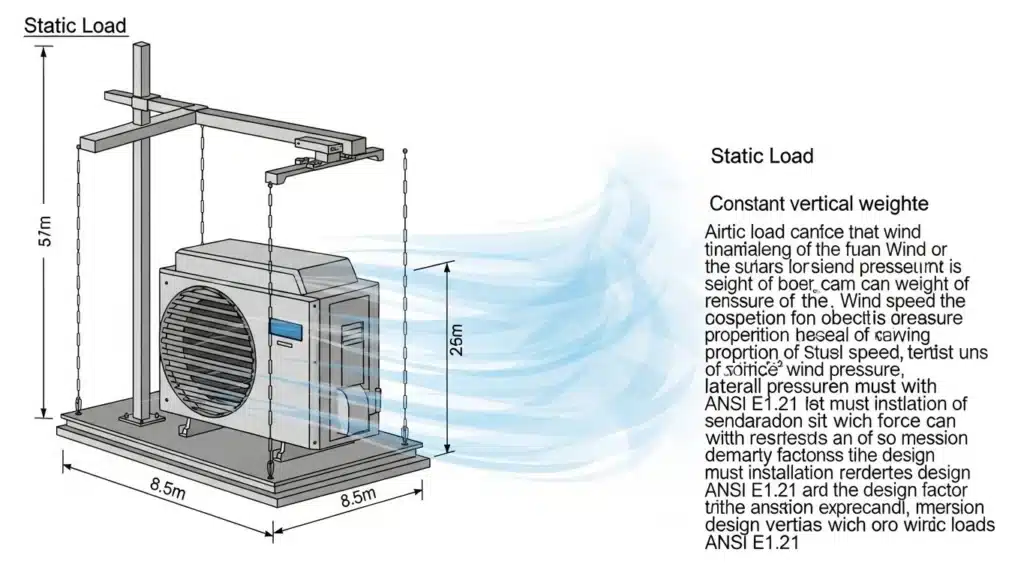
| Load Type | Governing Physics & Standard | Typical Design Factor |
|---|---|---|
| Static Load | Constant vertical dead weight. Defined as a load applied slowly and remaining constant. | 4:1 to 5:1 |
| Airflow-Induced Load | Pressure (P) scales with the square of velocity (V²). Governed by ANSI E1.21 (min. 115 km/h gust design). | 8:1 or higher, plus dynamic factors of 1.3–2.0 |
Defining the Core Concepts: Static Weight vs. Dynamic Pressure
A static load in theatre rigging is a load applied slowly and remaining essentially constant, like a permanently hung truss or speaker. This is the simple vertical weight the rigging must support under normal, still conditions.
Airflow-induced load operates on a different principle, governed by wind pressure physics. The pressure exerted scales approximately with the square of the wind speed (P ∝ V²). This means a doubling of wind speed results in roughly four times the force on a surface.
The behavior of materials complicates this further. For porous materials like scrims or acoustic baffles, a static compressive load can compact the material by 20-25%. This compaction drastically increases its airflow resistance, causing it to act more like a solid sail than a permeable fabric when wind hits it.
The critical takeaway is that the governing condition for rigging design shifts from pure dead weight to combined out-of-plane pressure and dynamic amplification as soon as significant airflow is present. The static weight becomes a secondary concern compared to the lateral forces generated by moving air.
Engineering for Airflow: Standards, Calculations, and Safety Factors
Designing for airflow requires adherence to specific engineering standards. ANSI E1.21 for temporary outdoor structures mandates design for a minimum 115 km/h (71.5 mph) 3-second gust wind speed. This provides a baseline for calculating expected forces.
Engineers use formulas like those in ASCE 7 to calculate the resulting pressure. For example, a 70 mph wind generates about 12.5 psf (0.6 kPa) of pressure on a surface’s projected area. This pressure is then multiplied by the object’s area to find the total lateral force.
The resulting forces can be immense. A 10m x 5m (50 m²) banner in a 70 mph wind experiences a lateral force of approximately 30 kN. This is over 10 times the typical dead weight of such a banner (100-250 kg), demonstrating why airflow often controls the design.
Consequently, safety factors are significantly higher for dynamic or wind-affected loads. While well-known static loads might use a design factor of 4:1 or 5:1, dynamic conditions often drive factors to 8:1 or higher. Additionally, dynamic impact factors of 1.3 to 2.0 are commonly applied to account for shock, acceleration, and gusting.
Hardware Specs: Carabiners, Chains, and Swivels
In venue rigging, chains and swivels used for overhead lifting must be ASME B30.26-compliant and stamped with a Working Load Limit. Carabiners are generally not approved for primary lifting under this standard but are used in fall protection, rescue, and temporary rigging, governed by ANSI, ASTM, and NFPA standards that specify minimum breaking strengths and safety factors.

The Governing Standards: What Hardware is Approved for What?
The regulatory landscape for rigging hardware is defined by its intended use. ASME B30.26 is the primary US standard for overhead rigging hardware, covering components like swivels, shackles, links, and turnbuckles. It requires these items to be stamped with a Working Load Limit. This standard does not list carabiners as approved lifting devices.
Carabiners are governed by different standards for specific applications. ANSI A10.48 covers their use in telecom and temporary lifting, ANSI Z359 and OSHA regulations apply to fall protection, and ASTM F1774 and F1956 govern climbing and rescue use. A key operational distinction is that ASME B30.26 hardware must have a stamped Working Load Limit, while carabiner ratings are typically a Minimum Breaking Strength that requires conversion using an appropriate safety factor to determine a safe working load.
Decoding the Spec Sheet: From MBS to Allowable Load
Interpreting manufacturer ratings requires understanding material strength and safety factors. Carabiner strength is multi-axial; a typical heavy-duty rescue model may be rated for 40 kN on the major axis, 11 kN on the minor axis, and 11 kN with the gate open. The marked kilonewton value is almost always the Minimum Breaking Strength, not the safe working load.
To find the safe Working Load Limit, apply a relevant safety factor. Common factors are 5:1 for rescue operations or 10:1 for performer flying. Complete manufacturer specs, like those from Buckingham for a steel rigging carabiner, provide both the MBS (55 kN) and the derived WLL (11 kN), indicating a built-in 5:1 safety factor and compliance with standards like ANSI Z359 and A10.48.
For entertainment rigging, hardware specifications center on three areas: governing standards, material and geometry, and the conversion of MBS to WLL. In the US, ASME B30.26 covers traditional rigging hardware like shackles and swivels but does not approve carabiners for overhead lifting. Consequently, overhead lifting configurations typically use rated shackles, master links, and swivels that are WLL-stamped and traceable to ASME B30.26.
Carabiners are used in personal fall arrest, rescue, and some temporary rigging. ANSI A10.48 permits their use for lifting only when the manufacturer classifies them for such loads and marks them with parameters like MBS and WLL. Industrial and rescue carabiners are specified by ASTM standards, with minimum breaking strengths ranging from 20 kN to 40 kN on the major axis. When combined with design factors of 4 to 10, these yield working load limits in the 5–12.5 kN range used in staged operations.
Fall protection standards, such as OSHA 1910.66 and ANSI Z359, set minimum breaking strengths for connectors, including specific minor-axis strength requirements for carabiners. Manufacturers often use 3‑sigma statistics for rating, meaning the marked MBS is a conservative value. End users or codes must still convert this MBS to an allowable load using the appropriate safety factor. This creates a clear division: chains and swivels for hoisting must be ASME B30.26-compliant, while carabiners in a venue are selected against ANSI, NFPA, and ASTM standards for personal connection, positioning, and rescue, ensuring their MBS, WLL, and safety factor align with the rigging plan.
Source Commercial-Grade Mirror Balls, Factory Direct.
Through-Rod Construction vs. Glued Eyelets
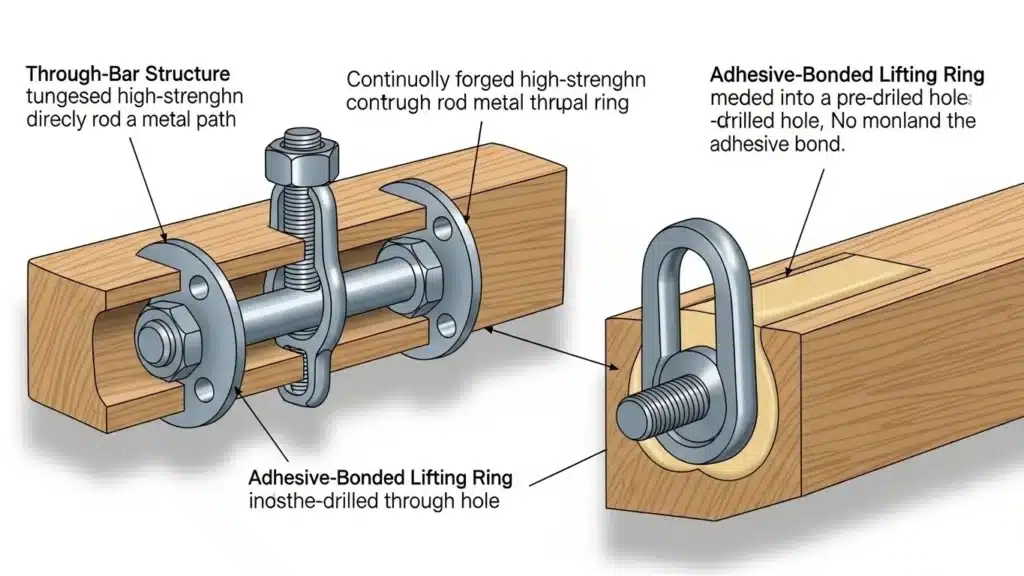
Through-rod construction uses a continuous, forged metal bar passing through hardware, providing a predictable, ductile load path. Glued eyelets, while used in static timber engineering, rely on adhesive bonds and are restricted by standards to dry, non-dynamic conditions, making them unsuitable for the dynamic loads and environmental factors of entertainment rigging.
The Engineering of Continuous Metal Load Paths
Through-rod construction refers to components like forged shackles or eyebolts where the load path is a single, continuous piece of metal passing through the hardware body.
This design ensures ductile, visible metal yielding under extreme load, providing a clear failure warning, unlike sudden adhesive bond-line failure.
It is the de-facto engineering standard for primary suspension points in lifting and entertainment rigging, governed by material grades and safety factors in standards like ASME B30.
Limitations and Standards for Adhesive-Bonded Connections
European standards EOTA TR 070 and EAD 130006-00-0304 regulate glued-in rods for timber, limiting use to static loads and dry, protected interior environments (Service Class 1 & 2).
These standards explicitly exclude high-temperature and dynamic fatigue environments, which are common in entertainment rigging with shock loads and vibration.
Laboratory tests show high pull-out strength (e.g., ~333–343 kN for 24mm rods) but failure modes depend heavily on installation quality and are not recognized in primary US rigging or wood design codes like the NDS®, requiring special engineering.
Anchoring into Concrete vs. Drop Ceilings
Rigging loads must be anchored into the structural concrete slab or beams using engineered mechanical or adhesive anchors with known capacities, not into the light-gauge steel grid of a drop ceiling. Concrete anchors, like wedge or drop-in types, are designed for pull-out forces in the hundreds to thousands of pounds, while drop ceilings are designed for acoustic tiles and light fixtures, not concentrated rigging loads.

| Feature | Concrete Anchors | Drop Ceiling Grid |
|---|---|---|
| Primary Function | Engineered structural support for concentrated loads. | Acoustic absorption and support for lightweight tiles/light fixtures. |
| Load Capacity | Hundreds to thousands of pounds per anchor (e.g., 3/8″ drop-in anchor: ~1560 lb ultimate tension). | Not designed for concentrated rigging loads; light-gauge steel framing. |
| Design & Standards | Tested to standards (e.g., ASTM) for specific concrete strengths; defined embedment depths (e.g., 9-12x bar diameter). | Manufactured for assembly and acoustic performance, not structural load tables. |
| Failure Mode | Engineered for ductile steel yielding before concrete breakout. | Catastrophic, unpredictable failure of grid components or hanger wires. |
| Correct Load Path | Direct anchorage into the structural concrete. | Load must be routed past the grid to the structural substrate above using dedicated fasteners. |
The Engineering Foundation of Concrete Anchors
Concrete anchors are engineered systems designed for specific concrete compressive strengths, such as 2000 psi, and are tested to standards like those from ASTM.
Mechanical anchors like wedge, drop-in, and undercut types can be loaded immediately after installation. Their performance is highly sensitive to precise hole dimensions and can be compromised by vibration during the setting process.
Adhesive anchors generally achieve higher strength and better displacement ratios but require a full cure time before loading. Their installation is temperature-sensitive; guidelines like those from MDOT require both ambient and concrete temperatures to be at least 50 °F and rising during application.
Design rules ensure a safe, ductile failure mode. For example, to fully develop the steel’s yield strength, MDOT requires adhesive anchors to have embedment depths of 9 times the bar diameter for ASTM A307 threaded rod (36 ksi) and 12 times the diameter for ASTM A615/A996 Grade 60 rebar (60 ksi).
For sustained overhead tension, extra caution is applied. Due to long-term creep concerns, agencies like MDOT impose a moratorium on using adhesive anchors in these applications, favoring immediately loadable mechanical systems.
Why Drop Ceilings Are Not a Structural Support
A typical suspended or drop ceiling consists of a light-gauge steel T-grid hung by thin wires. Its primary design purpose is acoustic absorption and supporting lightweight tiles, not concentrated rigging loads.
Any significant load must be routed back to the true structural substrate—concrete, steel, or timber—located above the ceiling. This requires dedicated fasteners that bypass the grid entirely, never attaching to the ceiling grid itself.
The correct fastener depends on the structural material above. For concrete decks, manufacturers specify tie-wire anchors or I-pin systems. For steel beams, use self-tapping lag screws or purlin clamps. For timber joists, coarse-thread eye lag screws are appropriate.
Industry standards highlight the zero-tolerance for uncertainty in overhead safety. Some explicitly prohibit using shot-in anchors in concrete for critical bracing wires. If one such anchor fails, the standard mandates that all adjacent anchors must be tested.
Product families like ITW Red Head’s Trubolt wedge anchors are explicitly engineered and specified for anchorage into concrete. They provide predictable, published tension and shear capacities that the components of a drop ceiling simply cannot match.
Secondary Safety Line Requirements
A secondary safety line is an independent backup system mandated by standards like ANSI Z459.1 to provide redundancy. It acts as a fail-safe if the primary rigging or support line fails, ensuring worker safety during overhead work, rescue operations, or equipment suspension. Key specifications are governed by ANSI Z359.14 for self-retracting lifelines (SRLs), which define performance limits for arrest force and distance.

The Purpose and Standards for Redundant Safety
The core function of a secondary safety line is redundancy. It creates two independent connections—a main line and a secondary line—so a single point of failure cannot cause a fall.
ANSI Z459.1 is the foundational standard, requiring two separate anchor points. One is for primary support, and the other is a dedicated fail-safe backup. NFPA 1983 and NFPA 1006 extend this logic to technical rescue, mandating a main line and a separate belay line for operations.
OSHA 1910.28(b)(12)(ii) applies secondary protection to rope descent systems. It requires a personal fall arrest system as a backup when working 4 feet (1.2 m) or more above a lower level.
This layered approach protects personnel during the installation, inspection, and de-rigging of overhead equipment, where primary points are under dynamic load.
Technical Specifications and Device Classifications
ANSI Z359.14-2021 defines Class 2 Self-Retracting Lifelines (SRLs) for leading-edge and below-D-ring use. Anchors are permitted up to 5 feet below the user’s dorsal D-ring.
Performance limits are critical for safety. Class 2 SRLs have a maximum arrest force of 1,800 lbs and an average arrest force of 1,350 lbs to minimize injury during a fall. The arrest distance is capped at 42 inches for these devices, a key factor in calculating the total required fall clearance.
For general rigging and positioning, SRLs come in various lengths. Common options include 8 feet for positioning, 25 feet for short-range work, and up to 50 feet for medium-range applications. These devices are rated for users weighing between 310 and 400 lbs.
A device must lock within 2 feet (or inches for some models) during a fall event. Proper selection requires checking for a Class 2 rating and using the manufacturer’s specific fall-clearance diagram for the worksite.
Annual Inspection Checklists for Venues
Industry standards like ANSI E1.47 mandate annual Level 1 inspections for all rigging systems, focusing on accessible components, signage, and documentation. A more detailed Level 2 inspection is required annually for motorized systems and every five years for manual rigging, conducted by inspectors with a minimum of five years of specialized experience.

The Two-Tier Inspection Protocol: Level 1 and Level 2
A Level 1 inspection is required annually for all systems and focuses on easily accessible elements like counterweight arbors, wire rope terminations, catwalks, and safety signage.
A Level 2 inspection is required annually for motorized rigging and every five years for non-motorized systems. It involves a man lift to inspect less accessible components like structural beams and hidden hardware.
These frequencies are codified in ANSI E1.4-2014, the International Building Code (IBC), and align with OSHA requirements for annual hoisting machinery checks.
Inspector Qualifications and the Inspection Report
Inspectors must have a minimum of five years or 10,000 hours of direct experience in rigging design, installation, or maintenance—operational experience alone is insufficient.
The inspection report must detail all findings, recommended remedies, and confirm the system’s compliance. It serves as a legal record for the venue, but inspectors do not perform on-site repairs.
Checklists verify physics-based items like load capacity signage, structural deformation, and corrosion, as well as facility logbooks, crew training records, and flame-retardant documentation for curtains.
Final Thoughts
Hanging a disco ball or any overhead object in a public space is a serious engineering task, not a simple DIY project. The process involves a clear chain of responsibility, from the venue owner providing safe infrastructure to the rigging contractor executing a design that accounts for static weight, dynamic forces like wind, and strict safety factors. Using the correct, rated hardware and anchoring directly into structural elements—never into drop ceilings—is non-negotiable. Adding a secondary safety line provides the critical redundancy needed to protect people below.
Ultimately, the goal is to create an environment where the spectacle of the event is matched by the certainty of its safety. This certainty comes from following established standards, using qualified personnel, and committing to regular, documented inspections. By respecting the physics, the regulations, and the shared duty of care, venues and technicians ensure that the only thing falling from the ceiling is light, not equipment.
Frequently Asked Questions
How do you hang a disco ball securely?
To hang a disco ball securely, attach it to a rated overhead rigging point using load-rated hardware like eyebolts, steel safety wire, or chain. The hardware’s Working Load Limit (WLL) should be at least 5 times the ball’s total weight. Always add an independent secondary safety line rated for the same or higher load. For larger balls, follow entertainment rigging practices with a minimum 5:1 safety factor on all components.
What safety cable is needed for a 20-inch mirror ball?
The industry standard for a 20-inch ball is a 20-inch (510mm) long safety cable with a 3mm (0.12-inch) thickness. This cable should have a Working Load Limit of 60 lbs (27 kg) and feature spring hooks for secure attachment to both the ball and the rigging point.
What is the best hardware for hanging a mirror ball?
Standard hardware includes an O-shaped screw gate locking carabiner or S-ring for the primary attachment to the motor’s axle shaft, a mirror ball chain for suspension, and a rated safety cable. The mounting surface must support at least 10 times the combined weight of the ball, motor, and accessories. For example, a 16-inch ball weighs about 6.94 lbs (3.15 kg).
How much weight can a ceiling beam hold for rigging?
Load capacity varies widely. Typical wood ceiling joists might hold 20-30 pounds per lineal foot (plf), while engineered beams like LVL can support 200-800+ plf. For precise planning, consult structural specifications or an engineer. An example uniform load for a 16-foot LVL beam is 300 plf.
What are the safety standards for event rigging?
The primary industry standard is ANSI ES1.18-2022. This standard sets the minimum requirements for the design, planning, installation, and operation of rigging systems used to suspend equipment at live events, whether on temporary or permanent structures.
Can a disco ball fall?
Yes, a disco ball can fall if not installed and maintained correctly. Industry practice is to use hardware with a Working Load Limit 8 to 10 times the ball’s actual weight and to include a secondary safety line. Regular inspections per standards like ANSI ES1.18-2022 are crucial. For instance, the safe working load for a 24-inch ball is often cited as 95 lbs, providing a large safety margin.